If you are purchasing a new car (including cars sold on TIDA), please remember to apply for an OIST parking tag or change your registration details with the Facility Management Section. Parking an unregistered vehicle in the campus parking lots is considered a violation of the regulations and may result in the locking of tires.
If you are considering purchasing a car from an individual or purchasing a very cheap car, we suggest you consider the following before making a decision to minimize the risk of purchasing a faulty car or getting involved in a financial problem:
Have the car evaluated at a garage: Take the car to a garage and have it inspected and evaluated to see if it is worth buying.
Get a voluntary insurance estimate: Compulsory insurance only covers minimum cost in case of an accident. There is a high chance that you end up paying a big amount of money for the excess if you don't have a voluntary insurance. Consult with an insurance company to get an estimate for voluntary insurance premiums.
Ensure to transfer the title properly: Make sure the car title is reliably transferred to you before the previous owner leaves Okinawa. If this is not carried out, you will be in trouble when scrapping/selling the car when you leave Okinawa.
Confirm responsibility for road tax payment: Clearly confirm with the previous owner who will be responsible for the payment of the automobile tax (road tax).
Cars in Japan are mainly classified into two categories depending on the weight and power of the vehicle. The procedures and requirements for purchasing a car vary depending on the classification of the car you are buying.
The smallest highway-legal passenger cars. Kei-cars feature yellow license plates. A yellow-plate car is a vehicle with an engine displacement of no more than 660cc. The road tax and the weight tax will be much lower for yellow-plate cars than white-plate cars. The number of passengers that a yellow-plate car can accommodate is up to 4 people, including the driver. Since yellow-plate cars are small and lightweight, they are not as safe compared to white-plate cars.
White-plate cars (aka regular-sized vehicles)
A white-plate car has a more powerful and larger engine displacement ranging from 661cc and up. The road tax and the weight tax will be much more expensive in comparison to yellow-plate cars. The number of passengers that a white-plate car can accommodate is 5 people or more.
Required documents upon purchase 必要書類
Yellow-plate car 軽自動車
Residence certificate (Juminhyo) 住民票
Inkan 印鑑 (if available)
White-plate car (Regular-sized vehicle) 普通乗用車
Residence certificate (Juminhyo)住民票
Inkan 印鑑 which is registered with your local municipality
Inkan registration certificate 印鑑証明書 obtained from the municipal office
Parking certificate 車庫証明書 (Not required for residents of Onna and Yomitan village)
If you are required to obtain a parking certificate upon purchase of a car, you will need to
Get your landlord sign a document which permits you to park your car on their property. (保管場所使用承諾証明書 Template)
Draw two maps that indicate 1) location of the parking space from the main roads, and 2) exact spot where your car will be parked at in the parking space. (保管場所の所在図・配置図 Template)
Visit a bank to purchase revenue stamps (沖縄県収入印紙 Example) which will be used to make the payment for the parking certificate. To purchase the revenue stamps, please show the below line to indicate what you want from them.
沖縄県収入証紙を2,200円分購入したいです。
Visit the local police station with the following:
1. Permission document from the landlord/housing management (保管場所使用承諾証明書 Template)
2. Scan of the JCI(Shaken) certificate of the car you are purchasing (車検証 Example)*
3. Okinawa Prefecture Revenue Stamps (2,200JPY) purchased at the bank (沖縄県収入印紙 Example) *If you do not have one yet, ask the current owner to send you a photo/scan of the certificate
Show the line below to indicate them that you are there to apply for a parking certificate:
車庫証明の申請に来ました。
Fill in the Parking Certificate application form (車庫証明申請書 Example)
Wait until the police calls you telling you the certificate is ready.
Revisit the police station to collect the certificate.
The certificate will be issued approximately a week later as the police will have to visit the parking in person to confirm the parking space before issuing the certificate.
Goo-net is an online platform that advertises the cars sold by dealerships across Japan. You can also filter your search by the prefecture, mileage, manufacture year, budget, etc. If you have found cars you like and want to make inquiries to the dealerships, please contact OIST Resource Center so we will help you to make inquiries about the cars.
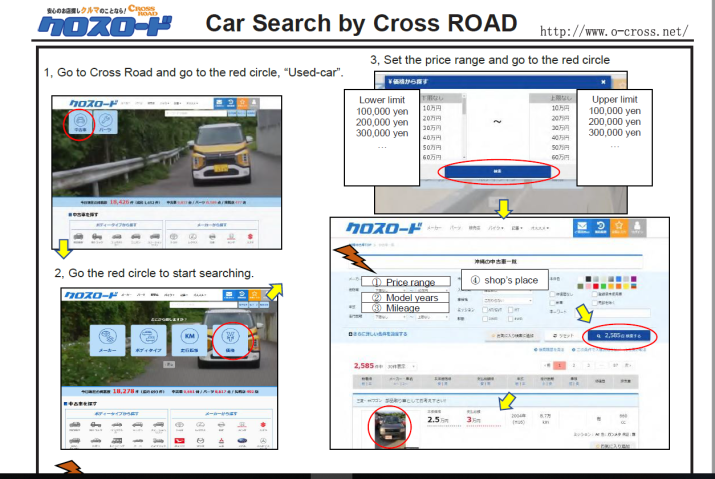
Cross Road is an online platform that advertises the cars sold by car dealerships on the island. Please use google translate and see the instruction below to find the cars you like. In case you want to inquire about the dealerships about the cars you are interested in, visit the Resource Center with a list of the cars you are interested in so we can help you to make inquiries to the dealerships over the phone.
TIDA Marketplace is a webpage where OIST people advertise things they want to sell or buy. If you arrive in Okinawa at the right time, you may be able to find cars sold by other OISTers for a reasonable price. If you are interested in buying a car you have found on TIDA Marketplace; please contact the seller directly.
Average prices for second-hand cars
The price may vary depending on which year the car was made, the condition, and the mileage.
Kei car (660 cc engine) Yellow license plate
Suzuki Wagon R: ¥200,000 to ¥700,000
Daihatsu Move: ¥200,000 to ¥700,000
Small car (around 1.3 to 1.8 Liters)
Toyota Vitz: ¥300,000 to ¥800,000
Toyota Corolla: ¥300,000 to ¥800,000
Regular (around 2 Liters)
Nissan Skyline ¥500,000 to ¥800,000
Honda Step Wagon ¥400,000 to ¥1,000,000
What to do with the car when leaving Okinawa/Japan?
Option1: Sell it to a dealership
However, you cannot expect it to be sold for good price unless your car is relatively new, in great conditions, and there is an increasing need for the model, etc.. Below are the steps:
1. Contact a dealership to evaluate the car (Resource Center can arrange this)
2. Give the to the dealership and get money
Option2: Sell it on TIDA Marketplace
Before selling it to another person at OIST, we recommend you do the below: Have the car evaluated at a garage: Take the car to a garage and have it inspected and evaluated to see if it is worth buying. Get a voluntary insurance estimate: Compulsory insurance only covers minimum cost in case of an accident. There is a high chance that you end up paying a big amount of money for the excess if you don't have a voluntary insurance. Consult with an insurance company to get an estimate for voluntary insurance premiums. Ensure to transfer the title properly: Make sure the car title is reliably transferred to you before the previous owner leaves Okinawa. If this is not carried out, you will be in trouble when scrapping/selling the car when you leave Okinawa. Confirm responsibility for road tax payment with the current owner: Clearly confirm with the previous owner who will be responsible for the payment of the automobile tax (road tax).
Option3: Junk it through a junkyard
If the car doesn't seem to sell, you can junk it through a junkyard. By doing so, you might get some money for the below:
1. for some parts to be recycled
2. remainder of the road tax you paid (for white-plate cars)