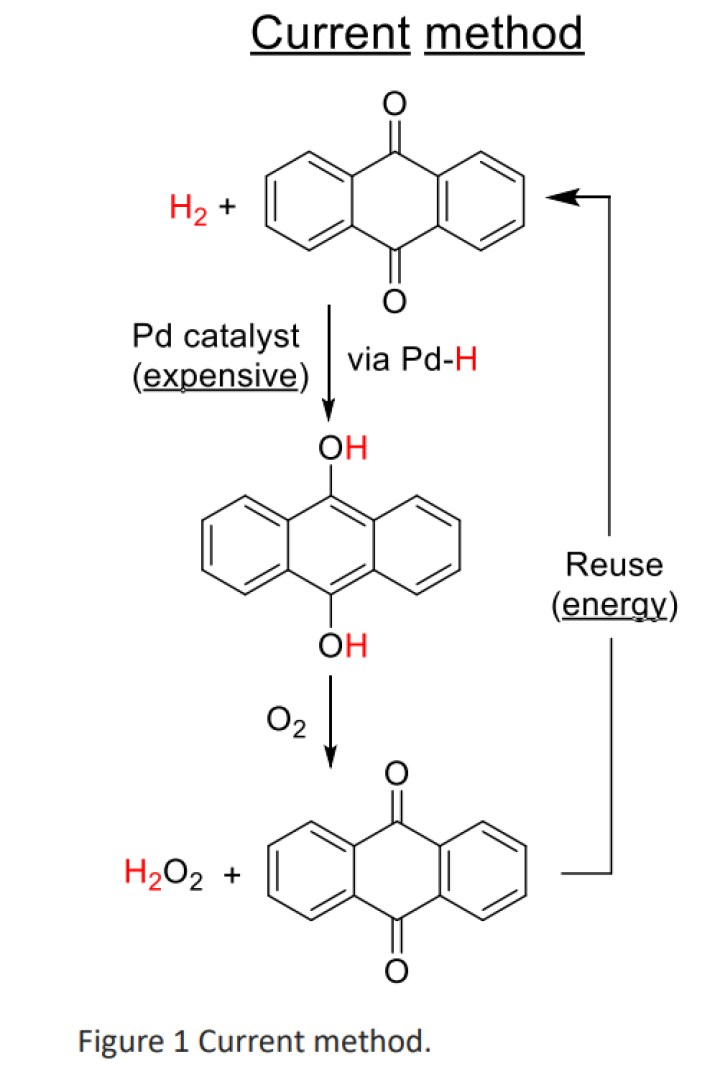
Hydrogen peroxide (H₂O₂) is an important chemical used for the bleaching of paper, preparation of chemicals, water treatment, and disinfection. Currently, H₂O₂ is almost exclusively produced by the anthraquinone process (Figure 1) that uses a large amount of organic chemicals and palladium catalysts to produce this very simple molecule. As a result, H₂O₂ is ranked as one of the top 10 most energy-intensive chemicals in the United States, and the production is only economically feasible at centralized large scale production sites.
One of the simplest ways to synthesize H₂O₂ is the reaction of H₂ and O₂ using a catalyst. Currently, palladium (Pd) is the most active catalyst in this reaction. Combination of this process and electrolysis of water will enable onsite production of H₂O₂ for water treatment at remote locations. However, the price of Pd catalysts is one of the burdens of this process.
Figure 1. Current method.
Solution
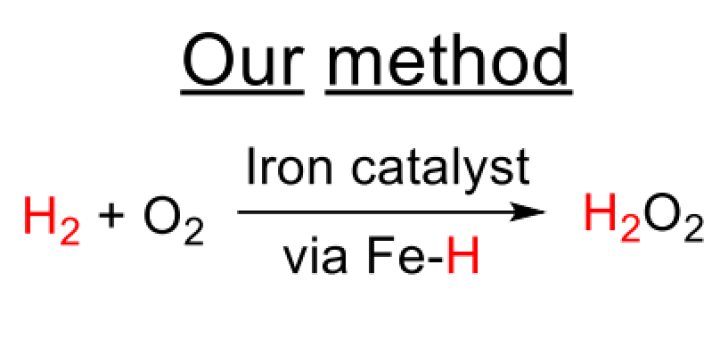
In this project, we will develop simple and cheap organometallic iron (Fe) catalysts to synthesize H2O2 from O2 and H2 (Figure 2). Iron is the most abundant transition metals in the Earth's crust, and used in important industrial processes such as Haber–Bosch process and Fischer–Tropsch process; however its use in the formation of H2O2 is unknown.
We are aiming to synthesize iron catalysts that can react with H2 and form Fe-H species. By tuning properties of iron catalyst, we will generate Fe-H species that have similar reactivity as the key Pd-H species and transfer two H from H2 to O2 to form H2O2. Our preliminary experiments showed that our iron catalyst can generate this type of Fe-H! Now, we are developing a process to form H2O2 from H2 and O2 using this catalyst.