Accelerating Human Cardiac Regeneration with UD Proteomics-guided Stem Cell Programming
Problem
Heart failure is one of the most widespread life-threatening and chronic illnesses, affecting millions of people globally.
Stem cell therapies for heart failure are emerging as a promising strategy because they may address obstacles in heart transplantation, such as complications from anti-rejection treatments and the limited availability of donor organs. However, there remain challenges in using stem cell-derived cardiomyocytes for regenerative medicine: 1) differentiated cells often lack sufficient health and maturity and 2) the differentiation process is slow, often taking weeks.
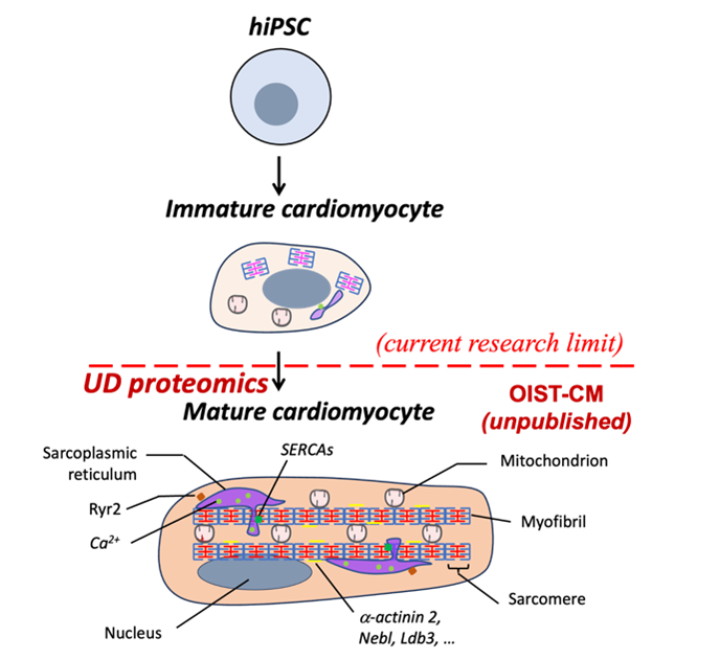
Therefore, our goal is to discover/develop the world's most efficient and rapid protocol capable of programming human stem cells into matured cardiomyocytes (CM).
Figure 1. We exploited the UD proteomics information to identify and test combinations of TFs which strongly enhance CM maturation compared to commercially available differentiation kits.
Solution
In this project we are optimizing the CM differentiation process by thoroughly studying cells with our deep ‘Ultra-definition’ (UD) proteomics workflow (Taoufiq Z et al PNAS 2020). We use proteomics instead of genomics and transcriptomics approaches because there are usually moderate and weak correlations between RNAs and proteins levels and half-lives respectively.
Moreover, we biochemically purify subcellular compartments, such as nuclei and cell membranes, to increase specific proteome detection depth, which is not accessible by traditional proteomic techniques. We mainly focus on the identification of key CM-transcription factors’ (TF) combinations and CM surface receptors to create new cell culture recipes and potent differentiation paths. Using this strategy, we have recently sped up CM differentiation from iPS cells to 5 days, which reach maturation at day 10.
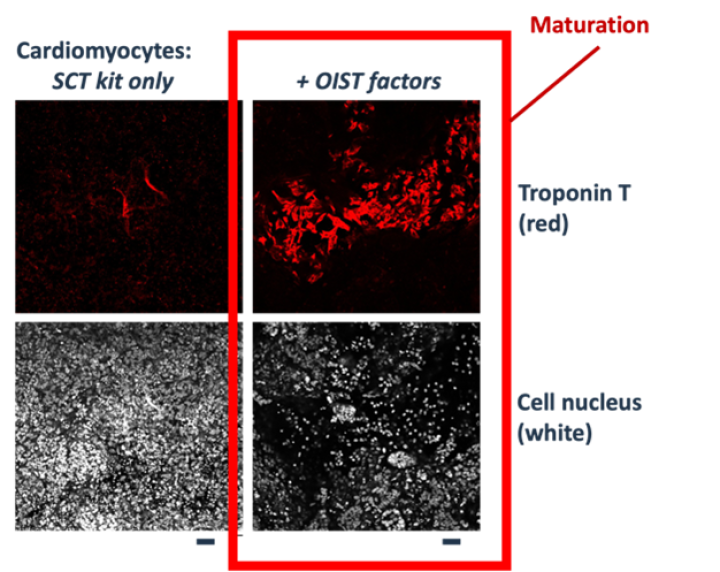
Figure 2. Immunofluorescence analysis of differentiated CM at day 10 using CM maturity marker Troponin T. It is expressed at high levels in CM that were differentiated with "OIST factors" compared to CM with Stem Cell Technologies kit. Scale bar = 50 um.