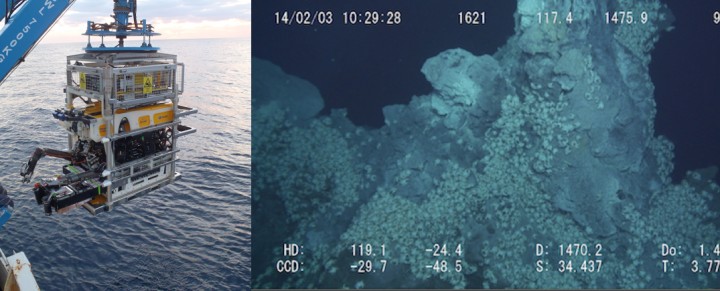
Far below the oceans surface where tectonic activity forces hot magma toward the earth's surface, seawater is superheated below the seabed and released as a hydrothermal vent. Unique ecosystems form around these hydrothermal vents. Ecosystems that survive independent of sunlight but instead rely on the chemicals released from the earths surface. Hydrothermal vents are a perfect case study for answering questions in island biogeography, endemism, genetic connectivity and many other subjects owed to their isolated environment.
The chemosynthetic species characteristic of hydrothermal vents spend their adult life within a small home range, constrained by the availability of their chemical energy source. Many benthic vent species exhibit a planktonic larval stage. These planktonic larvae may be able to travel great distances in order to colonise other hydrothermal vents. Genetic evidence showing the close relatedness between distant vent populations supports the theory that certain species are able to colonise distant vents while others remain endemic to single vents.
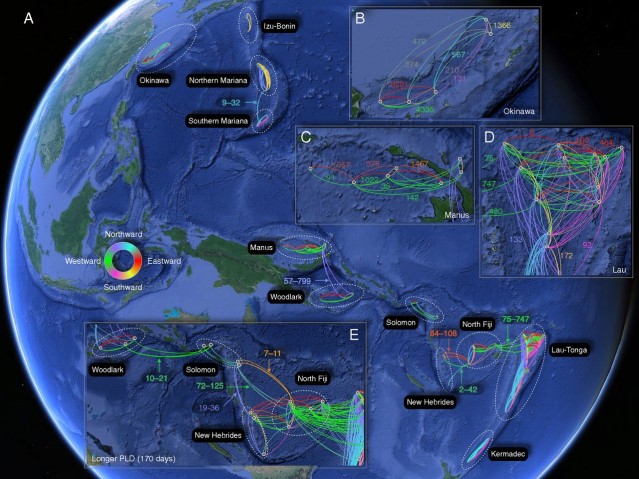
As an inhospitable and almost inaccessible habitat, direct observations of hydrothermal vent species are lacking. By incorporating up-to-date biological parameters into models of ocean circulation we have been able to predict the potential dispersal distance of vent species larvae in a quantitative manor.
Dispersal Modeling
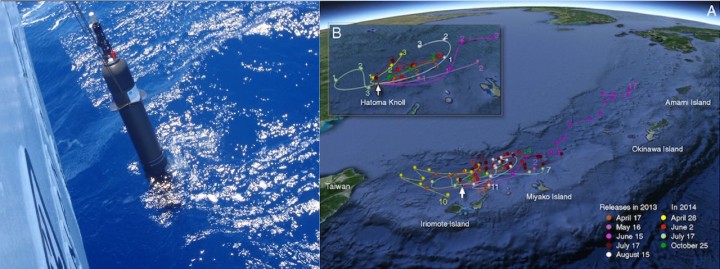
Lagrangian measurements of currents are obtained by deploying OPTIMARE NEMO-Floats in the vicinity of hydrothermal vents. These floats would autonomously travel at a specific depth and regularly return to the surface in order to transmit ocean current data via satellite.
In a simulation, model floats were also released at the same location. These model floats were passively transported by simulated currents that were created with the Regional Ocean Modeling System (ROMS). Using this oceanographic data with a Lagrangian probability density function modeling procedure, it is possible to determine the probability that larvae from a given site are transported to another site.
By collecting specimens from the hydrothermal vents themselves it is possible to employ genetic techniques to study population connectivity between vent sites. Using next-generation sequencing we can isolate polymorphic microsatellite loci. These the microsatellite markers will be useful for further population genetic studies to elucidate genetic diversity, differentiation, classification, and evolutionary processes. The extent to which separate populations of a single species share genetic characteristics can be indicative of how connected these populations are. Genetic tools can be a great compliment to modelling methods as they can be used to ground-truth predictions and assess historical connectivity.