



18 September 2026
The man sending cameras to Mars

Original article published in Asahi Shimbun Globe+, available here (Japanese).
Ever looked up to the night sky on a clear night, and seen the shimmering, iridescent beauty of an aurora? These natural light displays are prized by photographers worldwide. Japanese scientist, Dr Ryuho Kataoka, has plans to take particularly unique aurora photos — by sending cameras to Mars.
Becoming an aurora expert
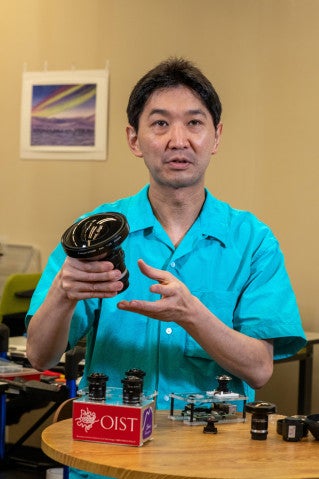
Today Kataoka is a renowned aurora and space weather expert, leading space physics research at the Okinawa Institute of Science and Technology (OIST). But it wasn’t until relatively late in his career that the scientist first saw an aurora with his own eyes. “I was trying to decide what to research when I was a third-year undergraduate student,” he says. “Although I’d only seen auroras on TV or in photographs, I decided to specialize in this field so that I might one day get the chance to see an aurora for myself.” He eventually saw his first aurora during a conference in Alaska, where it made him feel wondrously small, in his words, “like we are just tiny animals on a planet traveling through the vastness of space”.
Since then, Kataoka has spent over two decades researching auroras and related space weather phenomena, with the aims of understanding the physics of these light shows and improving the safety of air and space travel.
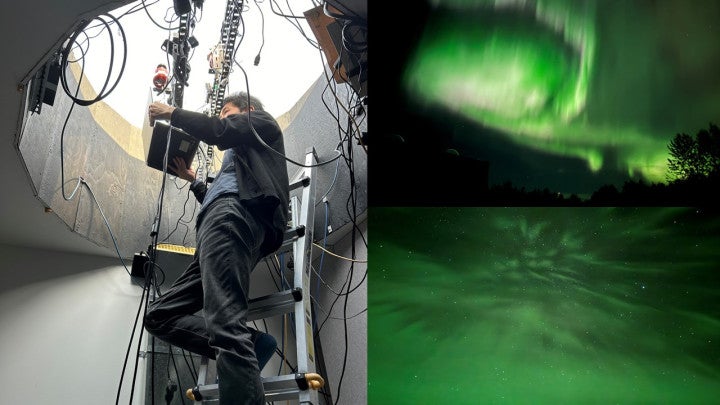
“If we can understand the scientific foundations of space weather and when events are likely to occur, we can design air and space travel around these predictions,” says Kataoka. “One of my first projects was building a tool to predict radiation risks for airplane passengers at different locations and altitudes based on space weather data. And I’m interested in how we can protect astronauts better too.”
What is an aurora?
Auroras appear at times of high-speed solar wind, when stars such as our Sun emit streams of high temperature charged particles. These interact with the Earth’s magnetic field, generating huge electric current, concentrating the electric current in polar regions where they collide with atmospheric gases such as oxygen and nitrogen. On collision, the gases are excited and light is emitted, forming the characteristic glowing auroras that Kataoka studies.
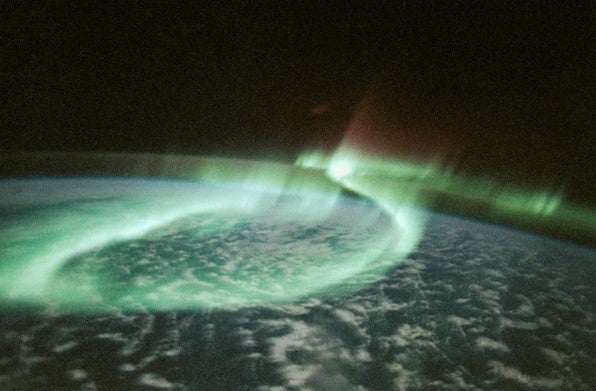
Auroras can be different colors depending on the gases present in the atmosphere. On Earth, oxygen is abundant, and causes green, or at higher altitude, red emissions. Nitrogen causes blue or purple light. Carbon dioxide also causes blueish light, of a slightly different color and wavelength.
“Auroras are an important visual indicator of solar activity,” highlights Kataoka. “Strong solar activity can affect health for those with higher exposure levels, like astronauts, and can also disrupt satellite communication, GPS technologies and power grids. That’s why it’s important to research space weather and build better predictions for solar events.”
Kataoka and his colleagues use a variety of techniques to study and date such weather events, including reading the 800-year-old diaries of a Medieval Japanese poet who wrote about the auroras they saw. By dating solar events with historical literature and carbon-14 measurements, scientists can understand the trends and likely frequency of particular events and refine their space weather models.
Understanding the Martian auroras
Even the keenest amateur photographer might struggle with Kataoka’s latest challenge—photographing auroras that are 140 million miles away.
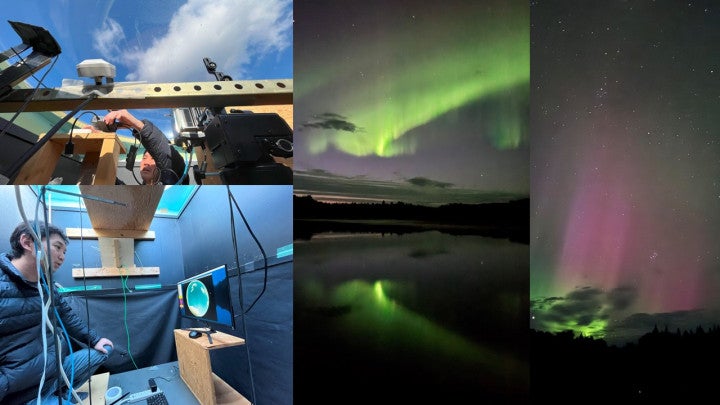
His team are part of a large, multi-institute project, funded by JAXA (the Japan Aerospace Exploration Agency) to design and build environmental sensors such as specialized imagers for use in space ahead of their future Mars missions. This may seem a long time away, but to design, program, build and thoroughly test all the devices is no small task. “We only get one shot at this,” says Kataoka. “I can’t exactly go and fix the camera if it breaks!”
So, why study Mars auroras? Until recently, scientists didn’t think the Red Planet could host auroras, given its weak magnetosphere — the region of space around the planet where charged particles can interact with its magnetic field. But three different types of auroras are thought to be able to fleetingly form. Kataoka’s cameras will capture key data to help understand these interesting phenomena and improve space weather prediction.
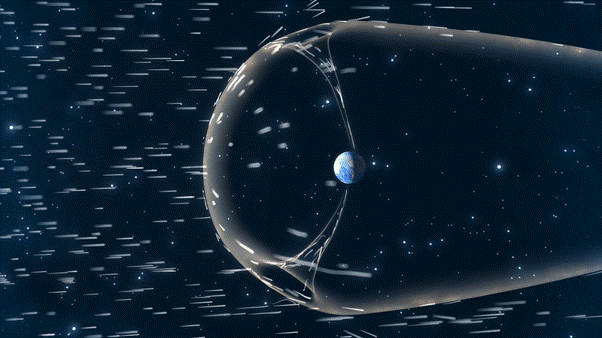
In order to do this, the cameras must be energy efficient, light enough and small enough to fit on the probes destined for the Martian surface. They’ll need to keep functioning within the extremely cold surface environment and be able to detect light emissions very different from Earth auroras, due to the compositional differences between the planets’ atmospheres.
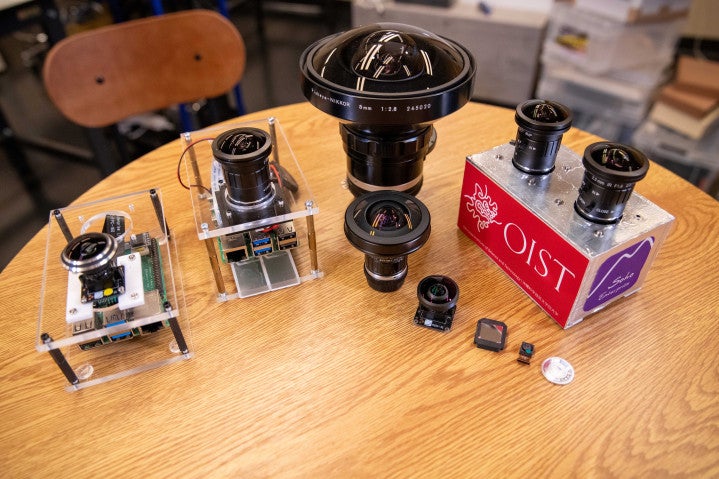
“Mars has a lot more CO2 in the atmosphere, so we expect to see blue light emissions in this range,” notes Kataoka. He’s designed special filters to target these wavelengths and is also developing AI processing software to enable these tiny cameras to make decisions on-site.
How Citizen Science is shaping aurora research on Earth
Of course, not everyone is able to send cameras into space. But you can still play your part in aurora research. Here in Japan, Hokkaido is one of the best regions for seeing auroras. By taking your own photos of the night sky, you can act as citizen scientists and help researchers to understand these beautiful phenomena.
For many years, Kataoka has analyzed space weather data in real time, sharing on social media when he predicts good auroras might be seen.
“People started taking my predictions seriously,” he says. “One keen photographer even booked a same-day trip from Tokyo to Hokkaido based on my social posts!”
As more and more people shared their aurora images online, Kataoka realized a wealth of useful data was amassing. In 2024, he created#オーロラシチズン (#AuroraCitizen in English), a hashtag which racked up millions of views and over 1,000 aurora photos. He’s now got an online form to collect valuable information and photos from enthusiastic citizen scientists. By analyzing public contributions, Kataoka and colleagues have authored several scientific papers reporting unusual emission heights and other important aurora characteristics. The papers acknowledge hundreds of citizen scientists who contributed photographs, listing their names in the acknowledgments section.
“I’m glad that there are so many people who see the beauty in auroras, and are interested in the scientific side too,” says Kataoka. “By joining together, we can get a much more thorough understanding of how our atmosphere and space work.”

Biography: Dr Ryuho Kataoka
After graduating from Tohoku University with a PhD in Science in 2004, Kataoka worked at many different institutes, including the National Institute of Information and Communications Technology, NASA's Goddard Space Flight Center, Nagoya University, RIKEN, the Institute of Science Tokyo and the National Institute of Polar Research. He now leads space physics research at the Okinawa Institute of Science and Technology. He has a passion for outreach, supporting many citizen science projects and has written several space weather-related books, such as his latest book “Scary Space: The Threat of Massive Solar Flares and Magnetic Storms”, published in June 2026. The book summarizes many of his activities, from space weather forecasting to literature surveying to his new Mars challenge. He also hosts two podcast channels "地球人ラジオ” and "OIST HUB RADIO." His X account has more than 42K followers.
Specialties
Submit a press inquiry


