



03 June 2026
Extreme adaptation helps Dead Sea single-celled organisms to swim

Living in the Dead Sea would be a very unpleasant experience for most creatures. With salt concentration above 30% and temperatures ranging from 10-50°C, it takes unique environmental adaptations to survive in such harsh conditions.
In a new Nature Communications study, researchers from the Okinawa Institute of Science and Technology (OIST) and the Institute of Protein Research of the Russian Academy of Sciences have described in detail a structural adaptation supporting one of the Dead Sea’s few hardy inhabitants — a single-celled archaea called Haloarcula marismortui (H. marismortui). Using single-particle cryo-electron microscopy (cryo-EM), the researchers characterize the proteins that form the archaeal filament, a long tail-like structure essential for movement.
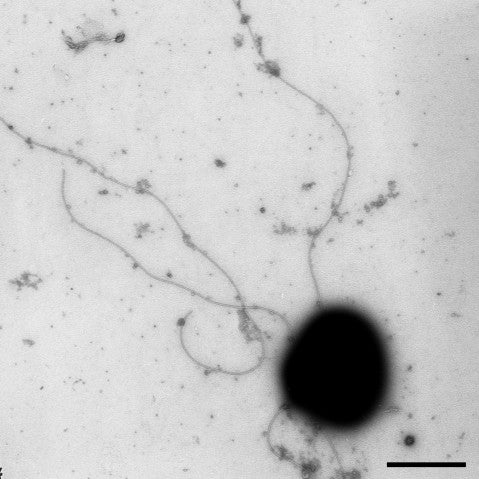
First author Dr. Vladimir Meshcheryakov of the Molecular Cryo-Electron Microscopy Unit at OIST explains the significance of their findings. “While we as humans might not notice as much difference swimming through higher salt concentrations, to a single-celled organism, mobility gets much more difficult as their environment is more viscous. These archaea have a unique outer sheath structure in their filaments, not previously found in any other archaea. We believe this is to stiffen and strengthen the filament, to help them swim better in viscous conditions.”
Co-author Professor Matthias Wolf adds, “Studying organisms like this which live under extreme conditions can give us insights into the unique environmental adaptations needed to support life in different contexts. For example, if one day we were to find life on other planets, it would likely be similar creatures to these archaea, with specific adaptations tailored for survival.”
Swimming through salty waters
To survive, most creatures need to stay mobile, generally moving away from threats and towards safety, food and friends. In archaea, this movement is powered by a large, helical protein structure called the archaeal filament, or archaellum, which rotates due to a membrane-anchored protein motor connecting it to the rest of the cell.
In H. marismortui, this filament is formed of one of two different types of subunits (ArlA2 or ArlB), depending on which genes are switched on to code for the proteins. “This variation can provide extra defense against antibodies or phages that might try to bind onto a specific site,” explains Wolf.
Such variation may also support environmental adaptation. The researchers discovered that although each of the two protein complexes share the same set of core components (a long polypeptide chain, an inner core and outer sheath), they display very different outer sheath structures.
“When the ArlB monomer units combine together, their D2 sections can flip orientation, which enables very strong interactions to form between monomers,” says Meshcheryakov. “This creates a strong, rigid outer sheath structure as needed for more powerful movement in saltier waters.”
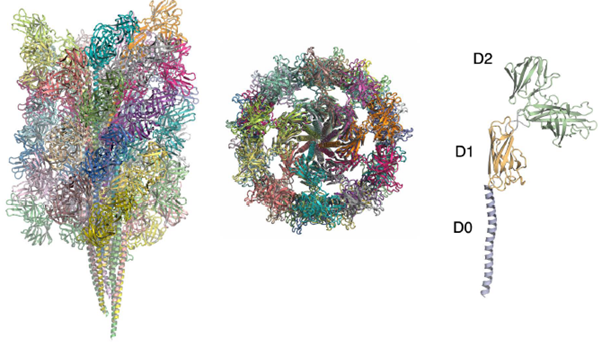
In contrast, ArlA2 filaments have much weaker interactions between each monomer’s D2 domains, and the researchers pin this down to environmental adaptation. ArlB proteins are adapted to suit much higher salt concentrations than ArlA2.
“ArlA2 functions in a wide range of temperatures and salinity (salt concentrations), while ArlB is adapted specifically for high salt and lower temperature conditions. That’s why most of the time we see ArlA2 in wild-type H. marismortui,” adds Meshcheryakov.
Converging solutions in evolution
Bacteria and archaea diverged from a common ancestor around 4 billion years ago. Most bacterial flagella (their archaeal filament equivalents) have an outer sheath structure. Yet, up until now, no other archaea had been characterized with this structure. The study presents the first example of convergent evolution in the filaments that power movement in these organisms.
Wolf comments, “These kinds of studies can help us unlock new insights into how life evolves and adapts. For example, over billions of years, both bacteria and archaea came up with similar, but ultimately molecularly, structurally different solutions to swim. With archaea being the ancestors of eukaryotic cells, like our mammalian cells, there’s a lot to learn by studying such organisms.”
Article Information
Research Unit
Submit a press inquiry


