Cyclic-1,3-Dione Derivatives Conjugated with Resins

Problem

Organic compounds including chemical reagents and pharmaceuticals are often decomposed and/or isomerized by acids or bases that are present as impurities. Samples that contain decomposed or isomerized products must be re-purified or discarded.

During the synthesis of pharmaceuticals or related compounds, undesired decompositions and isomerizations of starting materials and synthetic intermediates would reduce the yields of the final products and increase wastes. To prevent decompositions and isomerizations, pharmaceuticals and chemicals (such as starting materials, synthetic intermediates, and reagents) are often stored at low temperatures, which is impractical in many cases.

POC project (75 - Tanaka): figure 1

Solution

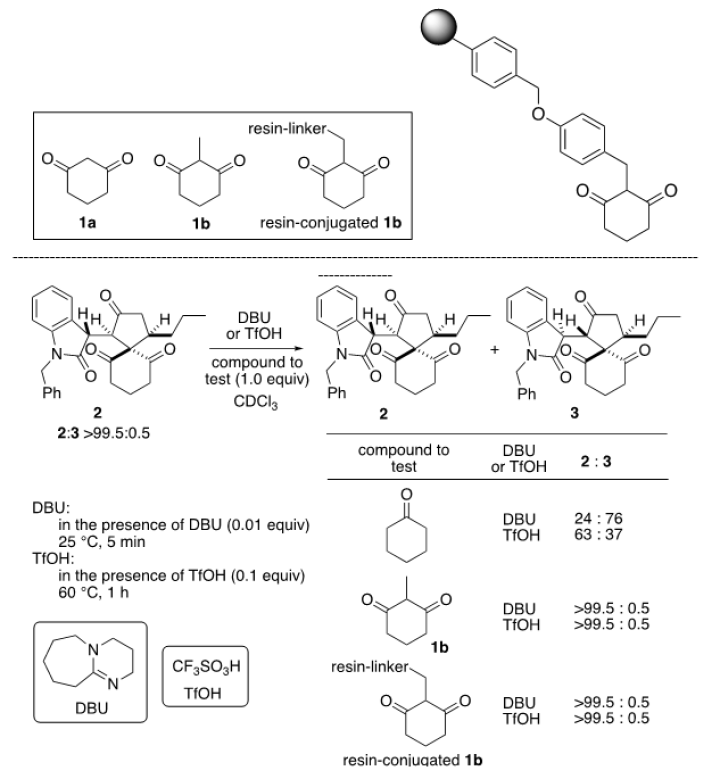
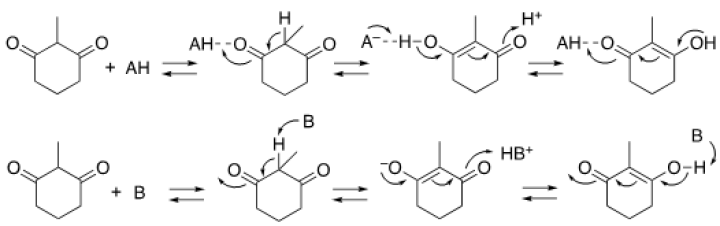
We have recently reported that addition of cyclic-1,3-dione derivatives (such as 1a and 1b) including the resin-conjugated derivative (resin-conjugated 1b) to solutions of compounds in organic solvents prevents base-caused and acid-caused decompositions and isomerizations of various organic compounds (Chem. Eur. J. 2020, 26, 222; WO/2021/075482). We use resin-conjugated cyclic-1,3-dione derivative (such as resinconjugated 1b) to suppress decompositions and isomerizations of compounds.

When a resin-conjugated cyclic-1,3-dione derivative is added to solutions of a compound of interest, it inhibits both acid-caused and base-caused decompositions and isomerizations. When a resin-conjugated cyclic-1,3-dione derivative is added to solutions of a compound of interest, the supernatant can be used. In addition, the resin-conjugated cyclic-1,3-dione derivatives can be removed by simple filtration when such requirement is present.

POC project (75 - Tanaka): figure 2