Rydberg Atom – Optical Nanofiber based Single Photon Emitter
Problem
Single-photon emitters (SPE) are a foundational component of quantum sensing, quantum communication, quantum repeaters, and photonic quantum circuits, where computation relies on the precise generation and manipulation of individual photons. Existing single-photon sources are often probabilistic, suffer from low efficiency, and produce photons with limited indistinguishability and a broad bandwidth. They also often require a cryogenic setup, making them unsuitable for large-scale systems.
Moreover, integration of the SPEs into larger systems remains a critical challenge. Many sources cannot be efficiently coupled into optical fibers or photonic chips, which are essential for building compact and scalable architectures. As a result, the broader quantum technology market faces a key bottleneck: no on-demand single-photon sources that can seamlessly integrate into photonic platforms and support technology transition from laboratory demonstrations to deployable quantum systems.
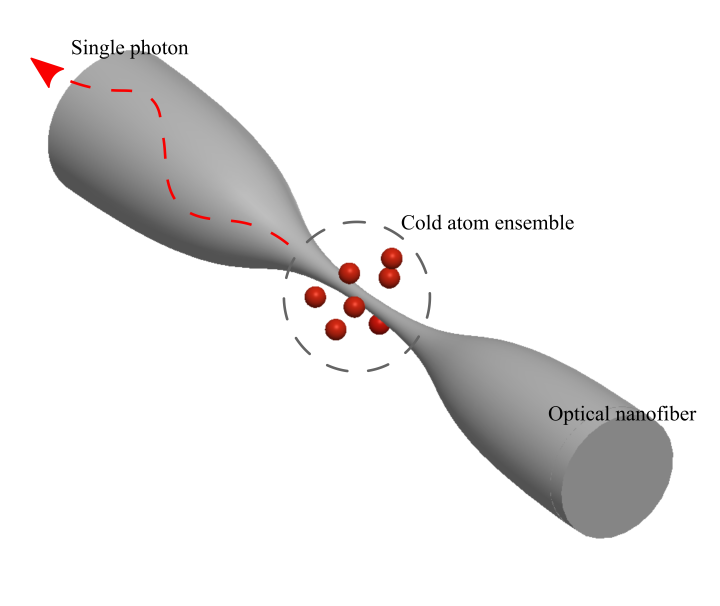
Figure 1. Schematic of the single-photon emission setup.
Solution
We are developing a miniaturized, fiber-integrated on-demand single-photon source based on cold atoms and an optical nanofiber. Our approach focuses on generating high-purity, indistinguishable photons with deterministic timing, while ensuring efficient coupling directly into an optical nanofiber, which is then coupled into a general optical fiber.
The integration of an optical nanofiber into the cold atomic system eliminates the need for complex free-space alignment, significantly improving the ease of operation and scalability. This architecture is compatible with existing fiber infrastructure and photonic chips, enabling straightforward integration into quantum communication links and photonic quantum circuits, reducing their price, cost of operation, and size — without the need for cryogenic cooling.
Figure 2. Image of the cold atomic cloud in a magneto-optical trap next to the optical nanofiber.