


22 October 2026
A New Effort Connecting Science and the Community

As part of the J-PEAKS program, the Okinawa Institute of Science and Technology (OIST) runs the Pilot Project for Addressing Community Challenges, an initiative that applies scientific expertise to help solve issues facing local communities. One of the current projects focuses on a persistent problem affecting sea grape cultivation in Onna Village: poor growth during the summer months.
How the Project Began
The project began with a casual conversation between an OIST administrative staff member and representatives of the Onna Village Fisheries Cooperative, with whom they regularly interacted through their work. During the conversation, the cooperative mentioned that sea grape harvests had been consistently poor during the summer season. Several months later, when OIST staff followed up on the issue, cooperative representatives explained that the problem remained unresolved and asked whether any researchers might be able to help. At the time, OIST had no formal mechanism for connecting community challenges with researchers. To address this gap, the initiative was launched as a pilot project under the J-PEAKS framework. After receiving advice on which research units might have relevant expertise, OIST invited researchers to participate, and three research units have since joined the project.
The project also aligns with the memorandum of understanding signed in June 2018 by Onna Village, the Onna Village Fisheries Cooperative, and OIST. The memorandum aims to promote collaboration through environmental conservation and restoration, the development of the Onna brand based on local resources, and the sharing of knowledge about regional assets such as marine life, coral reefs, and sea grapes.
The Community Challenge
Sea grapes are one of Onna Village’s signature marine products, and land-based cultivation techniques were originally established in the region. In recent years, however, serious growth problems have emerged, particularly during the summer. One symptom involves the appearance of net-like patterns on the grape-like vesicles of the seaweed, followed by tissue breakdown and dissolution. Another occurs after harvesting, when cut sections turn yellow and subsequently lose moisture, causing them to shrivel. Because these conditions render the product unmarketable, they pose a significant challenge for producers. The problem is especially serious because summer is also the peak tourist season, when demand for sea grapes is at its highest. Reduced production therefore affects not only growers but also the broader local economy. Similar problems have been reported elsewhere in Okinawa, meaning that identifying the causes and developing effective countermeasures could benefit across the prefecture.
A Collaborative Framework Across Industry, Government, and Academia
The project is being carried out through close collaboration with regional partners.
Partner Organizations
- Onna Village Fisheries Cooperative
- Okinawa Prefectural Fisheries Research and Extension Center
OIST Participants
- Researchers and interns from three research units
- Core facilities, including the Marine and Terrestrial Science Section, Sequencing Section, and Animal Resources Section
- The Provost Office
The project also makes use of OIST Sea neXus and OIST Land neXus, open-science and open-innovation facilities established through MEXT's Project for the Development of Facilities for Industry-Academia-Government Collaboration and Joint Research through the Cooperation of Regional Core and Distinctive Research Universities.
Activities and Progress to Date
In March 2025, project members met with stakeholders to discuss the project's background, objectives, and collaborative framework. They also visited sea grape cultivation facilities operated by the Onna Village Fisheries Cooperative.
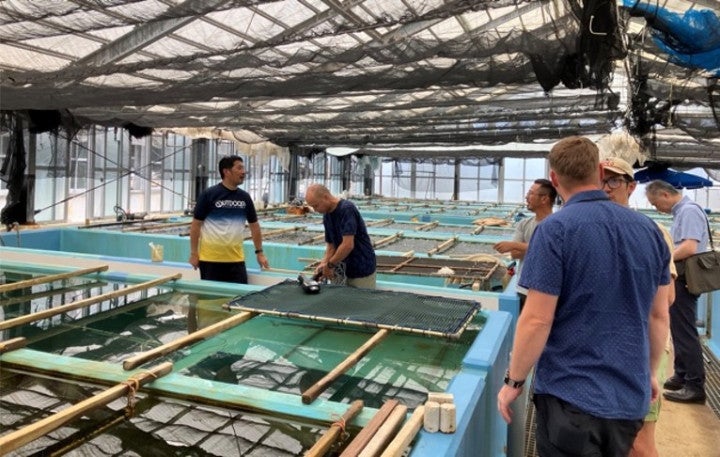
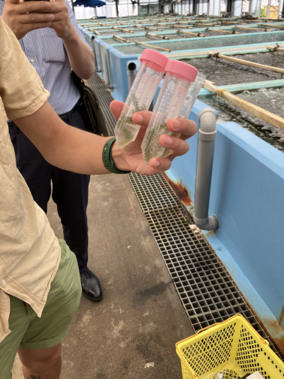
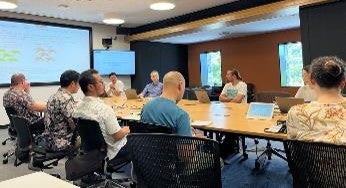
In June 2025, researchers confirmed the occurrence of the net-like patterning and tissue dissolution symptoms and began collecting environmental data from cultivation sites. In July, preliminary findings related to the yellowing phenomenon were shared with project partners. In August, stakeholders reviewed initial analyses of environmental factors such as water temperature and salinity. By November, initial sampling efforts focused on the net-pattern symptom had been completed, and plans for further analysis were presented. In January 2026, project members and stakeholders gathered for an exchange meeting. Participants also toured OIST Sea neXus and the OIST Marine Science Station and held further discussions on future collaboration. Sample analysis is ongoing.
Lessons Learned Through the Project
Approximately eighteen months into the project, several important insights have emerged regarding the role universities can play in addressing community challenges. First, many researchers feel a strong desire to give back to the local community that supports their research, including through the provision of research samples, and hope to contribute to solving local challenges through the power of science. At the same time, some researchers have found that local challenges can inspire new scientific questions and may even lead to publishable discoveries. However, efforts to address community issues do not always translate directly into high-impact academic outputs. Most participating researchers conduct project-related investigations and analyses alongside their primary research responsibilities. This is particularly important for early-career researchers, whose ability to secure research time and produce scholarly achievements is closely tied to career development within fixed-term appointments.
Toward a Sustainable Model for Community-University Collaboration
Beyond addressing the immediate problem of sea grape growth failure, this project seeks to establish a sustainable framework through which universities and local communities can work together to solve regional challenges. Balancing two important goals, contributing to local communities and advancing world-leading research, remains a significant challenge for research institutions. Determining how these objectives can be pursued simultaneously at an organizational level will be an important focus moving forward.
Building on the insights gained through this J-PEAKS pilot project, OIST aims to establish a new model of collaboration in which universities and local communities work together to create shared value in addressing regional challenges.


