Modern technological breakthroughs like lasers, MRI scanners, semiconductors, and quantum computers rest on the study of quantum mechanics. However, the field has predominantly focused on (sub)atomic phenomena far removed from our human senses.
Demonstrating quantum phenomena in objects massive enough to be meaningfully influenced by gravity has proven difficult, as large objects are significantly harder to isolate from environmental factors, such as heat and vibration, than nanoscopic particles are.
But now, researchers from the Okinawa Institute of Science and Technology (OIST) have successfully moved a levitating, centimeter-wide diamond using the force generated by electron spin alone, the first time a quantum effect has been observed directly manipulating an object subject to gravity.
Published today in Science Advances, their findings set a new baseline for studying the boundary between classical and quantum physics, heralding exciting forays into the fundamental nature of our universe as well as a new class of extremely accurate sensors for detecting dark matter, gravitational waves, and other exotic phenomena.
Professor Jason Twamley of the OIST Quantum Machines Unit explains: “There have been many efforts to test whether quantum mechanics holds for anything larger than a few tens of nanometers, so far without success. Now, we have observed a classical mechanical response to a quantum force on an object that is eight to nine orders of magnitude more massive than the current state-of-the-art spin-mechanical experiments.”
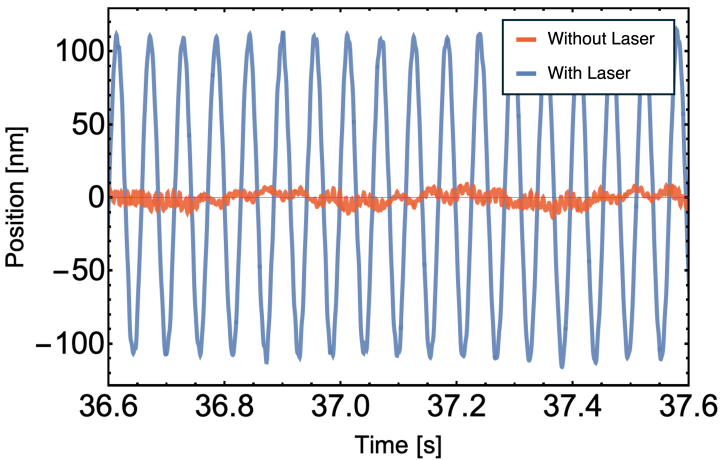
By shining a green, 50-milliwatt laser on a diamond with nitrogen-vacancy centers in pulses and measuring its movements with an interferometer, the researchers detected up-and-downward movements (blue line) driven by changes in spin force alone. These movements were much larger than those observed when the laser was off (orange line).
© Nayak et al., 2026
Unifying physics with magnets, an impure diamond, and a bit of graphite
Classical and quantum physics have long been divided over questions of scale. Gravity is central to the theory of general relativity in classical physics, yet its effects are extremely weak at the nanometer scale, where quantum phenomena have been observed. Conversely, positional superposition — the phenomenon in which a particle exists in distinctly different places simultaneously until measured — has only been experimentally demonstrated at the microscopic level.
“To test the quantum nature of gravity, we ultimately need to put objects with large enough masses into quantum superposition. And these objects need to be levitated in a vacuum to minimize the influence of environmental noise,” explains first author Anshuman Nayak, PhD student in the unit. “The typical approach has been to start with extremely small, levitated objects and gradually increase their mass until the effects of gravity become relevant. But levitating macroscale objects using conventional techniques, such as optical traps, has proven extremely challenging. That’s why we’re in the opposite camp — going from large to small. Just as diamagnetic levitation can lift maglev trains, it can also be used to levitate centimeter-wide objects holding diamonds, where the effect of gravity can be extremely strong, but quantum effects have not been observed.”
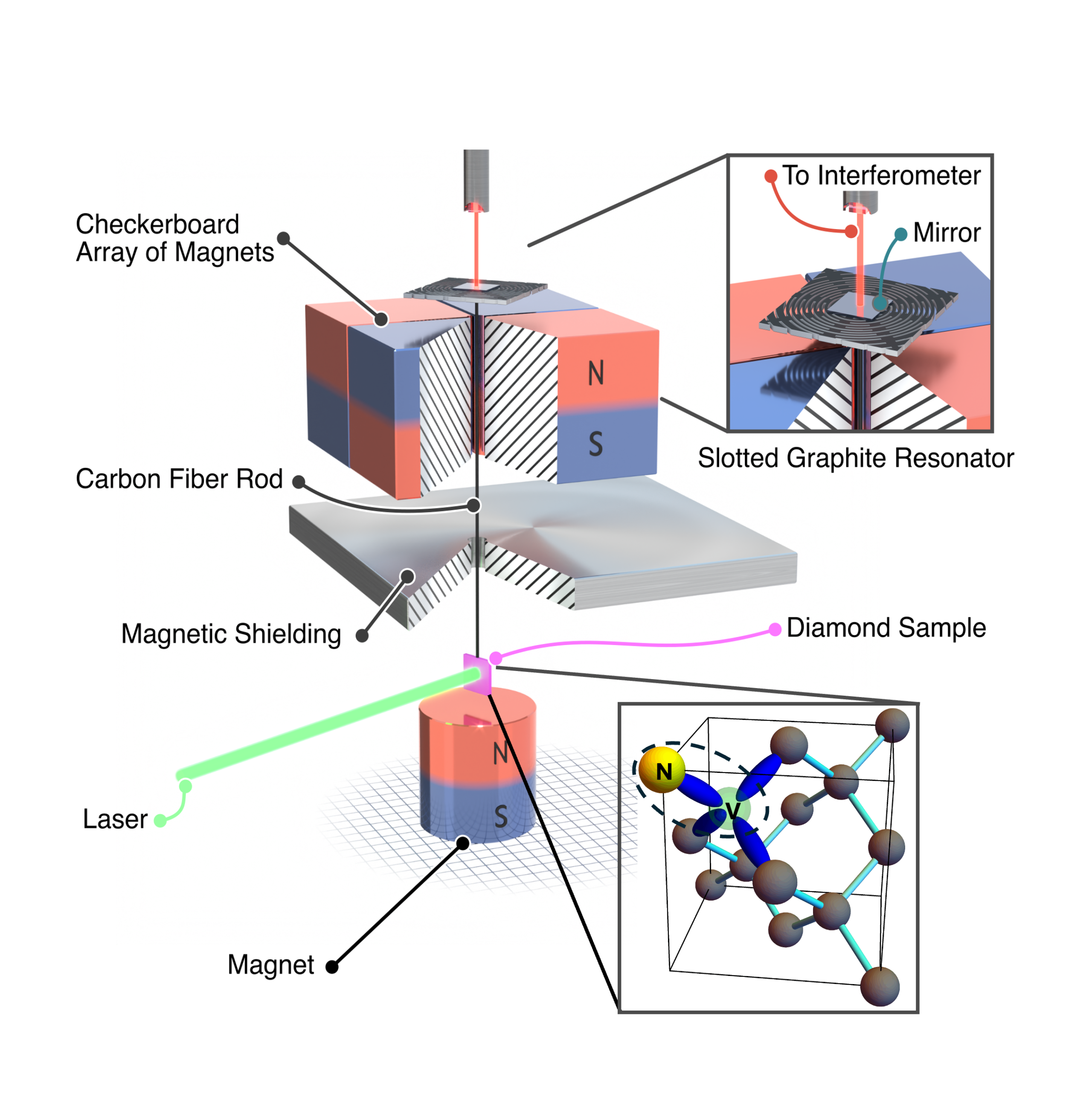
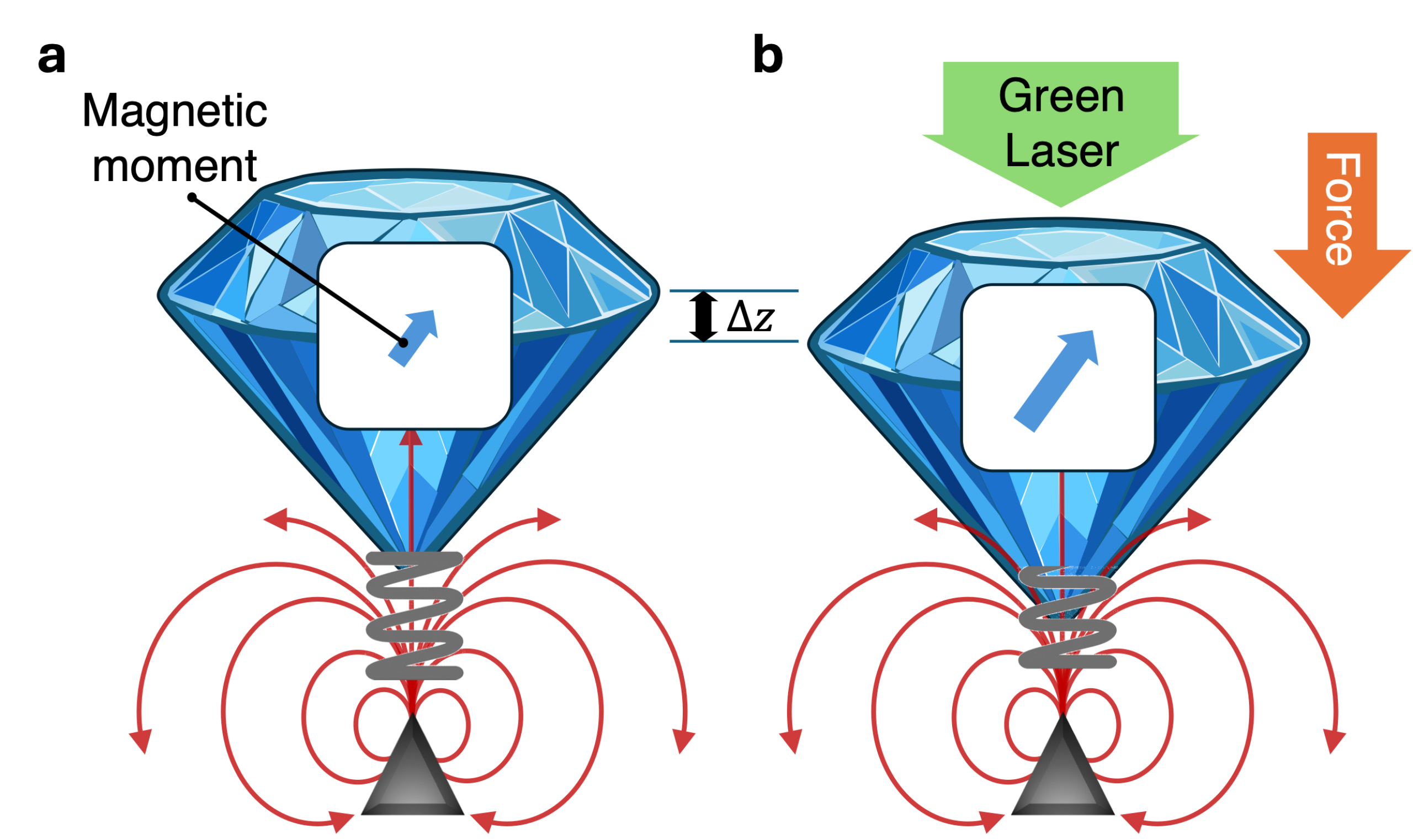
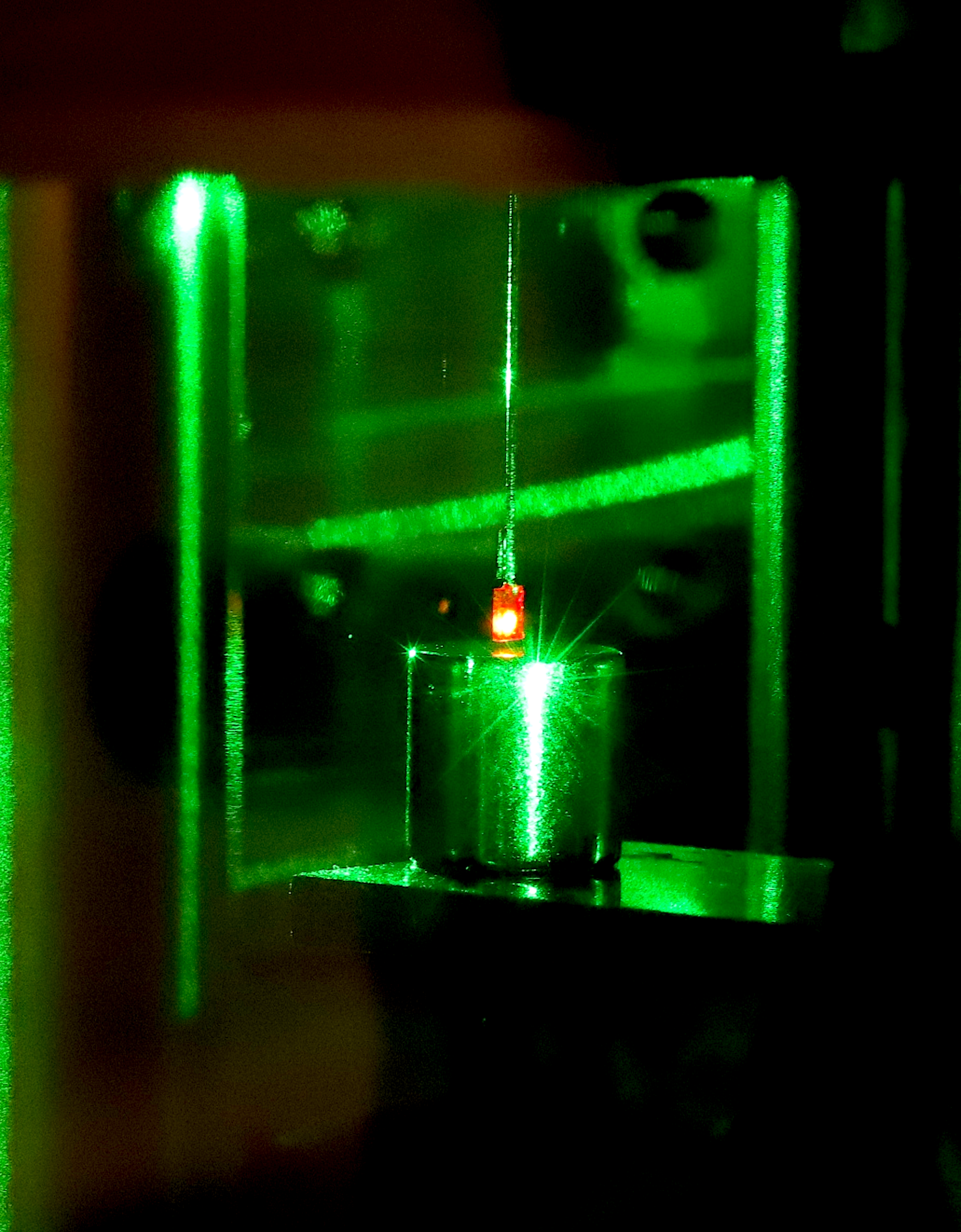
The key was to combine smaller, recently experimentally proven devices created by the same team: a diamagnetically levitated graphite plate fitted with a mirror, connected by a carbon fiber rod that passes through magnetic shielding to a diamond hanging above a magnet. This diamond has billions of so-called nitrogen-vacancy (NV) centers, which trap unpaired electrons and act as tiny, controllable quantum magnets via their quantum spin force. Periodically illuminating the diamond with a green laser polarizes these centers into a predefined spin state, generating tiny magnetic fluctuations that push the diamond down. The researchers tracked this motion using an interferometer that reflects a laser off the small mirror on the graphite plate to measure distance changes with picometer precision.
"NV diamonds are well understood and easy to control. That, and the fact that NV centers have some of the longest known coherence times, allowing them to maintain quantum superposition at room temperature much longer than other systems, makes them particularly attractive for generating macroscopic superposition of the motion or object in future research," adds co-author Daehee Kim, PhD student in the unit.