


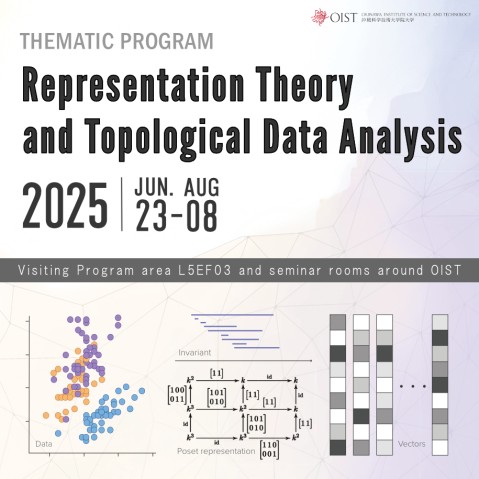
We are excited to announce the TSVP Thematic Program "TDA PARTI - Topological Data Analysis, Persistence And Representation Theory Intertwined". The program will run from June 23 to August 9, 2025. Here is an Overview of the program.
A symposium connected to the program will be held from July 22-26, 2025.
Title: TDA PARTI - Topological Data Analysis, Persistence And Representation Theory Intertwined
Theme of the program: Topological Data Analysis (TDA), and its mathematical foundation called persistence theory, studies the homology of families of sublevel-sets of functions valued in R^n (viewed as the product of n copies of the real line, equipped with the product order). Such objects are modeled as persistence modules, i.e., representations of the poset R^n in the category of vector spaces. The case n=1 is by now well-understood, with a large body of existing work on the structure and stability of persistence modules, on the efficient computation of their invariants called barcodes, and on their applications to a wide range of topics in data sciences. As is well-known in Representation Theory (RT), as n increases, the posets soon become of wild representation type, so classifying their indecomposables is virtually impossible. Hence there is a crucial need in TDA for new algebraic invariants for representations of R^n, that are as refined as possible, stable under perturbations of their originating functions, and easily computable.
The recent years have witnessed the beginning of a fruitful collaboration between researchers in TDA and in RT, with several seminal scientific contributions. Meanwhile, interest for collaboration has been ramping up in both communities, with for instance a very successful recent Banff workshop and an ISM summer school. The goal of our program is to help this collaboration between our two communities gain momentum. The current trends in TDA explore questions such as: the differentiability of the invariants, with applications in deep learning; the resolution of inverse problems, with applications in explainable AI; the use of persistence modules in other areas of pure and applied mathematics, such as symplectic topology, complex analysis, or statistical inference; and, most importantly, the extension of the algebraic foundations of the field to the case n>1. As shown in recent years, RT provides a rigorous mathematical framework and fresh impetus to the study of many challenging problems coming from TDA, including the above-mentioned directions of research.
Program coordinators
Sira Gratz (Aarhus University, Denmark)
Kaveh Mousavand (OIST, Japan)
Steve Oudot (Inria, France)
Tentative Schedule
- Week 1 (June 23-27): Expository lectures and Discussion sessions.
Expository talk by Prof. Hugh Thomas (June 24, at 10:00)
Expository talk by Prof. Thomas Brüstle (June 27, at 10:00) - Week 2 (June 30-July 4): Introductory mini-courses on Topological Data Analysis (TDA), Expository talk, and Discussion sessions.
Minicourses on TDA, by Dr. Emerson Escolar & Dr. Luis Scoccola (June 30-July 4, between 9:30-12:00)
Expository talk by Prof. Hideto Asashiba (July 2, 2025, at 14:00) - Week 3 (July 7-11): Introductory mini-courses on Representation Theory (RT), Expository talk, and Discussion sessions.
Minicourses on RT, by Dr. Baptiste Rognerud & Dr. Shijie Zhu (July 7-11, between 9:30-12:00)
Expository talk by Prof. Gordana Todorov (July 9, at 14:00) - Week 4 (July 14-18): Colloquium talk, Expository lectures, Seminar talks, and Discussion sessions.
2 Expository talks by Dr. Raphael Bennett-Tennenhaus (July 14, at 14:00 & July 15, at 11:00).
Colloquium talk by Prof. Ezra Miller (July 16, at 15:00)
2 Expository talks by Prof. Francois Petit (July 17, at 10:00 & July 18, at 10:00). - Week 5 (July 21-25): A symposium (between July 22-25), including talks and a discussion session.
Symposium on "Representation Theory and Topological Data Analysis: Latest Advances" - Week 6 (July 28-August 1): Introductory mini-course on the interactions between TDA and Machine Learning, Colloquium talk, Expository talks.
Colloquium Talk by Prof. Osamu Iyama (July 28, at 15:00)
Minicourse/Tutorials on TDA for Machine Learning, by David Loiseaux (July 30-August 1)
Expository Talk by Prof. Michael Lesnick (July 30, at 14:00)
Expository Talk by Prof. Ulrich Bauer (August 1, at 14:00) - Week 7 (August 4-8): Colloquium talk, Expository lectures, Outreach activities and Discussion sessions.
Expository talk by Prof. Sergio Estrada (August 4, at 10:30)
Colloquium talk by Prof. Yasuaki Hiraoka (August 6, at 15:00)
Expository talk by Prof. Greg Stevenson (August 7, at 10:30)
Expository talk by Prof. Dolors Herbera (August 8, at 10:00)
VIDEO RECORDINGS
Recordings of talks, minicourses, and symposium sessions from the TP25TD are available below.
https://vimeo.com/showcase/12305450?share=copy&fl=sm&fe=fs
Registration (for the symposium)
Registration has been closed.