Ray Sallan, DDS

I study vertebrate teeth and jaws from comparative and evolutionary perspectives, with interests in tooth morphology, dental diversity, jaw evolution, and tooth replacement systems across living and extinct vertebrates. I am particularly interested in whether the evolution of teeth and jaws is interconnected, and how different vertebrate groups have evolved distinct dental systems in response to functional and ecological pressures.

My current work at Okinawa Institute of Science and Technology uses fishes as model systems for studying vertebrate dentitions and tooth renewal. This work combines observational, comparative, and anatomy-based approaches to better understand how vertebrate dental systems function and evolve.

Before joining OIST, I practiced clinical dentistry from 2007–2022. I earned my DDS from New York University College of Dentistry and completed an Advanced Education in General Dentistry residency at Nova Southeastern University. My clinical background continues to influence my perspective on tooth structure, function, and comparative anatomy, and I incorporate techniques and concepts from human dentistry into my current research approaches.
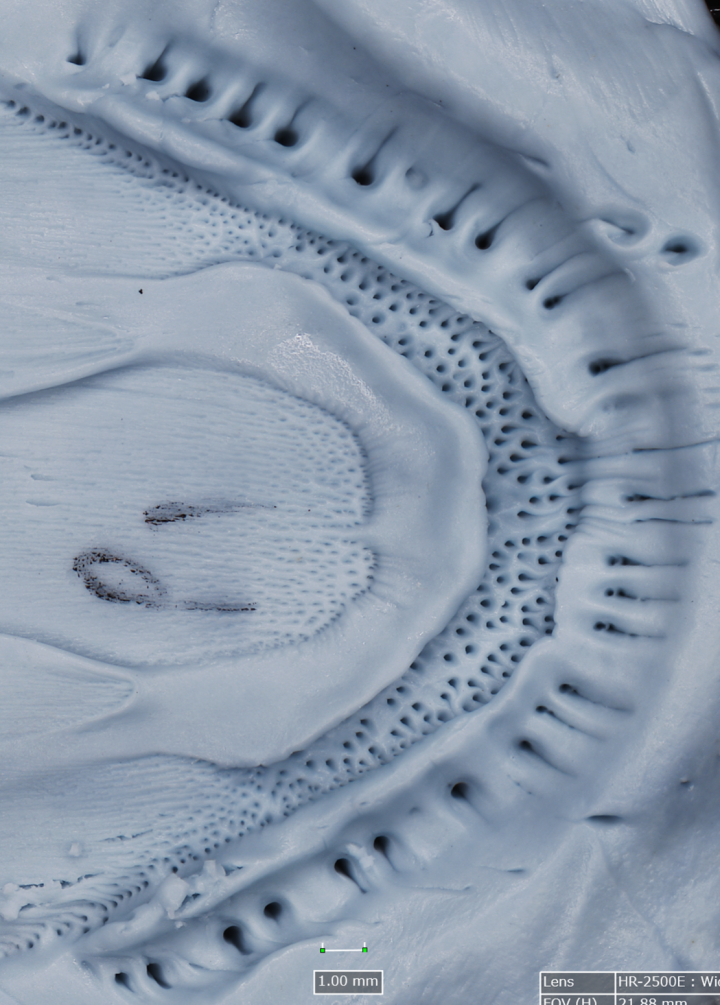
Impression of fish teeth

Current Research

I study life-long tooth replacement (polyphyodonty), the ancestral vertebrate condition retained in most vertebrate lineages outside of mammals. Despite its widespread occurrence, we still know surprisingly little about how quickly teeth are replaced in most vertebrates, how much replacement rates vary among individuals and species, or how these systems respond to long-term functional demands. Much of our current understanding is based on preserved specimens, which provide only static snapshots of what is fundamentally a dynamic biological process.

My research examines tooth replacement through time using longitudinal, in vivo data from fishes. I work with ecologically similar but evolutionarily distant taxa to better understand how replacement patterns vary across vertebrate lineages and to move beyond single-time-point interpretations of vertebrate dentitions. By following dental changes within individuals over extended periods, my work aims to establish baseline replacement patterns while identifying biologically meaningful sources of variation.

This research is part of a long-term, multi-phase project designed to examine dental systems under biologically realistic conditions over extended timescales. The current phase expands upon earlier baseline observations and explores how sustained functional demands may influence replacement dynamics through time.

More broadly, my work sits at the intersection of functional morphology, vertebrate evolution, and comparative anatomy, with the goal of developing more dynamic frameworks for interpreting dental systems in both living and fossil vertebrates. My background in clinical dentistry also informs aspects of my research approach, including the adaptation of concepts and techniques derived from human dental practice.

Publications:

Wibisana, J.N., Sallan, R.A., Ota, T., Puchenkov, P., Kubo, T. and Sallan, L. (2024), Modifiable Clinical Dental Impression Methods to Obtain Whole-Mouth and Detailed Dental Traits From Vertebrates. Journal of Morphology, 286: e70017. https://doi.org/10.1002/jmor.70017

Kubo, T., Wibisana, J. N., Sallan, R. A., and Sallan, L.
Feeding experiments with Polypterus senegalus reveal diet-related tooth damage and dental microwear.
(In revision)