Ray Sallan, DDS

My primary interest is to understand the evolution of teeth but not only from the viewpoint of basic, natural science but also in terms of unlocking potential medical applications. In my previous work as a dental professional, I have focused exclusively on the diagnostic, surgical, and clinical treatment aspects of my profession. Joining OIST as a Science and Technology Associate in the spring of 2023 positioned me to explore scientific questions that I have accumulated throughout my career, leveraging my experience as a clinician, surgeon, and biologist to investigate topics such as natural tooth replacement and jaw and tooth coevolution.

I earned a Doctor of Dental Surgery degree (DDS) from New York University College of Dentistry (2002-2006). My graduate school focus was to understand the epidemiology of oral disease from a public health perspective. This education provided an opportunity to study the effects of disease on populations and the importance of looking at entire groups versus individual patients. Following that, I completed an Advanced Education in General Dentistry (AEGD) residency at Nova Southeastern University (2006-2007) where I studied the surgical and bone biointegration aspects of restorative dentistry. From 2007 to 2022, I practiced in both corporate and private settings as a dental clinician. In 2023, I joined OIST as a Science and Technology Associate to pursue research full-time.


NHK footage

Current project

I study life-long tooth replacement (polyphyodonty), which is thought to represent the ancestral condition for vertebrates and is retained in most lineages outside of mammals. Despite this, we still know surprisingly little about how fast teeth are replaced in most vertebrates, how much those rates vary among individuals and species, or how external factors influence replacement dynamics. Much of what we think we know is based on preserved specimens, which capture only static snapshots of what is inherently a dynamic process.

My research focuses on examining tooth replacement through time using longitudinal, in vivo data from fishes. I work with ecologically similar but evolutionarily distinct taxa to better understand how replacement patterns vary across lineages, and to move beyond single-time-point interpretations of vertebrate dentitions. By following dental changes within individuals over extended periods, my work aims to clarify baseline replacement dynamics and identify sources of biologically meaningful variation.

This research is part of a multi-phase, long-term project. The study has moved beyond an initial phase centered on establishing baseline patterns and is currently in a subsequent phase that expands the temporal scope of the data. The longevity of the project allows me to examine whether tooth replacement rates remain stable over time or shift in response to sustained changes in feeding behavior, while maintaining a focus on biologically realistic conditions.

More broadly, my work sits at the intersection of functional morphology, development, and vertebrate evolution, with the goal of providing a more dynamic framework for interpreting dental systems in both living and fossil taxa.

Publications:

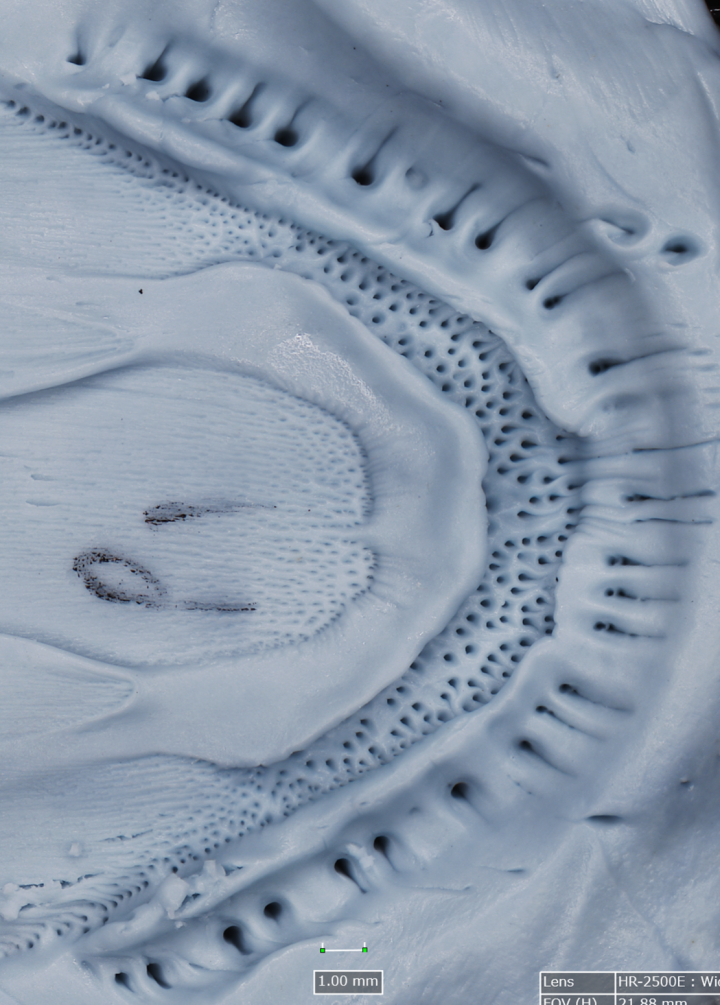
Wibisana, J.N., Sallan, R.A., Ota, T., Puchenkov, P., Kubo, T. and Sallan, L. (2024), Modifiable Clinical Dental Impression Methods to Obtain Whole-Mouth and Detailed Dental Traits From Vertebrates. Journal of Morphology, 286: e70017. https://doi.org/10.1002/jmor.70017

Kubo, T., Wibisana, J. N., Sallan, R. A., and Sallan, L.
Feeding experiments with Polypterus senegalus reveal diet-related tooth damage and dental microwear.
(In revision)


NHK footage

                                                                   This paper was highlighted in an NHK program in Nov 2023