


Research Projects・研究プロジェクト

報酬等に対する感受性(Reinforcement Sensitivity)
当研究所では、モチベーションに関係する刺激に対する感受性の個人差、特に、報酬を予測する手がかりや強化スケジュールが、子どもの学習や行動にどのような影響を及ぼすかを主要なテーマの一つとして研究しています。
トリップ教授は、ADHD特性がある場合、報酬を予測する手がかりや、実際に報酬を受け取ったときの反応が異なるという仮説を提唱しており、脳画像研究でも、この仮説と一致する結果が得られています。
これまでの研究から、ADHD特性のある子どもは、報酬が得られる条件に応じて行動を調整すること(例えば、ある場面では報酬されていた行動が、別の場面では報酬されなくなる場合に行動を変えること)が難しいこと、報酬を待つことが苦手であること、報酬の頻度が低い場合には学習により時間がかかること、そして罰に対する感受性が高いことが示されています。また、ADHD特性のある子どもは、肯定的・否定的いずれの結果に対しても、より強い感情反応を示す傾向があることが分かってきています。当研究所では、報酬が子どもの行動の学習や維持にどのような影響を与えるのかについて、ゲーム形式のコンピューター課題を用いて研究を進めています。
さらに、子どもの報酬や罰に対する感受性を評価する質問紙の開発も進めています。将来的には、臨床場面でも活用できる尺度にすることを目指しています。
これらの研究は、治療・支援の向上にも貢献することが期待されます。ADHD特性のある子どもの行動のサポートには、保護者や支援者が報酬や罰などを体系的に活用し、環境を調整することが推奨されています。ただし、このような支援は、それぞれの子どもが報酬や罰にどのように反応するかに合わせて調整することが重要です。

言語と社会的スキル(Language and Social Skills)
ADHD特性のある子どもの多くは、対人関係や社会的な場面で困難を経験することがあります。また、特に人とのやりとりの中で生じる言語面の難しさもよくみられますが、気づかれないままになっていることも少なくありません。
当研究所では、新たに開発した課題を用いて、子どもが相手に指示や説明をするときや、会話をするときに、どのように言葉を使うのかをみる研究を行いました。
また、子どもが対人関係の問題をどのように解決するのか、対立が起きた場面で自分や相手の責任をどのように捉えるのか、そしてそれらに関連する要因についても調べています。
これらの研究から得られる知見は、ADHD特性のある子どもが社会的な場面で経験しやすい困難を軽減することを目的とした、心理社会的な治療や支援のあり方を考えるうえで重要な示唆をもたらすと考えています。

ウェル・ペアレント・ジャパン(WPJ)
Well Parent Japan(WPJ)は、ADHDを持つ子どもを育てる保護者を対象に、イギリスで開発されたNew Forest Parenting Programme(NFPP)を日本の文化やニーズに合わせて再構築した支援プログラムです。全13回のグループセッションで構成されており、保護者自身の心の健康(ウェルビーイング)を高める要素も取り入れています。多施設で実施された実用的なランダム化比較試験(RCT)により、WPJには以下の効果があることが確認されました:
- 養育ストレスや家庭内の緊張の軽減
- 養育行動や育児に対する自信(育児効力感)の向上
- 費用対効果の高さ
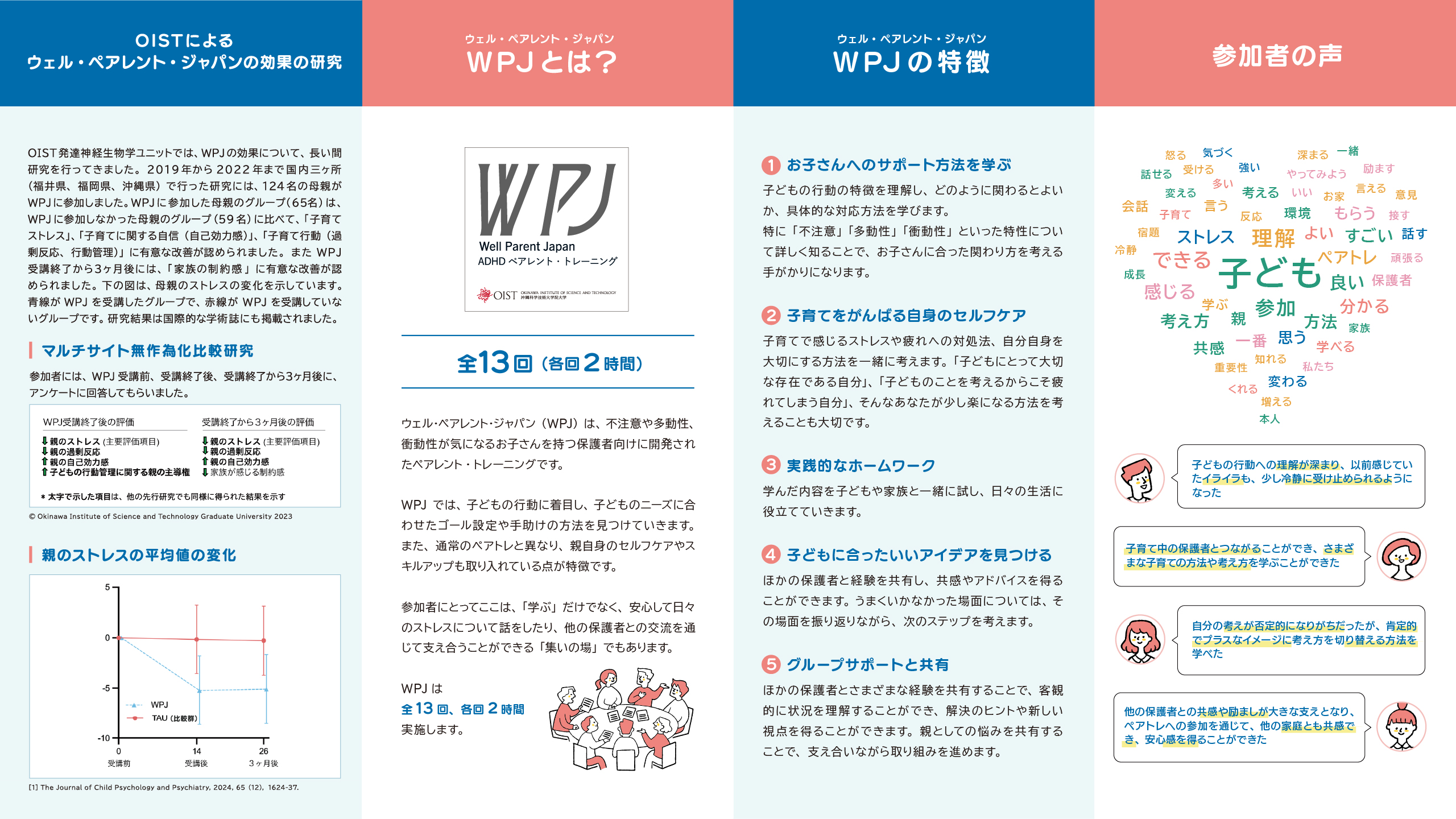
プログラムの概要と最新の取り組みについては、パンフレットをご覧ください (クリックして表示) 。
現在は、沖縄県の中頭教育委員会との連携のもと、県内の学校を通じたWPJの導入に向けた実装研究を行っています。この取り組みでは、教師向けの教育用ビデオも組み込まれています。
詳細については、研究責任者の島袋静香(wpj@oist.jp)までお問い合わせください。
2024年4月には、WPJの開発・評価・実装を通じて、ADHDのある子どもの保護者支援に大きく貢献したことが認められ、島袋静香博士が文部科学大臣表彰(科学技術振興部門)を受賞しました。
Research Findings
See here for findings from our research studies.
Collaborators
- Prof. Yushiro Yamashita, Kurume University, Fukuoka
- Prof. Akemi Tomoda, University of Fukui, Fukui
- Dr. Satoshi Harada, Ryukyu Hospital, Okinawa
- Dr. Takahiro Endo, Ryukyu Hospital, Okinawa
- Professor Takashi Oshio, Hitotsubashi University, Tokyo
- Dr. Tadashi Shiroma, University of Ryukyus
- Ms. Noriko Yamada, University of Ryukyus
- Prof. Brent Alsop, University of Otago, NZ
- Prof. David Daley, Nottingham Trent University, UK
- Prof. Saskia Van der Oord, KU Leuven, Belgium
- Prof. Tom Beckers, KU Leuven, Belgium
- Dr. Hasse de Meyer, HELP University, Malaysia
- Dr. Heloisa Alves, University of Massachusetts Dartmouth, US
- Dr. Paulo Mattos, D’Or Institute Research and Education, Brazil
- Ms. Camila Bernardes, D’Or Institute Research and Education, Brazil
- Dr. Patrícia Bado, Catholic University of Rio de Janeiro, Brazil
- Dr. Jorge Moll, D’Or Institute Research and Education, Brazil
- Prof. Egas Caparelli-Daquer, Federal University of State of Rio de Janeiro/University of Rio de Janeiro, Brazil
- Prof. Erasmo Barbante Casella, University of Sao Paulo, Brazil
- Prof. Jeff Wickens, OIST, Japan
Ethics Approvals
Please contact the CRC Principal Investigator if you have any questions about the research you participated in, or if you would like to have your data withdrawn from further analysis of the collected data.
- CRC Principal Investigator: Gail Tripp
- Phone: 098-966-8814
- E-mail: adhd@oist.jp
- Address: OIST Lab 4 Level C, 1919-1 Tancha, Onna, Kunigami, Okinawa, Japan 904-0495
We have received approvals from OIST Human Subjects Research Review Committees for our research projects.
| Reference # | Lead Investigator | Study Title |
| HSR-2008-001-45 | Gail Tripp | Reinforcement sensitivity, working memory, and attention deficit hyperactivity disorder (ADHD): Changing reinforcement contingencies and response cost |
| HSR-2011-004-15 | Gail Tripp | Social problem solving and language skills in children with and without attention deficit hyperactivity disorder (ADHD) |
| HSR-2015-002-10 | Gail Tripp | Relationship of Language and Social Problem Solving in ADHD |
| HSR-2017-007-3 | Gail Tripp | Motor skills in children with and without ADHD: A pilot study |
| HSR-2020-022-4 | Gail Tripp | Effects of extinction of reinforcement on the behavior of children with and without ADHD |
| HSR-2020-031-4 | Gail Tripp | Effects of reinforcement schedule on learning and emotional reactions among children with and without ADHD |
| HSR-2020-032-3 | Gail Tripp | Investigating sign tracking and goal tracking behavior in children with and without ADHD |
| HSR-2021-003-4 | Gail Tripp | Effects of mild punishment on behavior and emotional reactions among children with and without ADHD |
| HSR-2022-015-3 | Gail Tripp | Conditional discrimination learning and emotional reactivity among children with and without ADHD |
| HSR-2021-008-2 | Hend Samniya | Monitoring and Repair in the Social and Narrative Discourse of Children with and without ADHD |
| HSR-2022-024-2 | Izabela Stefania Porebska | Social Functioning in Children with and without ADHD: Expectations of Others, and Allocation of Responsibility |
| HSR-2023-018 | Mana Oguchi | Development of Measurement Tools for Altered Reinforcement Sensitivity in ADHD |
| HSR-2012-001-7 | Shizuka Shimabukuro | The relationship between parenting, maternal psychological functioning, and ADHD symptomology |
| HSR-2017-010-9 | Shizuka Shimabukuro | A study on the standardization of psychological measures: Affective Reactivity Index (ARI), Parenting Sense of Competence Scale (PSOC) and Expressed Emotion (EE) |
| HSR-2019-014-5 | Shizuka Shimabukuro | Multisite pragmatic randomized controlled trial of a parent training program specific to ADHD: Toward implementation in the community |
| HSR-2023-014 | Shizuka Shimabukuro | Translational pilot study: Feasibility of Implementation of Well Parent Japan (WPJ) combined with teacher educational videos in Japanese school setting |
| HSR-2020-029-2 | Emi Furukawa | Assessing the needs of families of children with Attention Deficit Hyperactivity Disorder (ADHD) seeking professional help in Brazil |
| HSR-2021-011 | Emi Furukawa | Encouraging positive parenting habits through digital media: A pilot study of an educational program for parents with children demonstrating ADHD symptoms |
| HSR-2022-016-2 | Emi Furukawa | Community-based participatory research: Incorporating community feedback in developing parent training program |
| HSR-2023-020-2 | Emi Furukawa | Loving Habits: A feasibility study of a support program for building new parent-child behavioral habits (Pilot study) |
| HSR-2023-025-2 | Emi Furukawa | Understanding children's behavioral healthcare needs and experiences through online surveys and interviews |