About the Workshop

Quantum reference frames are a universal tool for dealing with symmetries in quantum systems. They thus arise in seemingly disparate areas. This includes appearing as observers in quantum gravity, as edge modes in gauge theory and gravity, as stand-in references in quantum information protocols in the absence of shared external frames, as reference systems in thermodynamic setups, as an essential tool in quantum foundations for exploring the universality of quantum theory, as the redundant data in quantum error correction, and in many other guises in fundamental physics. They are the tools for describing quantum systems “from the inside”, and a core development is that they give rise to a novel quantum covariance of physical laws and properties.

This workshop will bring together leading experts on quantum reference frames and the many related subjects in the first focused event in the new era of quantum frame covariance. Owing to their diverse range of applicability, a number of approaches to quantum reference frames have emerged. This event will reflect these diverse developments and aim to unify and streamline them. Our goal is to bring representatives from different approaches and disciplines in which quantum frames appear together to discuss and foster building an emergent community. The workshop will include contributed talks, discussions, a poster session, and some social activity.

Quantum Reference Frames 2025 is co-funded by the Quantum Information Structure of Spacetime consortium.

For researchers based in Japan, there was a preparatory intensive lecture series on quantum reference frames and their application in high-energy physics at RIKEN iTHEMS between 24 and 26 September, 2025 (see here for the recordings of the 9 lectures). For more information, please click here.

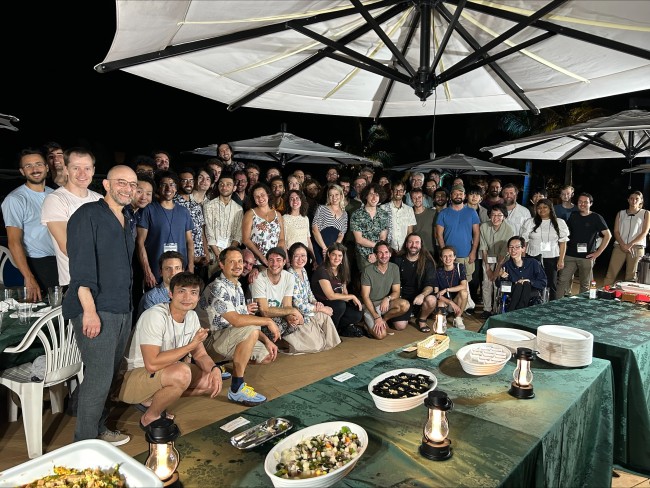
QRF participants 1
QRF participants 2

目次

Recordings of the conference talks
Recorded talks can be accessed via the links in the Abstracts section or the collective link below.

Click here to download the poster:

QRF2025 Poster

Invited Speakers

  • Shadi Ali Ahmad (NYU) - cancelled due to unforeseen circumstances
  • Caslav Brukner (IQOQI Vienna)
  • Anne-Catherine de la Hamette (IQOQI Vienna/ETH Zurich)
  • Stefan Eccles (Penn State)
  • Laurent Freidel (Perimeter)
  • Thomas Galley (IQOQI Vienna)
  • Flaminia Giacomini* (ETH Zurich/Rome Tor Vergata)
  • Steve Giddings* (UCSB) [moved online]
  • Kristina Giesel (FAU Erlangen)
  • Jan Glowacki (IQOQI Vienna)
  • Henrique Gomes* (Oxford) [moved online]
  • Masahiro Hotta (Tohoku U)
  • Josh Kirklin (Perimeter)
  • Max Lock (TU Vienna)
  • Fabio Mele (U Western Ontario/Louisiana State U)
  • Flavio Mercati (U Burgos)
  • Takayuki Miyadera (Meiji Gakuin U) - cancelled due to unforeseen circumstances
  • Markus Müller (IQOQI Vienna)
  • Kasia Rejzner (York U)
  • Alexander Smith (St. Anselm/Dartmouth)
  • Robert Spekkens* (Perimeter)
  • Wolfgang Wieland (FAU Erlangen)
  • Edward Witten* (IAS Princeton)

* online talk

There will be contributed talks and posters...
Among the talk submissions, we will select a limited number of 30-minute presentations. Regular contributed talks will be 15 minutes.
Registration fees ¥45.000 daily shuttles, airport shuttles (at fixed times), lunch, coffee breaks, and banquet included, without the excursion to Churaumi Aquarium

On-site participants who are not invited speakers will be asked to pay a ¥ 45.000 registration fee. This fee includes shuttles from/to the airport (at fixed times), daily transportation to/from the Fuchaku area (where most hotels are) and Seaside House, as well as lunches, coffee breaks, and the banquet dinner at the poolside of the Oriental Hotel on Wednesday, the 15th.

Organizers: 

Qubits and Spacetime Unit, OIST

Sergio E. Aguilar-Gutierrez, Gonçalo Araújo-Regado, Luca Ciceri, Julian De Vuyst, Philipp A. Höhn, Luca Marchetti, Javier Pagan Lacambra, Sam Pickup, Francesco Sartini, Bilyana Tomova

Contact: qrf2025@oist.jp

Schedule

All times are in JST. Talks will be held in Seminar Room B250. Coffee and lunch will be served in the pavilion outside the seminar room. Please check in at the registration desk outside the seminar room upon arrival on the first day. The registration desk will open at 8:20 on Monday, 13th.

     Monday 13th     
Monday 13th
8:20 Registration desk opens  
09:00 - 09:15 Opening remarks Philipp Höhn
09:15 - 10:00 Ruling out exchange statistics beyond Bosons and Fermions with quantum reference frames Markus Müller
10:00 - 10:45 Operational Quantum Frames: from quantum mechanics to quantum field theory and beyond Jan Głowacki
10:45 - 11:15 Coffee break  
11:15 - 12:00 Microstate reality at the horizon for metric detectors as quantum reference frames Masahiro Hotta
12:00 - 12:30  Quantum frame fields and relational Renormalization Group Luca Marchetti
12:30 - 14:15 Lunch  
14:15 - 15:00 Linking quantum error correction and gauge theory via quantum reference frames Fabio Mele
15:00 - 15:15 Reference-frame-independent entanglement detection Satoya Imai
15:15 - 15:45 Coffee break  
15:45 - 16:30 Extension of the Einstein Equivalence principle to quantum reference frames Flaminia Giacomini [online]
16:30 - 18:30 Poster session and reception  


     Tuesday 14th     
Tuesday 14th
09:00 - 09:45 A background independent algebra in quantum gravity Edward Witten [online]
09:45 - 10:30 Gravitational observables, reference frames, algebras, and puzzles Steve Giddings [online]
10:30 - 11:00 Coffee break  
11:00 - 11:45 Reference frame applications for gravitational subregions Stefan Eccles
11:45 - 12:30  Quantum Null Rays: effective dynamics and localized gauge invariant observables Laurent Freidel
12:30 - 14:15 Lunch  
14:15 - 15:00 Quantum Null Rays: area as a quantum reference frame Josh Kirklin
15:00 - 15:30 Horizon Edge Partition Functions in \Lambda > 0 Quantum Gravity Yuk Ting Albert Law
15:30 - 16:00 Coffee break  
16:00 - 16:45 Why quantum reference frames? Henrique Gomes [online]
16:45 - 17:00 Coffee break  
17:00 - 17:15 A Carrollian Perspective on Null Surfaces Puttarak Jai-akson
17:15 - 17:30 Superposition of Einstein elevators as a toy model for quantum reference frames Natália Salomé Móller
17:30 - 17:45 Detectability of post-Newtonian classical and quantum gravity via quantum clock interferometry Eyuri Wakakuwa
17:45 - 18:00 Make Reference Frames Quantum Again  Ofek Bengyat


     Wednesday 15th     
Wednesday 15th
09:00 - 09:45 Operational QRFs and algebraic structure of relativized observables Kasia Rejzner
09:45 - 10:00 An algebraic approach to edge modes and large gauge transformations in quantum electromagnetism Daan Janssen
10:00 - 10:30 The relationship between soft and edge modes Gonçalo Araújo-Regado
10:30 - 11:00 Coffee break  
11:00 - 11:15 A relational roadmap for microcausality and local algebras in gauge theories Bilyana Tomova
11:15 - 11:45 Relational entanglement entropies and quantum reference frames in gauge theories Francesco Sartini
11:45 - 12:00  Gauge ambiguities and quantum reference frames in cavity QED Germain Tobar
12:00 - 12:30 Lunch  
12:30 - 17:30 Excursion/ Free afternoon  
17:30 - 20:30 Banquet dinner  


     Thursday 16th     
Thursday 16th
09:00 - 09:45 Indefinite probabilities from finite quantum reference frames Caslav Brukner
09:45- 10:30 Dynamical reference frames in quantum gravity Kristina Giesel
10:30 - 11:00 Coffee break  
11:00 - 11:45 Gravitational subsystems on the light front: luminosity and local amplitudes  Wolfgang Wieland
11:45 - 12:15  Three Aspects of Relational Approaches toward Background-Independent Quantum Spacetimes Lin-Qing Chen
12:15 - 14:00 Lunch (optional OIST lab tour: 13:20 -14:00)  
14:00 - 14:45 On the Goals and Methods of the Quantum Reference Frame Program Thomas Galley
14:45 - 15:30 What is observable in a quantum reference frame? Anne-Catherine de la Hamette
15:30 - 16:00 Coffee break  
16:00 - 16:45 Discussion: different approaches to QRF Chair: Leon Loveridge


     Friday 17th     
Friday 17th
09:00 - 09:45 The Limits of Relational Encoding: Quantum Reference Frames and the Unitary/Antiunitary Divide Rob Spekkens [online]
09:45 - 10:30 Temporal reference frames and relational dynamics Alexander Smith
10:30 - 11:00 Coffee break  
11:00 - 11:45 Causality and non-unitary dynamics in the Page–Wootters formalism Max Lock
11:45 - 12:00 Perspectives on perspectives Andrea Di Biagio
12:00 - 12:15 Relational teleportation Samuel Pickup
12:15 - 14:00 Lunch  
14:00 - 14:45 Quantum-group reference frames Flavio Mercati
14:45 - 15:00 Third particle paradox for spin degrees of freedom Carla Ferradini
15:00 - 15:15 The sum of entanglement and subsystem coherence is invariant under quantum reference frame transformations Carlo Cepollaro
15:15 - 15:30 Wigner-Araki-Yanase theorem for unsharp observables Mohammad Hamed Mohammady
15:30 - 16:00 Coffee break  
16:00 - 16:45 Final discussion: future directions  
16:45 - 16:55 Closing remarks Philipp Höhn


Recordings of the conference talks

Recorded talks can be accessed via the links in the abstract section (or by clicking on the title of the talk in the schedule above). For a playlist of all recorded talks, see https://vimeo.com/showcase/11951064

Zoom link for online participation

All talks will be broadcast on Zoom at the following link:

https://oist.zoom.us/j/93962582423?pwd=7AP7cEqSa8xrEUkU7toaZKRnihOf1Q.1

Meeting ID: 939 6258 2423
Passcode: 894290

Important Online Participation Guidelines:

  • All talks will be recorded.
  • Participants will not be able to unmute themselves or turn on their video without prior permission. Conference moderators will enable both audio and video for those asking a question.
  • To ask a question, please raise your hand virtually and type it in the chat before being invited to speak.
  • Please note that in-person questions will take priority, and depending on time constraints, it may not always be possible to address all online questions.

We appreciate your understanding and cooperation.

Venue and Access

Information on how to reach OIST from Naha can be found under the below "OIST campus" link. Note that on arrival day, October 12, we will arrange three shuttle buses between Naha airport and the accommodation area near OIST (more information on this later).

Talks will take place in the Sydney Brenner Lecture Theater (Seminar Room B250) on Level B of the Central Building. See the map below for local access information.

OIST campus ariel
OIST campus
CV-OIST Main Campus Seminar Rooms Map All
Workshop venue

Talks will also be broadcast online; please consult the Schedule for connection information.

Scheduled shuttles will run between Naha Airport and OIST on Sunday, Oct 12, and Saturday, Oct 18, see schedule below for details.

A daily shuttle will also run between the main hotel area and the venue during workshop days. These services are included in the registration fee.

Here is a map with the route for the airport and daily shuttles: Shuttle Bus Map, and the schedule:

QRF2025 Shuttle Bus Schedules

A banquet dinner will be held on Wednesday, October 15th, at the Oriental Hotel poolside venue(Participation in the banquet dinner is included in the in-person conference registration fee.)


Abstracts: invited talks

Monday

Markus Müller (IQOQI Vienna)

Ruling out exchange statistics beyond Bosons and Fermions with quantum reference frames
Quantum systems invariant under particle exchange are either Bosons or Fermions, even though quantum theory admits in principle more general behavior under permutations. But why do we not observe such “paraparticles” in nature? Here we show how the notion of internal quantum reference frames can shed significant light on this longstanding problem, offering an explanation for the nonexistence of fundamental parastatistics. For this, we reinterpret particle indistinguishability as the absence of a canonical "reference frame of labelling", and the (more general) inability to identify particles even across branches of a superposition as the absence of a quantum reference frame of labelling. This is equivalent to a stronger form of indistinguishability, namely invariance under permutations that are coherently controlled by permutation-invariant observables (such as swapping two particles of their distance is small, and doing nothing otherwise). We show that only Bosons and Fermions, but not paraparticles satisfy this form of invariance under quantum coordinate transformations. Our results demonstrate the explanatory power, but also subtle limitations of quantum covariance principles, and they hint at a generalization of the perspective-neutral framework beyond tensor product subsystems.

🎥 Link to the video: https://player.vimeo.com/video/1129084072

Back to the schedule

Jan Glowacki (IQOQI Vienna)

Operational Quantum Frames: from quantum mechanics to quantum field theory and beyond

In this talk I will begin with a concise overview of the development of the operational approach to quantum reference frames (QRFs), tracing the line from its foundational contributions to its most recent applications. I will then introduce the central ideas of the research direction that I am pursuing which aims at developing relational foundations for relativistic quantum physics. The starting point is the application of the operational QRF formalism to the context of the Poincaré group, and establishing connections between this emerging framework and existing formalisms in quantum field theory. This part of the talk will summarize results from a recent preprint written with Samuel Fedida (arXiv:2507.21601). I will conclude by outlining a number of open research directions, highlighting selected topics in more detail depending on the available time and the interests of the audience

🎥 Link to the video: https://player.vimeo.com/video/1129084116

Back to the schedule

Masahiro Hotta (Tohoku U)

Microstate reality at the horizon for metric detectors as quantum reference frames

For understanding the horizon of a black hole, quantum reference frames are essential. As their physical representation, we discuss within the framework of classical general relativity the asymptotic symmetries near the horizon and the properties of the microstates they generate.

🎥 Link to the video: https://player.vimeo.com/video/1129084132

Back to the schedule

Fabio Mele (Louisiana State U)

Linking quantum error correction and gauge theory via quantum reference frames

One of the defining features of gauge theories is that they describe physics redundantly, in a way that is insensitive to certain local details. This is similar to how quantum error correcting codes (QECCs) protect quantum information from local errors by redundantly encoding logical states into a larger physical space. In this talk, I will show that this analogy is not merely a coincidence but that there is a deeper underlying structural relationship between these two fields. The key ingredient is quantum reference frames (QRFs), a universal toolkit for dealing with symmetries in quantum systems. A choice of QRF defines a split between redundant and physical information in gauge systems, thus establishing a notion of encoding in that context. The result is a precise dictionary between QECCs and QRF setups within the perspective-neutral framework for gauge systems. In particular, focusing on Pauli stabilizer codes, I will show that there is a one-to-one correspondence between maximal correctable error sets and tensor factorizations splitting system from error-generated QRF degrees of freedom. Relative to this split, errors corrupt only redundant frame data, leading to a novel characterization of correctability. The dictionary also reveals a novel error duality, based on Pontryagin duality, between standard Pauli errors and a new class of correctable errors related to gauge-fixing.

Based on: S.Carrozza, A. Chatwin-Davies, P. A. Höhn, F. M. Mele, "A correspondence between quantum error correcting codes and quantum reference frames",  arXiv: 2412.15317 [quant-ph]

🎥 Link to the video: https://player.vimeo.com/video/1129084165

Back to the schedule

Flaminia Giacomini (Rome Tor Vergata)

Extension of the Einstein Equivalence principle to quantum reference frames

The Einstein Equivalence Principle (EEP), stating that all laws of physics take their special-relativistic form in any local inertial (classical) reference frame, lies at the core of general relativity. Because of its fundamental status, this principle could be a very powerful guide in formulating physical laws at regimes where both gravitational and quantum effects are relevant. The formulation of the EEP only holds when both matter systems and gravity are classical, and we do not know whether we should abandon or modify it when we test it with quantum systems and/or the gravitational field is not classical. In my talk, I propose an extension of the EEP which relies on quantum reference frames, namely the possibility that reference frames can be associated to quantum systems, and hence be in a quantum superposition or entangled relative to each other. In addition, I show that this generalised principle can be tested, for classical gravity, using atom interferometry with quantum clocks. Finally, I will argue that such an extension of the EEP can overcome Penrose’s argument in favour of the classicality of the gravitational field.

🎥 Link to the video: https://player.vimeo.com/video/1129084200

Back to the schedule


Tuesday

Edward Witten (IAS)

A background independent algebra in quantum gravity

I consider an algebra of observables along the worldline of an observer as a background independent algebra in quantum gravity.

🎥 Link to the video: https://player.vimeo.com/video/1129084217

Back to the schedule

Steve Giddings (UCSB)

Gravitational observables, reference frames, algebras, and puzzles

I will review some aspects of relational observables, describing a classification of types and connection to quantum reference frames.  A particular focus will be gravitationally dressed observables, and their connection to departure from the usual algebraic structure of quantum field theory; the transition to type II von Neumann algebras appears to be just a small piece of this.  Expected properties of full gravitational dressing raise interesting questions related to holography, and regarding a possible fundamental role for other non-algebraic structure in quantum gravity.

🎥 Link to the video: https://player.vimeo.com/video/1129084239

Back to the schedule

Stefan Eccles (Penn State U)

Reference frame applications for gravitational subregions.

I will give an overview of selected applications of dynamical and quantum reference frames to gravitational subregions.  This will include the use of quantum clock frames to construct gauge invariant algebras associated with a spacetime subregion (such as a dS static patch), resulting in “crossed product” algebras with well defined density operator descriptions and regularized entropies.  It will also include the use of dynamical reference frames in classical gravity to elucidate the origin and role of “edge modes” arising in phase space descriptions of bounded subregions.  I'll conclude by outlining a novel formulation of "fluctuation theorems" for spacetime subregions in this classical context.

🎥 Link to the video: https://player.vimeo.com/video/1129084254

Back to the schedule

Laurent Freidel (Perimeter)

Quantum Null Rays: effective dynamics and localized gauge invariant observables

In this talk, I'll review the construction of gravitational constraints and of the corresponding phase space along generalized horizons. I will focus my exposé on the study of the Raychauduri Constraint and its quantization, which describes the dynamics of quantum null rays. I will present a detailed construction of the null ray phase space and the localized gauge-invariant observables. Such a construction requires the introduction of a preferred time frame called the dressing time, which includes edge modes that allow localization along a null ray interval. Gauge-invariant observables are then obtained by dressing the fields with the dressing time. We will see how the edge mode symplectic structure can be understood in terms of the integration of degrees of freedom complementary to the chosen region and how the gauge-invariant observables include the covariant area element as a generator of reorientations of the frame. Finally, we will describe how the quantization procedure can be encoded through an effective deformation of the gravitational phase space labelled by a central charge. If time permits, I'll comment on the role the central charge plays in resolving the fundamental problem of time in quantum gravity.

🎥 Link to the video: https://player.vimeo.com/video/1129084286

Back to the schedule

Joshua Kirklin (Perimeter)

Quantum Null Rays: area as a quantum reference frame

Elementary quantum reference frames (QRFs) such as clocks have recently led to surprising insights into quantum gravity. But far richer structures should emerge once we consider more full-fledged gravitational QRFs, i.e. quantum coordinate systems. A complete theory of such objects remains elusive, largely due to the subtleties in quantizing diffeomorphism symmetry. Null surfaces provide an ideal simplified setting to explore the properties of quantum coordinates. In this talk, I will show how one may form a useful QRF out of the area degrees of freedom on each light ray: the quantum dressing time. This construction permits relational observables and frame reorientations within an algebraic structure generalizing the crossed product, and consistent with established QRF approaches such as the perspective-neutral formalism. Along the way, I will discuss how diffeomorphism anomalies can be cancelled by the introduction of a suitable classical counterterm; I will describe some implications of the fact that QRFs made from fields (such as the quantum dressing time) must be Kähler-quantised; and I will comment on the consequences of our construction for gravitational entropies.

🎥 Link to the video: https://player.vimeo.com/video/1129084314

Back to the schedule

Henrique Gomes (Oxford)

Why quantum reference frames? 

Go through a general relativity book (like Wald's) and you won't find many mentions of reference frames. Classically, worrying about 'gauge-invariance' seems optional. There, the implicit assumption that symmetry-related solutions represent the same physical state of affairs suffices for most applications (as long as they can be stated using abstract-index notation). Why do we always bring up talk of reference frames, gauge-fixing, etc, in the quantum domain? I will argue it is because, when superpositions of states are involved, we need to compare solutions, and for that, we need a standard of comparison. And to a certain extent, such a standard is also required at the interface between two subsystems. I will relate this standard to reference frames/dressings/gauge-fixings; interpret obstacles to the existence of such standards in the form of the Gribov ambiguity; and present workarounds to these obstacles, in the form of history-dependent reference frames (also called 'relational connection-forms'). Time allowing, I will give a clear-cut, local example of how the quantum invokes reference frames using the Higgs mechanism. 

🎥 Link to the video: https://player.vimeo.com/video/1129084344

Back to the schedule


Wednesday 

Kasia Rejzner (York U)

Operational QRFs and algebraic structure of relativized observables

I will discuss how adopting an operational description of measurement using quantum reference frames (QRFs) induces nontrivial modifications in the algebraic structure of quantum field theory (QFT). My starting point will be the net of algebras in the the sense of Haag and Kastler, generalized to curved spacetimes. I will focus on the example of a quantum clock coupled to a QFT on de Sitter spacetime in a KMS state, originally analyzed by Chandrasekaran, Longo, Pennington, and Witten. In the work with Chris Fewster, Daan Janssen, Leon Loveridge, and James Waldron, we have reproduced and generalized the results concerning the types of von Neumann algebras arising by constructing relativized observables. We have also linked the existence of the finite trace on such algebras with thermal properties of the QRF.

🎥 Link to the video: https://player.vimeo.com/video/1129084398

Back to the schedule


Thursday

Caslav Brukner (IQOQI Vienna)

Indefinite Probabilities from Finite Quantum Reference Frames

While individual measurement outcomes in quantum mechanics cannot be assumed to be predefined—as shown by Bell’s theorem—the probabilities for outcomes of all measurements, and thus the quantum states, are generally taken to be well defined. This assumption implicitly relies on measurements being performed with respect to ideal, unbounded reference frames. We show that when measurements are made relative to finite quantum reference frames, the probabilities themselves become indefinite: even in the limit of infinitely many runs, the relative frequencies cannot be assumed to take predefined values. We establish the fundamental nature of this effect through a Bell-type theorem for relative frequencies. These findings motivate an extension of the notion of the quantum state to scenarios constrained by finite resources.

🎥 Link to the video: https://player.vimeo.com/video/1130102898

Back to the schedule

Kristina Giesel (FAU Erlangen)

Dynamical reference frames in quantum gravity

The quantisation of systems involving gravity is often more challenging than for systems in which gravity is absent or is treated classically. This includes, for example, the choice of dynamical reference frames, access to the physical sector of the theory, and the formulation of the dynamics. In the first part of the talk, we will  review some  choices of dynamical reference frames for canonical quantum gravity that aim to complete the quantisation programme. In the second part, we will consider dynamical reference frames in the context of linearised gravity and possible connections to quantum reference frames

🎥 Link to the video: https://player.vimeo.com/video/1130104702

Back to the schedule

Wolfgang Wieland (FAU Erlangen)

The crucial role of quantum reference frames for the light front quantisation programme of gravity

This presentation outlines the role of quantum reference frames for the canonical quantisation of gravitational null initial data. The starting point is a non-perturbative realisation of the radiative phase space on a null boundary for tetradic gravity with the parity violating γ-term (Holst term) in the action. Next, we explain how to introduce reference fields that can serve as quantum clocks at the null front. To remove otherwise problematic UV divergencies, we introduce a regularisation along the angular directions. The two-dimensional cross sections of the light front are thereby tesselated into a fixed number of plaquettes. Each plaquette is the base of a thickened light ray that carries infinitely many radiative modes and additional quantum reference frames. To obtain a representation of the canonical commutation relations, we introduce an auxiliary CFT attached to each plaquette. Finally, we report on two important features of the model. First, the area of each plaquette turns into a quantum operator. Its spectrum is discrete and agrees (up to ordering ambiguities) with related results in loop quantum gravity. Second, the spectrum of the radiated power splits into two sectors. For an asymptotic boundary, the two regimes are separated by the Planck power. Below the Planck power, the spectrum of the radiated power is discrete. Above the Planck power, the spectrum is continuous but the corresponding quantum states exhibit certain pathologies that render them unphysical. Finally, I will discuss a theory-independent framework to construct local amplitudes between boundary states at generic null initial surfaces. The talk is based on arXiv:2402.12578, arXiv:2401.17491, arXiv:2104.05803.

https://iopscience.iop.org/article/10.1088/1361-6382/adb536
https://iopscience.iop.org/article/10.1088/1361-6382/ae0235

🎥 Link to the video: https://player.vimeo.com/video/1130104785

Back to the schedule

Thomas Galley (IQOQI Vienna)

On the Goals and Methods of the Quantum Reference Frame Program

In this talk I will ask some very basic questions: what are the different roles played by reference frames classically? which of these roles do different approaches to quantum reference frames (QRFs) try to generalise? what are the main strengths and drawbacks of different approaches to QRFs? I will provide some answers to these questions in part using recent work (https://arxiv.org/abs/2508.09540v2) where a simple three qubit example is used to illustrate the main differences between three contemporary approaches: the perspective neutral, extra-particle and operational approach. The aim of this talk is to prompt discussion about the overall goals of the QRF research program as well as generate discussion about existing frameworks and methods.

🎥 Link to the video: https://player.vimeo.com/video/1130103065

Back to the schedule

Anne-Catherine de la Hamette (IQOQI Vienna)

What is observable in a quantum reference frame?

The field of quantum reference frames has seen a lot of progress in recent years, with several distinct frameworks having emerged as a result. This has allowed us to answer various questions on subsystem relativity, frame-dependence of quantum resources, and even non-classical spacetimes and causality. In this talk, we address a remaining fundamental question: in the presence of symmetries, what global properties of a quantum system, such as its total momentum, can be inferred from the perspectives of internal quantum reference frames? Extending both the perspectival and perspective-neutral approaches to arbitrary fixed charge sectors, we consider scenarios in which the entire system, including the reference frames, moves at a fixed total momentum P relative to an external frame. This extension yields modified relative states and observables with QRF transformations that induce an additional P-dependent phase, treating all charge sectors equally. By granting internal observers successively more resources, we identify under which conditions they can infer the total momentum. These results help clarify the relationship between major QRF approaches — perspectival, perspective-neutral, operational, and extra-particle — showing how their differing conclusions stem from different assumptions about which observables are deemed accessible from within. Our findings cast light on scenarios where no global perspective exists, contributing to fundamental questions about relationality and the role of perspectives in quantum theory.

🎥 Link to the video: https://player.vimeo.com/video/1130103029

Back to the schedule


Friday

Rob Spekkens (Perimeter)

The Limits of Relational Encoding: Quantum Reference Frames and the Unitary/Antiunitary Divide

Earlier explorations of quantum reference frames taught us two important lessons. First, when an external reference frame for a collective unitary symmetry is unavailable, the implementable states, transformations, and measurements are those of the symmetry-twirled theory—i.e., quantum theory subject to the corresponding superselection rule. Second, a system prepared in a state that breaks the symmetry can serve as a token of the missing frame, and access to this token lifts the superselection rule by encoding information into relational degrees of freedom between system and token. Recent work yields a third lesson: for unitary symmetries, any circuit that relies on an external frame can be simulated without such a frame using only independent, uncorrelated tokens for each system, implying that there exists a simulation that preservesthe circuit’s causal structure.  Surprisingly, this conclusion does not generalize to symmetries that fail to be unitary. For the example of time-reversal, which is antiunitary, the twirling operation maps complex-amplitude quantum theory to its real-amplitude counterpart, so a token of a reference frame for time-reversal enables simulation of the complex theory within the real one. However—unlike the unitary case—one cannot always find a simulation that preserves the causal structure, hence neither can one always find a simulation wherein the tokens are independent. This reframes and sharpens recent “real vs complex” separations (e.g., Renou et al. 2021) as a quantum reference frame phenomenon: whether quantum information can be faithfully encoded in system–frame relations depends qualitatively on whether the underlying symmetry is unitary or not.  Based on: Ying et al., arXiv:2506.08091.

🎥 Link to the video: https://player.vimeo.com/video/1130103441

Back to the schedule

Alexander Smith (St. Anselm/Dartmouth)

Temporal reference frames and relational dynamics

Reference frames are defined by a symmetry because their possible configurations form a group. For temporal frames, the relevant symmetry is the one-parameter group of time translations. Consequently, observables that operationally specify a frame must transform covariantly under this group, motivating a description of time observables by covariant positive‐operator‐valued measures (POVMs).

In this talk, I will review these time observables which evade Pauli’s objection to the existence of a time operator, saturate the time-energy uncertainty relation, and serve as the keystone for two equivalent formulations of relational quantum dynamics:

  1. The Page-Wootters formalism, in which evolution is encoded in entanglement between a clock and the rest of the system;
  2. The evolving constants of motion formalism, in which a family of gauge-invariant Dirac observables is constructed that evolve relationally with respect to a chosen clock variable.

Using these formalisms, I will show how unitary dynamics emerges from conditional probabilities and the kinematical structure of quantum theory alone. I will discuss the implications for the measurement problem and describe extensions to interacting clock-system models and quantum field theory.

Finally, I will apply this machinery to relativistic particles carrying internal degrees of freedom that function as clocks measuring their proper time. Remarkably, a novel quantum time-dilation effect arises between two clocks when one is placed in a superposition of different momenta. Using the lifetime of a hydrogen‐like atom as a clock, I will argue that this effect is within reach of near future spectroscopic experiments, thus offering a new test of relativistic quantum mechanics.

🎥 Link to the video: https://player.vimeo.com/video/1130103366

Back to the schedule

Max Lock (TU Vienna)

Causality and non-unitary dynamics in the Page–Wootters formalism

This talk will consider two complementary aspects of relational dynamics in constrained quantum systems, in particular within the Page–Wootters formalism. The first part discusses how the operational approach to modelling causality can be embedded in the formalism. In particular it is shown how the identification of system-local interventions fails under a change of reference frame, leading to the breakdown of standard operational causal models. However, explicitly timing interventions via interaction with a clock system allows us to identify a part of the physical Hilbert space on which these interventions can remain system-local in different frames, at the cost of "smearing" them in time. The second part of the talk concerns how certain clock-system interactions seem to lead to time non-locality and non-unitarity, and presents examples of how these effects relate to the choice of clock. It will be shown how the existence of a Page-Wootters model resulting in unitary time evolution leads to a restriction on the structure of the physical Hilbert space.

🎥 Link to the video: https://player.vimeo.com/video/1130103256

Back to the schedule

Flavio Mercati (U Burgos)

Quantum-group reference frames

I will introduce and motivate the Hopf-algebraic (quantum group) description of isometries of noncommutative spacetimes, emphasizing the quantum nature of transformations between reference frames. In this context, the notion of reference frame itself must acquire quantum properties. I will then overview recent work describing quantum reference frames via quantum groups of frame transformations, both within noncommutative spacetimes and in more general settings. These developments provide new perspectives on the operational meaning of reference frames and observers in quantum gravity.

🎥 Link to the video: https://player.vimeo.com/video/1130103290

Back to the schedule

Abstracts: contributed talks

Monday

Luca Marchetti (OIST & Kavli IPMU)

Quantum frame fields and relational Renormalization Group

Two main challenges in non-perturbative, background-independent approaches to quantum gravity are the construction of local observables and the definition of renormalization and coarse-graining. I will show how both challenges can be addressed by implementing the relational strategy through the construction of quantum reference frame fields for spacetime diffeomorphisms. Specifically, I will construct a relational path integral and motivate the form of the corresponding gauge-invariant relational effective action on the basis of covariance under changes of frame. I will then introduce a relational regulator, derive the corresponding relational functional renormalization group flow, and discuss its covariance under frame transformations. I will conclude with an outlook on future directions.

🎥 Link to the video: https://player.vimeo.com/video/1129084150

Back to the schedule

Satoya Imai (University of Tsukuba)

Reference-frame-independent entanglement detection

Detecting and characterizing entanglement remains challenging, especially when control over quantum systems is limited. Traditional approaches—such as quantum state tomography, fidelity estimation, and the measurement of observables like Bell inequalities or spin-squeezing inequalities—often require a shared reference frame between distant parties or prior knowledge about the system. How can we extract meaningful information about quantum systems and characterize their properties without such requirements? In my talk, I will cover three topics: First, I will introduce the basic concept of a reference-frame-independent approach to entanglement detection, known as randomized measurements. Second, I will present our results on entanglement criteria that are applicable to arbitrary states in both bipartite and multipartite systems. Finally, I will outline several open problems, addressing both fundamental questions and practical challenges. This talk is mainly based on the Review paper [Analysing quantum systems with randomised measurements, Phys. Rep. 1095, 1 (2024)].

🎥 Link to the video: https://player.vimeo.com/video/1129084179

Back to the schedule


Tuesday

Yuk Ting Albert Law (Stanford University)

Horizon Edge Partition Functions in \Lambda > 0 Quantum Gravity

Discrepancies between Lorentzian and Euclidean one-loop calculations of de Sitter thermodynamics point to “edge” degrees of freedom associated with the cosmological horizon. I will present new results clarifying the physics of these edge modes in gauge theories and in Einstein and higher-spin gravity. In p-form tensor gauge theories, edge modes arise from large gauge transformations supported near the stretched horizon. For totally symmetric tensor gauge fields on S^D, the edge partition functions receive contributions from lower-spin, shift-symmetric fields on S^{D-2} that nonlinearly realize global higher-spin symmetries. For Einstein gravity, the edge field content is consistent with an interpretation of the horizon as a dynamically fluctuating sphere. I will also describe how these results extend to the gravitons on Nariai black holes, whose edge partition function exhibits notable differences from the pure de Sitter case.

🎥 Link to the video: https://player.vimeo.com/video/1129084335

Back to the schedule

Puttarak Jai-akson (RIKEN iTHEMS)

A Carrollian Perspective on Null Surfaces

Carrollian physics has recently emerged as a powerful framework for describing gravitational (sub)systems with null boundaries, playing a central role in contexts such as flat-space holography and black hole horizons. In my presentation, I will demonstrate a three-layer correspondence (at the levels of geometry, dynamics, and phase space) between Carrollian physics and null surfaces. I will begin by presenting Carrollian geometry as a universal and intrinsic structure of generic null surfaces. I will then highlight the correspondence between the dynamics of gravitational degrees of freedom on null surfaces and Carrollian fluid dynamics. Finally, I will show that the gravitational phase space associated with a null surface coincides with that of Carrollian hydrodynamics, and discuss the associated symmetries and Noether charges.

🎥 Link to the video: https://player.vimeo.com/video/1129084360

Back to the schedule

Natália Salomé Móller (Slovak Academy of Sciences)

Superposition of Einstein elevators as a toy model for quantum reference frames

I will present a toy model for an Einstein elevator in a superposition state, originally developed to explore indefinite causal order [Quantum 8, 1248 (2024)]. We consider a massive spherical shell in a superposition of radii, sharing a common Schwarzschild exterior, so that spacetime remains classical in the external region. An Einstein elevator travels inside the shells, becoming entangled with their spacetime configuration. By the equivalence principle, an agent inside cannot detect the shell’s state locally. A crucial feature of this setup is that, after a few oscillations, the two wave packets of the elevator return to the same location in the external region of the shells, arriving simultaneously at the same coordinate time for an external observer and at the same proper time of the elevator. At this point, the elevator disentangles from the shell's state, effectively regaining its classical behavior. I will conclude this talk by discussing how this enables a gravitational quantum switch, what its advantages are, and open possibilities to use this toy model in different approaches of quantum reference frames.

🎥 Link to the video: https://player.vimeo.com/video/1129084373

Back to the schedule

Eyuri Wakakuwa (Nagoya University)

Detectability of post-Newtonian classical and quantum gravity via quantum clock interferometry

Understanding physical phenomena at the intersection of quantum mechanics and general relativity is a major challenge in physics. Experimental proposals often focus on the Newtonian regime, leaving post-Newtonian effects like frame dragging largely unexplored. In this study, we propose a scheme to investigate how post-Newtonian gravity affects quantum systems. We consider two setups: (i) a quantum clock interferometry configuration to detect the gravitational field of a rotating mass, and (ii) a scheme to explore whether such effects could mediate entanglement between quantum systems. Due to the symmetry of the configuration, the setup is insensitive to Newtonian gravity but remains sensitive to frame-dragging. Assuming the validity of the quantum equivalence principle, this method may offer insights into the quantum nature of gravity and spacetime. However, our analysis shows that the expected effects are too small to be detected under realistic experimental conditions. We discuss the implications of this undetectability for tests of quantum gravity.

🎥 Link to the video: https://player.vimeo.com/video/1129084385

Back to the schedule

Ofek Bengyat (IQOQI Vienna)

Make Reference Frames Quantum Again

Quantum reference frame transformations embody a quantization of the notion of coordinate systems through using a superposition of classical coordinate systems. In this talk I will show that this can be extended to a notion of quantum coordinate transformations more general than superposition of classical ones. This more general notion will be ``locally quantum”, as opposed to the current known QRFs, which are only ``globally quantum”: similarly to the transition from special to general relativity. To do this we will import a mathematical object called quantum permutations (aka `magic unitaries’) into physics, showing that it can form a notion of quantum coordinate systems that includes quantum reference frames as a small subset. This is the subset of quantum-controlled permutations. The control basis is in turn global, i.e. space(time) independent: otherwise different branches would not correspond to different classical coordinate transformations. By including an important principle of quantum theory — non-commutativity —  one can get out of this small subset and thus generalize quantum reference frames to the entirety of the set of quantum permutations. This unlocks \emph{local} quantum coordinate systems, which control on different bases at different space(time) points, while of course still being a unitary transformation. We showcase the implications of this extension, using the “local quantumness” to localize a particle in a superposition without delocalizing another particle in a definite location, a feat impossible with the currently known QRF transformations. Joint work with Marios Christodoulou and Caslav Brukner.

🎥 Link to the video: https://player.vimeo.com/video/1129109677

Back to the schedule


Wednesday 

Daan Janssen (University of York)

An algebraic approach to edge modes and large gauge transformations in quantum electromagnetism

We construct an algebra of semi-local observables for the quantum electromagnetic field on spacetimes with corners, including observables sensitive to large gauge degrees of freedom or edge modes. We show that these edge mode observables define an operational quantum reference frame associated with large gauge transformations, providing an algebraic perspective to quantum reference frames at the corner of spacetime, and discuss how these frames can be used in gluing procedures of algebras and quantum states. Furthermore, we show that this algebra of semi-local observables admits physically well-behaved (Hadamard) states and representations and discuss their decomposition into superselection sectors of the algebra of local observables.

🎥 Link to the video: https://player.vimeo.com/video/1129084419

Back to the schedule

Gonçalo Araújo-Regado (OIST)

The Relationship between Soft and Edge Modes

In this talk we explore the connection between asymptotic soft physics and subregional physics in Maxwell theory. We discuss how subregional edge modes can be understood as U(1) reference frames built from the dynamical field content and how this leads to a natural classification into intrinsic and extrinsic edge modes. The latter correspond to the inclusion into the subregional algebra of certain observables with complement support. This leads to a universal extension of the subregional phase space by a gauge-invariant corner Goldstone symplectic pair. This extended phase space has physical symmetries supported entirely on the corner, corresponding to frame reorientations of the extrinsic edge mode frame. In the global picture, such corner symmetries inherit a relational interpretation in terms of complement-supported transformations, which we can intuitively associate with the addition of hard radiation. Moreover, if the edge mode is charged under large-gauge transformations, then the associated corner symmetries can also be generated by the addition of soft radiation, as well as large-gauge transformations. The picture presented sets the stage for an algebraic study of the interplay between subregion and global physics in gauge theories. 

🎥 Link to the video: https://player.vimeo.com/video/1129084434

Back to the schedule

Bilyana Tomova (OIST)

A relational roadmap for microcausality and local algebras in gauge theories

The non-local nature of generic gauge-invariant observables poses challenges to the standard axioms of the algebraic formulation of quantum field theory. In this talk, I will discuss a new approach to these challenges based on dynamical reference frames in Abelian gauge theories. Classically, the phase space of each subregion splits into intrinsic and corner phase spaces. The latter contains the boundary charges that generate symmetries of the subregion, and a non-local field with support outside, defined as the difference of two reference frames, that parametrizes the corner symmetry group. We compute the Peierls brackets of observables across two space-like separated subregions to study the violations of microcausality introduced by the non-local corner field. Other axioms of algebraic QFT also get violated. However, keeping track of this corner mode is necessary to construct a meaningful net of algebras in gauge theories. At a quantum level, we discuss whether and how the corner fields can be promoted to well-defined operators. Finally, we discuss the prospects of a version of the Reeh–Schlieder theorem for the non-local algebra and how it interplays with the super-selection sectors of the global theory.

🎥 Link to the video: https://player.vimeo.com/video/1129084448

Back to the schedule

Francesco Sartini (OIST)

Relational entanglement entropies and quantum reference frames in gauge theories

Quantum reference frames (QRFs) provide a powerful new lens on subsystems and entropies in gravity and gauge theory. We extend this to lattice gauge theories, where QRFs generate edge modes on entangling boundaries and yield a relational factorization of the Hilbert space with distillable entanglement entropies. As in gravity, where QRFs regularize entropies, this demonstrates that the relational approach also offers clear advantages in gauge theories. A key insight is the distinction between extrinsic and intrinsic frames, which lead to corresponding relational algebras, with the “electric” and “magnetic” centers of previous non-relational constructions recovered as the common algebras of all extrinsic or intrinsic QRFs, respectively. Equivalently, the electric center arises by projecting any extrinsic algebra onto the subspace invariant under the corner symmetry group, while, for finite Abelian groups, the magnetic center follows by group-averaging any intrinsic algebra over a dual magnetic corner group. We establish a hierarchy of algebras and entropies, bounded by their non-distillable center counterparts, and show how extrinsic QRFs encode the imprint of asymptotic symmetries, offering a unified view of symmetry, entropy, and relational subsystems across gravity and gauge theory.

🎥 Link to the video: https://player.vimeo.com/video/1129084466

Back to the schedule

Germain Tobar (Stockholm University)

Gauge ambiguities and quantum reference frames in cavity QED

In the ultrastrong coupling regime of cavity quantum electrodynamics, the form of the light–matter interaction is commonly referred to as gauge-dependent, leading to an interpretation of gauge-relative subsystems. This has led to multiple controversies on an apparent break-down of gauge-invariance in the strong coupling regime. Here we examine this light–matter relativity in the context of quantum reference frames (QRFs), in which functions of the field degrees of freedom play the role of the reference frame. We find that different QRFs induce different sets of gauge-invariant light and matter subsystem observables, re-interpreting the gauge-relative subsystems of Stokes and Nazir as QRF-dependent, but gauge-invariant light and matter subsystemsAs a manifestation of subsystem relativity, quantities such as photon number and matter–field entanglement are all QRF-dependent. Existing controversies are due to the inability to truncate the matter sub-system's Hilbert space without changing the spectra, but no break-down of gauge-invariance occurs. This clarifies that what has been previously referred to in the literature as a gauge-dependent (or gauge-relative) form of the light–matter interaction should instead be understood as a QRF-dependence.

🎥 Link to the video: https://player.vimeo.com/video/1129084473

Back to the schedule


Thursday

Lin-Qing Chen (IQOQI Vienna)

Three Aspects of Relational Approaches toward Background-Independent Quantum Spacetimes

Three foundational aspects will be discussed in which relational approaches offer insight into a background-independent description of quantum spacetime: the notions of events, diffeomorphisms and the assumption underlying probability assignments. The first aspect concerns the notion of events and localisation, which fundamentally differ in quantum theory and general relativity. We propose an operational approach from quantum information and apply it to the quantum switch (QS). This analysis reveals differences between classical and quantum spacetime realisations of QS, clarifies a longstanding interpretational debate. The second aspect addresses diffeomorphisms in regimes beyond superpositions of semiclassical spacetimes. I will briefly present a construction of quantum diffeomorphisms for linearised quantum gravity, along with their physical implications. The third concerns a basic assumption in probability assignments, that experimental data arise from an identically and independently distributed (i.i.d.) ensemble. It does not hold in quantum gravity. I will outline a proposal to resolve this by leveraging the tool of quantum reference frames in the measurement context.  

🎥 Link to the video: https://player.vimeo.com/video/1130104744

Back to the schedule


Friday

Andrea Di Biagio (IQOQI Vienna)

Perspectives on perspectives

Physics is perspectival, but in what sense?
There are at least two senses of "perspective" used in quantum foundations. One is the notion of the perspective of a quantum reference frame, the other is the notion of the perspective of an observer as used in Wigner's friend experiments. We argue that these notions are related but distinct and, using a recently proposed definition of relative fact, we derive results connecting the two kinds of perspectives in the perspective-neutral framework. We use these results to characterise what a "resolution” of Wigner's friend paradox using quantum reference frames would have to look like, and comment on its (im)possibility. If time permits, we'll discuss how measurements and storing frame-dependent information affect the frame itself and the relationship between frames.

🎥 Link to the video: https://player.vimeo.com/video/1130103197

Back to the schedule

Samuel Pickup (OIST & University of Oxford)

Relational Teleportation

Quantum teleportation allows Alice to communicate quantum information to Bob by sending purely classical information. If the state Alice wishes to teleport contains directional information, such as spin, one may ask whether the shared entanglement also allows Alice to communicate this, by sending non-directional classical bits. Classically, this would be impossible if Alice and Bob don't share a reference frame. Until now, such quantum communication was also considered impossible, as a result of a no-go theorem by Chiribella et al. In this talk, I will demonstrate a way to circumvent the theorem, if we allow Alice and Bob to share an entangled pair of ideal Quantum Reference Frames (QRFs), and the perspective-neutral framework for QRFs is exploited to relationally encode directional information. A remarkable result of our protocol is that Alice can communicate directional quantum information to Bob, by sending purely non-directional classical information.

🎥 Link to the video: https://player.vimeo.com/video/1130103345

Back to the schedule

Carla Ferradini (ETH Zurich)

Third particle paradox for spin degrees of freedom

Quantum information protocols, such as quantum key distribution (QKD), routinely rely on internal degrees of freedom—particularly spin—to encode and transmit information. These processes implicitly assume stable and aligned reference frames between communicating parties. However, features of quantum reference frames, such as the third particle paradox, raise questions about whether an adversary can exploit changes of reference to infer information about systems confined within supposedly closed laboratories. In this work, we investigate the implications of this paradox for practical quantum information processing. We first develop a general formulation of the paradox applicable to arbitrary symmetry groups, with a focus on systems exhibiting rotational symmetry (SO(3)). We then show that when reference frames are extremely imperfect—conditions that correspond to generic SO(3) quantum reference frames—the paradox cannot manifest. Our results suggest that for realistic implementations involving spin degrees of freedom, such as those in QKD, the third particle paradox poses no operational threat under these symmetry constraints.

🎥 Link to the video: https://player.vimeo.com/video/1130103229

Back to the schedule

Carlo Cepollaro (IQOQI Vienna / University of Vienna)

The sum of entanglement and subsystem coherence is invariant under quantum reference frame transformations

Since the earliest works on quantum reference frames (QRFs), it has been recognized that superposition and entanglement change under QRF transformations. Given the central role of these resources in quantum information processing, it is crucial to understand how a mere change in perspective can produce or reduce these resources. In this talk, I will present the existence of a QRF-invariant quantity that captures a trade-off between entanglement and subsystem coherence: as one resource increases under a QRF transformation, the other one necessarily decreases, in such a way that their sum is conserved. I will also present the implications of this phenomenon for violations of Bell inequalities, emphasizing that for any choice of QRF, there always exists a quantum resource that accounts for the observed nonlocality. These findings contribute to a better understanding of the quantum information theoretic aspects of QRFs, and open a new avenue for investigating physically meaningful QRF-invariants and their role in characterizing relational aspects of quantum phenomena. Based on arXiv:2406.19448

🎥 Link to the video: https://player.vimeo.com/video/1130103156

Back to the schedule

Mohammad Hamed Mohammady (Slovak Academy of Sciences)

Wigner-Araki-Yanase theorem for unsharp observables

The Wigner-Araki-Yanase (WAY) theorem states that when the measuring process is subject to conservation laws, or symmetry constraints, then the only sharp (projection valued) observables that can be accurately measured are those that commute with the conserved quantity, i.e., those that are invariant with respect to the symmetry. Here, we extend the WAY theorem to the case of arbitrary unsharp observables, i.e., POVMs. We show that an unsharp observable not commuting with the conserved quantity may be accurately measured provided the measuring apparatus is initially prepared in a state with sufficiently large asymmetry. However, if the unsharp observable admits definite values -- that is, if there exist states in which the measurement outcomes obtain with probability one or zero -- then analogous constraints to the original WAY theorem still apply.

🎥 Link to the video: https://player.vimeo.com/video/1130103327

Back to the schedule

Abstracts: posters


Sergio Ernesto Aguilar Gutierrez (OIST)

Evolution With(out) Time: Relational Holography & BPS Complexity Growth in $\mathcal{N}=2$ Double-Scaled SYK

How can we describe non-trivial bulk measurements relative to an observer (i.e. relationally) in systems with/without observer time flow? How do we interpret this holographically? We address these questions, in the $\mathcal{N}=2$ double-scaled SYK model and its putative bulk dual by: (i) formulating a holographic procedure in the language of quantum reference frames to gravitationally dress bulk observables from R-charged boundary clocks (extending the Page-Wootters mechanism); (ii) proposing a new measure of complexity with R-charge in the boundary theory that probes exactly zero-energy BPS states. Holographically, this proposal reproduces a BPS wormhole length in the bulk. We contrast it to the Krylov complexity for Hartle-Hawking states with non-trivial time flow. The latter reproduces the same observable as in the bosonic model in the semiclassical limit, while its quantum fluctuations can capture supersymmetric corrections.


Rodrigo Andrade e Silva (Perimeter Institute)

Reduced phase space of gravity from the null perspective

By characterizing the phase space of (3+1)-dimensional Einstein-Hilbert gravity in terms of initial data on a null surface, we manage to carry out the symplectic reduction in a (large) sector of the theory, thereby obtaining the reduced phase space. This sector is defined by fixing the endpoints of the null rays at the edge of the null surface, which corresponds to fixing the (codimension 2) supertranslation charges. All other aspects of the formalism are general, and both the topology and the symplectic structure of the reduced phase space are fully non-perturbative. The inversion of the symplectic form, and the computation of Poisson brackets, is more involved and can only be described as a perturbative expansion in terms of the shear variable.


Tim Blankenstein (University of Amsterdam)

Charged Observers in the Phase of Gravity

From the Euclidean gravitational path integral one can define, to leading semiclassical order, a thermal partition function for spacetime geometries and extract their thermodynamical properties. Once quantum corrections are included, however, the partition function can acquire an imaginary or even negative phase, potentially rendering it ill-defined. Recent work shows that incorporating an observer, modeled as a black hole, into the partition function makes the phase disappear in pure gravity. In this research, we test the universality of the resolution by analyzing charged (Nariai) black holes in Einstein–Maxwell theory and determine whether the observer mechanism continues to cancel the phase once charge is present. The result has consequences for the thermodynamic interpretation of the partition function, as well as the quantum stability of particular spacetimes.


Emil Broukal (IQOQI Vienna)

Observables are glocal

What is the problem of observables for theories defined on weighted graphs? We argue the correct analogue of coordinate independence is the invariance under changes of node labels. Then, the theory of invariants of finite groups applied to graphs provides complete and finite sets of observables, which are algorithmically constructible and have a straightforward physical interpretation as global averages of connected correlations. This solves the problem of observables for discrete general relativity and spin networks.


Luca Ciceri (OIST & EPFL)

Quantum Reference Frames Perspectives on Holographic Codes

Holography, quantum reference frames and quantum error correction are three distinct yet connected research areas in physics. In particular, a dictionary between stabiliser quantum codes and ideal quantum reference frames has been recently formalised. In this work we apply it to holographic codes. These are a special class of tensor network-based quantum stabiliser codes that mimic the boundary/bulk correspondence of holographic gravitational theories. We challenge their interpretation as discrete toy models of a quantum gravity theory by looking for analogies between the quantum reference frames emerging from the code structure and boundary dressings. This approach is also beneficial to a deeper understanding of boundary quantum reference frames in holography, since this is not well appreciated in the literature. To achieve this, we leverage the quantum LEGO formalism. This allows us to describe the structure of holographic codes by focusing on how individual tensors are contracted together. By providing the interpretation of contraction as a quantum reduction map we connect this formalism to gauge theories, understanding contractions as partial gauge fixings. Using the inverse reduction map we also complete the quantum LEGO formalism by describing how tensors are cut. Thanks to this result, we pave the way for the analysis of how ideal quantum reference frames transform when tensors are glued together. Our preliminary work in this direction shows that it is always possible to find a quantum reference frame for the contracted tensors, provided knowledge of the reference frames before contraction. These results provide a solid base to advance the analysis of quantum reference frames in holographic codes and their comparison with boundary dressings, as well as understanding the relation with their continuum counterparts.


Julian De Vuyst (OIST)

On the relation between perspective-neutral, algebraic, and effective quantum reference frames

The formalism of quantum reference frames (QRFs) has gained more attention recently as a toolbox to deal with symmetries in quantum theories. Throughout the years, multiple approaches have surfaced, differing in how these symmetries are implemented and in their applicability. This poster talks about the relation between three of those: the perspective-neutral, the algebraic, and the effective semiclassical approach. The latter two are especially useful when implementing the constraint on the space of states proves to be a laborious task. The algebraic approach instead considers the state space of complex linear functionals on a kinematical algebra while the effective semiclassical one builds a quantum phase space parametrized by expectation values and fluctuations. We prove that for ideal QRFs, for which the frame orientations are orthogonal, these three approaches are equivalent. Moreover, we explore the QRF covariance of uncertainties and fluctuations and show that they are frame-dependent. Finally, we provide an outlook on building a quantum covariant effective phase space based on the effective one.


Guilhem Doat (Institut Polytechnique de Paris)

Charge accessibility as the source of disagreement between quantum reference frames frameworks

The study of QRFs has received renewed interest in the last years, leading to the parallel development of non-equivalent frameworks. We clarify these differences, and formulate the approach taken by each framework in a common language. At the mathematical level, these frameworks mainly differ in the kind of symmetry (either weak or strong) employed to constrain the system. We argue that this mathematical difference corresponds to a fundamental physical question: whether the global charge associated to the symmetry group is accessible to symmetry-constrained observers. Turning to consequences of adopting either approach, we discuss how adopting the weak approach induces an ambiguity in the momenta included in each perspective and bars from defining reversible QRF transformations. We then review and analyze the arguments motivating each approach, and show how they bear upon the problem of charge accessibility. Finally, we introduce a simple operational scenario in which it appears that internal observers could measure the global charge by 1/ probing their systems with a relativized interference measurement and 2/ classically communicating. (joint work with Augustin Vanrietvelde)


Stanislav Filatov (University of Latvia)

Decoherence of curvature superposition due to quantum clock. Lessons from QRF.

A setup is considered where a quantum clock is placed on the superposition of two different spacetime curvatures. The clock is allowed to communicate with other clocks or observers by emitting photons. This setup is isomorphic under QRF to one where a clock is put in a spatial superposition over varying spacetime curvature. For example, at different heights over the Earth. It can be shown that if clock’s interaction with vacuum resulting in emitting of the photon is local, the spatial superposition of clock becomes entangled with the state of emitted photon. In other words, the clock’s spatial superposition decoheres (becomes a mixture) immediately after emission of the photon regardless of the existence of other clocks or observers. There are scenarios, however, in which decoherence doesn’t happen and clock superposition is preserved regardless of the outside clocks or observers. This observation implies that for superposition of curvature not to decohere immediately, vacuum should probe the clock in a very particular way that couples superpositions of curvatures and not the individual curvatures to the clock and emission of the photon.                                                                                                                                                                                                                                                                                                                                                                                                                                

Niyusha Hosseini (TU Wien, Atominstitut)

The time of arrival problem in the Page and Wootters formalism

The concept of time in quantum mechanics presents unique challenges, as time is not an observable in the conventional sense. This paper explores the construction of a time of arrival observable within the framework of the Page-Wooters formalism, which treats time as an additional degree of freedom in a larger Hilbert space. By conditioning on a clock subsystem, we derive a time of arrival observable and investigate the resulting time of arrival probability distribution. We examine the necessary structure for the conditional Hilbert space and discuss the limitations of using single factor observables in deriving accurate probability distributions. Through comparative analysis with similar approaches, we evaluate the validity and applicability of the derived distribution. This study provides insights into the boundaries and potential applications of the Page-Wooters formalism in quantum mechanics, offering a deeper understanding of the nature of time and its measurement at the quantum level.


Shashaank Khanna (Aix Marseille University)

Which causal scenarios can support non-classical correlations?

The classical causal relations between a set of variables, some observed and some latent, can induce both equality constraints (typically conditional independences) as well as inequality constraints (Instrumental and Bell inequalities being prototypical examples) on their compatible distribution over the observed variables. Enumerating a causal structure's implied inequality constraints is generally far more difficult than enumerating its equalities. Furthermore, only inequality constraints ever admit violation by quantum correlations. For both those reasons, it is important to classify causal scenarios into those which impose inequality constraints versus those which do not. Here we develop methods for detecting such scenarios by appealing to d-separation, e-separation, and incompatible supports. Many (perhaps all?) scenarios with exclusively equality constraints can be detected via a condition articulated by Henson, Lal and Pusey (HLP). Considering all scenarios with up to 4 observed variables, which number in the thousands, we are able to resolve all but three causal scenarios, providing evidence that the HLP condition is, in fact, exhaustive.


Stefan Ludescher (IQOQI-Vienna)

Beyond Coherent States and Subsystems: A General Framework for Quantum Reference Frames

In the perspective-neutral approach to quantum reference frames, all relata and systems under consideration are described by a wave function living in the physical Hilbert space. By using reduction maps, one can access different perspectives. The construction of these reduction maps relies on coherent state systems, where each coherent state, for example, describes a particular position or, more generally, is associated with a group element of the underlying symmetry group. Such coherent state systems come with covariant POVMs. We generalize the perspective-neutral approach by starting from general covariant POVMs and constructing reduction maps from them. Our generalization enables the construction of maps to new perspectives, for example, we can construct a map from the physical Hilbert space to the center-of-mass frame. Moreover, our framework accommodates entirely new scenarios. Notably, we no longer require the representation of the symmetry group to have any tensor factorization, as in the case of bosons. We show that, within our generalization, it remains possible to switch between different perspectives via the physical Hilbert space.


Manuel Mekonnen (Institute for Quantum Optics and Quantum Information (IQOQI) Vienna)

Distinguishing Bosons and Fermions with internal quantum reference frames

The entanglement of indistinguishable particles has been the subject of significant confusion and controversy. For example, why should states be (anti)symmetrized, and how does this admit a proper quantum information definition of separability? Here we relate these questions to a seemingly independent area of research: the treatment of reference frames as quantum objects. We show that the latter sheds significant light on the former: the (anti)symmetric subspace is nothing but the physical Hilbert space of the perspective-neutral framework; the usual quantum information formalism for entanglement is obtained by breaking the permutation symmetry with an internal quantum labelling frame, and quantum reference frame transformations switch between equivalent representations of the same physical situation. Fermions are described by ideal and Bosons by non-ideal quantum reference frames. Our results unify the formalism of indistinguishable particles with that of quantum reference frames and constraint quantization, and demonstrate the operational necessity to have a frame that breaks permutation invariance.


Nikolaos Mitrakos (The Cyprus Institute)

The role of quantum fluctuations in Gravity Mediated Entanglement

Entanglement generated through the Newtonian interaction between parties at spacelike separation would imply the possibility of instantaneous signalling, if quantum fluctuations of the field were to be neglected. This has raised the possibility that a detection of entanglement in the Newtonian regime could imply the existence of gravitational quantum fluctuations (i.e. gravitons). We examine this claim in detail within the context of a scalar field theory and linearized quantum gravity. We conclude that there are two distinct mechanisms of entanglement generation, therefore, a 'table-top' detection of gravity induced entanglement does not imply the existence of quantum fluctuations.


Kota Numajiri (YITP, Kyoto U.)

Towards a Healthier Quantum Cosmology within a Lorentzian Path Integral Approach

Revealing the quantum origin of the universe is one of our ultimate goals, accompanied by several theoretical challenges, ranging from technical formulations to physical consistency and interpretational clarity. Quantum cosmology based on the Lorentzian path-integral approach, combined with Picard-Lefschetz theory, provides a compelling framework for determining the initial state of the universe through a precise investigation of its analytic structure. Nevertheless, standard 4-dimensional General Relativity (GR) still faces perturbative instabilities, suggesting the necessity of beyond-GR effects to achieve a viable quantum cosmological scenario.

In this work, we explore the initial quantum state of the universe and investigate its stability across several extensions of 4-dimensional GR, including higher-dimensional theories and theories involving dilatonic degrees of freedom. Employing the Lorentzian path-integral approach, we explicitly compute the initial state and systematically discuss how differences in spacetime dimensionality and the number of dynamical degrees of freedom influence its viability and perturbative stability.


Patrick Orman (Caltech)

Quantum chaos in the sparse SYK model, with analysis of recent experimental simulation of holography

The Sachdev-Ye-Kitaev (SYK) model is a simple toy model of holography that has seen widespread study in the area of quantum gravity. It is particularly notable for its feasibility of simulation on near-term quantum devices. Recently, Swingle et al. introduced a sparsified version of the SYK model and analyzed its holographic properties, which are remarkably robust to deletion of Majorana interaction terms. Here we analyze its spectral and quantum chaotic properties as they pertain to holography as well as how they scale with sparsity and system size through large scale numerics. We identify at least two transition points at which features of chaos and holography are lost as the model is sparsified, and above which all important features are preserved, which may serve as guidelines for future experiments to simulate quantum gravity. Additionally, we apply these analyses to the SYK model that was recently experimentally simulated on the Google Sycamore quantum processor, which itself was a highly sparsified SYK model obtained through a machine learning algorithm incorporating mutual information signatures of a traversable wormhole.


Yuki Osawa (Nagoya University)

Unruh radiation as a signature of Unruh effect

We investigate the back-reaction of the Unruh effect through the lens of radiation(Unruh radiation) emitted by a uniformly accelerating point particle interacting with a scalar field in 3+1 dimensions. Tracing out the particle’s degrees of freedom yields a reduced density matrix for the scalar field that encapsulates the radiation characteristics. Our analysis reveals that the total radiation naturally splits into two distinct components: one independent of the initial quantum state, identified as Larmor radiation, and another that is state-dependent—termed dipole radiation—which is intrinsically correlated with the internal degrees of freedom of the source. This state-dependent component serves as an indirect indicator of the Unruh effect, as further supported by the emergence of Rindler-like correlations in the point particle’s reduced dynamics. We will also visit Unruh effect and Unruh radiation for point particles in the quantum superposition and we will reconsider them from the perspective of QRF.


Javier Pagan Lacambra (OIST)

QED as a Quantum Error Correcting Code

We analyze the error correction structure of lattice quantum electrodynamics (QED) in 1+1 dimensions. In the pure gauge sector, Maxwell theory realizes a repetition code, where global electric flux plays the role of the logical degree of freedom protected by Gauss’s law. When matter is included through staggered fermions, the resulting Schwinger model acquires the structure of a subsystem code. We further work towards a physical interpretation of errors in this context and show that gauge operators generated by products of bare Wilson lines in Maxwell theory can be mapped to gauge-invariant charge excitations in the Kogut–Susskind bosonic formulation. This correspondence illustrates how local gauge redundancy gives rise to error correction structures naturally embedded in lattice gauge theories.


Taishi Sano (Waseda University)

Schrödinger Symmetry in Spherically-symmetric Static Minisuperspaces with Matter Fields

Matter fields significantly affect quantum aspects of black holes such as Hawking radiation, information problem, and quantum fluctuation in a highly-curved region. We explore the symmetry for spherically-symmetric static minisuperspaces coupled to matter fields. We consider two cases: (i) electromagnetic field with cosmological constant, corresponding to the Reissner–Nordström–(A)dS metric; and (ii) massless scalar field, leading to the Janis–Newman–Winicour metric. We show that the both systems exhibit a three-dimensional Schrödinger symmetry, suggesting a potentially universal symmetry for black-hole minisuperspace models with matter fields. In a matter-decoupling limit, it reduces to the same two-dimensional Schrödinger symmetry in different coordinates of the minisuperspace, implying a covariance of the symmetry. These findings should be a foundation for the quantization of matter-coupled black holes within the framework of Schrödinger symmetry in future studies.


Keito Shimizu (Kyoto University)

Asymptotic symmetry and confinement in three-dimensional QED

In recent years, the infrared structure of gravity and gauge theories has been intensively studied via asymptotic symmetries, which are genuine physical symmetries rather than mere redundancies. Despite this progress, few works have explored the connection between asymptotic symmetries and the confinement phenomenon. In this talk, we examine the asymptotic symmetries of three-dimensional quantum electrodynamics (QED₃) and show that, under the assumption of confinement, their action on asymptotic states becomes trivial. This talk is based on arXiv:2503.20173.


Robin Simmons (University of Vienna and IQOQI)

Type II algebras and crossed products in gravity

The recent interest in type reduction and crossed products has provided a rigorous bridge between quantum gravity and quantum foundations research. However, much of the machinery of operator algebras and modular theory is unfamiliar to many in quantum foundations, and much of the existing quantum foundations research seems removed from gravity. We present a hyperfinite construction of the crossed product, which provides an alternative derivation by now well known results and highlights the connections to quantum foundations. Finally, we show that this can be used in a Wagnerian approach to quantizing gravity, as in Balasubramanian and Cummings 2024, providing evidence that when G -> 0, finite regions should be well described by a type II_1 algebra.


Harsh Talwar (Indian Institute of Science Education and Research Kolkata)

On Quantum Mechanical Treatment of Reference Frames

We study Quantum Reference Frames (QRFs) as a formalism to analyse observer dependence and nested observer scenarios in quantum theory. We apply existing QRF approaches to Wigner’s friend-type scenarios and examine their implications for relative-state assignments. Predictions made by different approaches to QRFs are compared in the context of gedanken interference experiments, where we also show the key distinctions between working with a classical reference frame and a quantum reference frame.


Germain Tobar (Stockholm University)

Quantum metasurfaces as probes of vacuum particle content

The quantum vacuum of the electromagnetic field contains spatially localised particle content. We propose to probe this content in the non-perturbative regime of boundary-condition changes using a quantum mirror — a two-dimensional sub-wavelength atomic array dividing a photonic cavity. Its reflectivity is quantum-controlled by a single Rydberg atom, creating coherent superpositions of transmissive and reflective states. Unlike parametric dynamical-Casimir approaches, this platform enables boundary changes that non-perturbatively alter the cavity-mode structure, directly coupling to the particle content of the vacuum. This opens an experimental route to observing superposed Dirchtlet boundary conditions, superpositions of particle creation effects and the dynamical casimir effect with highly non-perturbative boundary condition changes.


Masanori Tomonaga (Nagoya University)

Second-order coherence as an indicator of quantum entanglement

Since Hawking’s discovery of black hole evaporation, the issue of information loss in black holes remains a significant topic in modern physics. A deeper understanding of the quantum entanglement of Hawking radiation is crucial to addressing this problem. In my previous work, I evaluated second-order coherence using a moving mirror system. In this study, I proposed that second-order coherence can be considered as one of the indicators of quantum entanglement. I will explore these relationships further from the perspective of detector mode, which I will discuss it.


Yuki Yokokura (RIKEN iTHEMS)

Effective Dynamics of Spherically Symmetric Static Spacetime

In general relativity, the Einstein equations provide spherically symmetric static spacetimes with dynamics defined as an evolution along the radial coordinate r. The geometrical sector becomes a one-dimensional mechanical system, with the Misner-Sharp mass and lapse as canonically conjugate variables, and a vanishing Hamiltonian for pure gravity. Coupling classical or quantum matter fields, or introducing (quantum) corrections to general relativity, then generate a non-vanishing effective Hamiltonian, leading to non-trivial evolutions of the mass and lapse. We illustrate this mechanism through various examples of classical matter fields and identify Hamiltonians describing the effective dynamics of gravity coupled to perfect fluids with linear barotropic equation of state. Finally, we derive effective Hamiltonians that reproduce the gravitational semi-classical dynamics coupled to renormalized quantum matter fields and discuss the conditions for which the singularity at r=0 is resolved. In particular, we find a singularity-free black-hole-like solution, stabilized by quantum matter, smoothly transitioning from a bulk with constant negative Ricci scalar to the standard outside Schwarzschild metric. This opens new possibilities for the modeling of both semi-classical corrections and deep quantum effects on the interior structure of self-gravitating compact objects and black holes. [arXiv: 2507.18345]


Accommodation Information

A limited number of rooms will be provided free of charge and including breakfast for non-invited students and postdocs at Seaside House. Please indicate if you would like to apply during registration. Please note that some rooms may be shared with other participants.

Non-invited participants who cannot be accommodated at Seaside House are kindly requested to book their own accommodation. We recommend staying in the Fuchaku and Tancha area, where many hotels are located. Some suggested hotels along our shuttle route can be found on the map. 

A daily shuttle service will be provided between Fuchaku, Seaside House, the hotels in between, and the venue. Here is a map with the route for the airport and daily shuttles: Shuttle Bus Map, and the schedule:

QRF2025 Shuttle Bus Schedules

Open in Google Maps

Excursion and Banquet

Wednesday afternoon will be dedicated to an off-campus excursion, followed by a banquet dinner.

Our excursion will go to Okinawa’s famous Churaumi Aquarium (see also this link) with one of the biggest aquarium tanks in the world. The aquarium focuses on the coral seas around Okinawa and, in addition, harbours a larger exposition park, as well as other museums. We will go directly from the conference venue to the aquarium by bus (approximately 1:15h) and from there directly to the banquet. For those taking part, the bus will depart at 12:30 from OIST Auditorium.

Please note that participation in this excursion is not mandatory. Participants will need to cover additional ¥1.795 for the admissions fee to the aquarium (the bus and banquet are covered by the conference).

Oriental Hotel poolside

If you do not participate in the excursion, you will have a free afternoon, where you can explore Okinawa on your own. There will be one separate bus taking those not participating in the excursion to the banquet from OIST which will depart from Moon Beach Hotel at 16:45 and stop at OIST Auditorium at 17:00 before heading to the banquet venue.

The conference banquet dinner will start at 17:30 at the Oriental Hotel poolside venue (weather permitting, otherwise inside). Shuttle buses will go directly from each excursion to the banquet.

Schedule of the buses: QRF2025 Shuttle Bus Schedules

Banquet photo of QRF 2025

Intensive lecture series on Quantum Reference Frames

There was a preparatory intensive series of 9 lectures, introducing quantum reference frames in general and discussing their applications in high-energy physics in particular, at RIKEN iTHEMS in Wako, Japan, between 24 and 26 September, 2025. For more information, please click here. To watch the recordings, click here.

Participant List

  • Juan Abranches (OIST)
  • Sergio Ernesto Aguilar Gutierrez (OIST)
  • Rodrigo Andrade e Silva (Perimeter Institute)
  • Gonçalo Araujo Regado (OIST)
  • Ofek Bengyat (IQOQI Vienna)
  • Oliver Benz (University of Innsbruck)
  • Tim Blankenstein (University of Amsterdam)
  • Beatrice Bonga (U Nijmegen/OIST)
  • Emil Broukal (IQOQI Vienna)
  • Caslav Brukner (IQOQI Vienna)
  • Carlo Cepollaro (IQOQI Vienna / University of Vienna)
  • Lin-Qing Chen (IQOQI-Vienna)
  • Luca Ciceri (EPFL)
  • Anne-Catherine de la Hamette (IQOQI Vienna/ETH Zurich)
  • Julian De Vuyst (OIST)
  • Andrea Di Biagio (IQOQI Vienna)
  • Guilhem Doat (Institut Polytechnique de Paris)
  • Stefan Eccles (Penn State)
  • Kashf Ul Eman (LUMS Pakistan)
  • Carla Ferradini (ETH Zurich)
  • Stanislav Filatov (University of Latvia)
  • Jackson Fliss (University of Cambridge)
  • Guilherme Franzmann (Nordic Institute for Theoretical Physics)
  • Laurent Freidel (Perimeter)
  • Markus Frembs (Leibniz University Hannover)
  • Thomas Galley (IQOQI Vienna)
  • Flaminia Giacomini* (ETH Zurich/Rome Tor Vergata)
  • Steve Giddings (UCSB)
  • Kristina Giesel (FAU Erlangen)
  • Jan Glowacki (IQOQI Vienna) 
  • Henrique Gomes* (Oxford)
  • Philipp A. Höhn (OIST)
  • Rin Horimoto (Kwansei Gakuin University)
  • Niyusha Hosseini (TU Wien, Atominstitut)
  • Masahiro Hotta (Tohoku U)
  • Satoya Imai (QSTAR, INO-CNR, and LENS)
  • Puttarak Jai-akson (RIKEN iTHEMS)
  • Daan Janssen (University of York)
  • Shashaank Khanna (Aix Marseille University)
  • Josh Kirklin (Perimeter)
  • Yuk Ting Albert Law (Stanford University)
  • Max Lock (TU Vienna)
  • Leon Loveridge (University of South-Eastern Norway)
  • Stefan Ludescher (IQOQI-Vienna)
  • Luca Marchetti (OIST and Kavli IPMU)
  • Daniel McNulty (University of Bari, Italy)
  • Manuel Mekonnen (IQOQI Vienna)
  • Fabio Mele (U Western Ontario/Louisiana State U)
  • Flavio Mercati (U Burgos)
  • Nikolaos Mitrakos (The Cyprus Institute)
  • Mohammad Hamed Mohammady (Slovak Academy of Sciences)
  • Natália Salomé Móller (Slovak Academy of Sciences)
  • Markus Müller (IQOQI Vienna)
  • Kota Numajiri (YITP, Kyoto U.)
  • Yuki Osawa (Nagoya University)
  • Patrick Orman (Caltech)
  • Javier Pagan Lacambra (OIST)
  • Samuel Pickup (OIST & University of Oxford)
  • Tanush Reddy Vaka (National Institute of Science Education and Research)
  • Kasia Rejzner (York U)
  • Taishi Sano (Waseda university)
  • Francesco Sartini (OIST)
  • Keito Shimizu (Kyoto University)
  • Robin Simmons (University of Vienna and IQOQI)
  • Alexander Smith (St. Anselm/Dartmouth)
  • Robert Spekkens* (Perimeter)
  • Hirotaka Sugawara (KEK)
  • Harsh Talwar (Indian Institute of Science Education and Research Kolkata)
  • Germain Tobar (Stockholm University)
  • Masanori Tomonaga (Nagoya University)
  • Bilyana Tomova (OIST)
  • Eyuri Wakakuwa (Nagoya University)
  • Tom Wetzstein (OIST)
  • Wolfgang Wieland (FAU Erlangen)
  • Edward Witten* (IAS Princeton)
  • Yuki Yokokura (RIKEN iTHEMS)


* online talk


Code of Conduct 

Purpose

To ensure that all participants have a clear understanding of the behavior that is expected of them.

Code of Conduct

We are committed to making our workshops (workshop(s) organized by OIST, hereinafter “our workshop(s)”) an inclusive space for sharing ideas and knowledge. We will not tolerate disrespectful communication, discrimination, harassment, or bullying in any form. As such, all participants attending our workshops are required to comply with this Code of Conduct. To provide all participants the opportunity to benefit from our workshops, we at OIST are dedicated to a positive, safe and harassment-free experience. Harassment in any form is specifically prohibited.

What is Harassment?

Harassment involves continued antisocial or unreasonable actions that violate a reasonable person’s personal rights and/or dignity and cause mental suffering, and thus worsen the person’s environment or make him/her anxious about participation. Behavior that is acceptable to one person may not be acceptable to another, so we ask that you use discretion to be sure that respect is communicated. Harassment intended in a joking manner nevertheless constitutes unacceptable behavior. Speech that is not welcomed or that is personally offensive, whether it is based on gender, age, sexual orientation, mental or physical disability, ethnicity, national origin, religion etc. will not be tolerated.

If you are being harassed, notice that someone else is being harassed, or have any other concerns, please bring this to the immediate attention of the organizers. If you wish to report an issue concerning the organizers, you can contact the Conference and Workshop Section directly and submit a confidential report by sending an email to workshop-codeofconduct@oist.jp (use the provided Report Form Template to submit your report. You can attach other type of files to the email if necessary).

All complaints will be taken seriously and responded to by the Dean of Research promptly. Confidentiality will be maintained to the extent that it does not compromise the rights of others. Individuals found in breach of this Code of Conduct will be dismissed from the workshop immediately. Retaliation for reporting harassment is also a violation of Code of Conduct, as is reporting an incident in bad faith.

TravelAgencyScam_OSP

Sponsors