


To reach their best performance, quantum computers need to efficiently detect and manipulate weak information signals in extreme environments such as temperatures close to absolute zero, amplifying them without adding much noise. In the case of microwave signals, today’s superconducting amplifiers (i.e., Josephson parametric amplifiers) can read and amplify signals very well, but they can only handle a limited amount of signal power. As more qubits are measured simultaneously, advanced quantum computers require many amplifiers, which makes the readout system a lot more complex, and the effectiveness of these amplifiers is strongly degraded in relatively small static magnetic fields.
Weak signals are also a major challenge for advanced measurement instruments such as nuclear magnetic resonance (NMR) and magnetic resonance imaging (MRI) devices, where poor signal quality can mean a tradeoff between longer or more imprecise measurements. Longer scans increase the burden on patients, especially children, elderly people, and those unable to remain still for long periods of time, and they can also limit the number of patients scanned each day, contributing to longer appointment waiting times, which may delay diagnosis and treatment in acute and time-critical cases, as well.
Spin-based ultra-low-noise amplifier for microwave quantum technologies and magnetic resonance applications
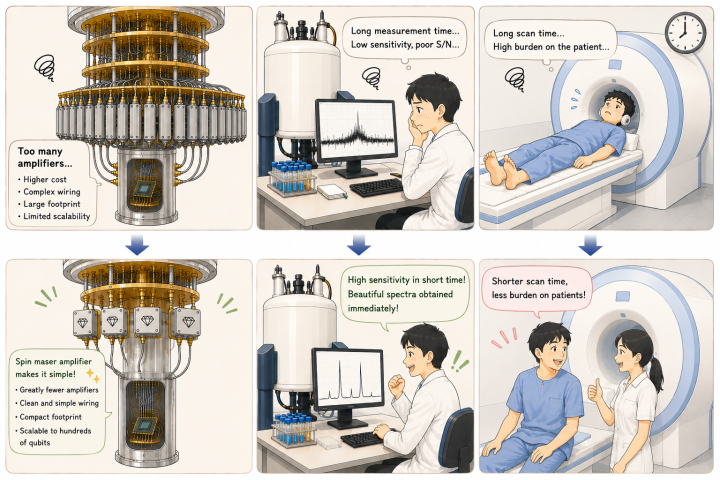
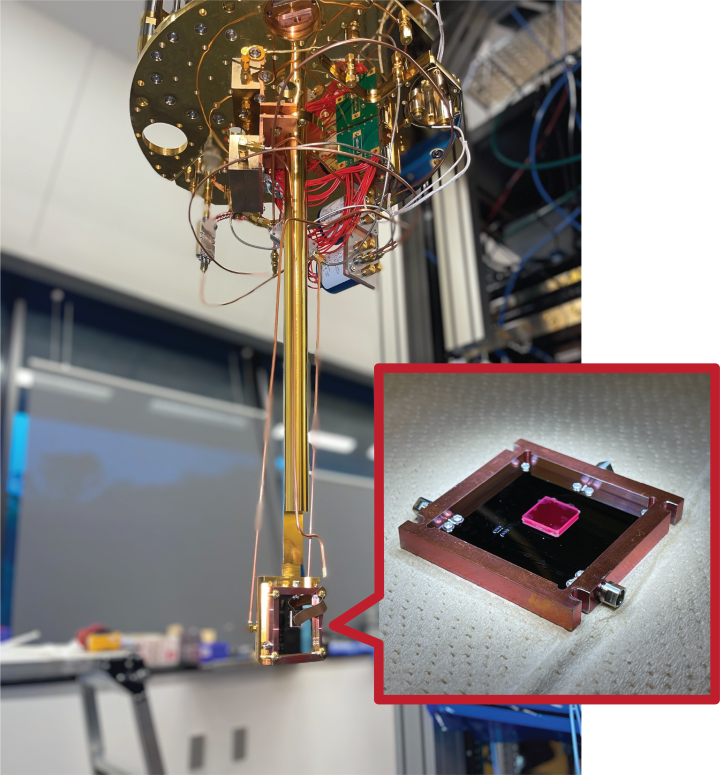
We are developing a new ultra-low-noise microwave amplifier stable at cryogenic temperatures, which uses impurity spins inside crystals such as ruby to amplify microwave signals through a process called microwave amplification by stimulated emission of radiation, or maser — the microwave equivalent of a laser.
Our amplifier will combine very low noise with the ability to handle much stronger signals than conventional designs, and to operate in static magnetic fields found in real-world use cases. We are developing a traveling-wave design that aims for more than 20 dB of gain (100 times in power), about 1 GHz of bandwidth, and a saturation power above 1 µW.
For quantum computing, this could allow one amplifier to handle more readout signals, reducing the number of amplifiers needed as the number of qubits grows. For magnetic resonance, including NMR and MRI, the same low-noise amplification could improve signal detection and help shorten measurement and scan times.
Other resources:
- Patent: Ultra-low noise cryogenic microwave amplification
- Research paper: A near-quantum-limited diamond maser amplifier operating at millikelvin temperatures
- Outreach video: Developing a Spin-Based Ultra-Low-Noise Amplifier for Microwave Quantum Technologies
- News article: Developing a Spin-Based Ultra-Low-Noise Amplifier for Microwave Quantum Technologies