


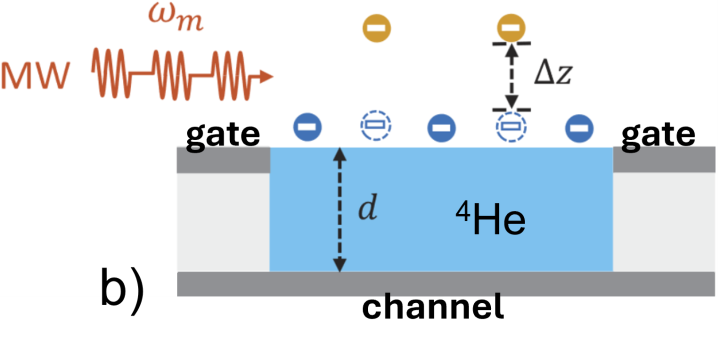
A key limitation preventing electron-on-liquid-helium systems to become a viable system for quantum computing is their lack of precise, efficient energy delivery. Electrons on liquid helium are attracted to the helium surface by their image charge inside the helium and repelled by the helium's interface potential barrier, resulting in large transition energies and anharmonic quantum Rydberg (vertical) states, reducing unwanted transitions, and with it reducing noise and increasing quantum coherence. However, while electron-on-liquid-helium systems are predicted to offer exceptionally long coherence times due to their clean, defect-free environment, current systems are limited in operation speed and energy efficiency caused by inefficient microwave delivery, and experience interference from standing waves, limiting the achievable electric field at the electron location and thus the gate speed.
Quasioptical Microwave Field Enhancement for Electron-on-Helium Qubits
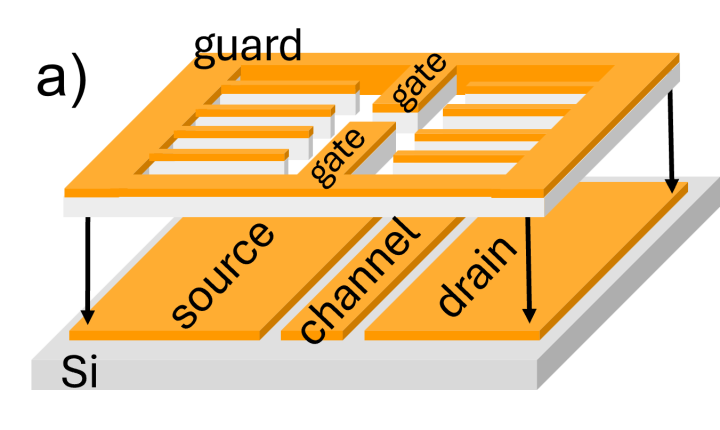
Horizontal cross-section of the hermetic He cell where the microchannel sample chip is inserted, allowing the increase of delivery efficiency of microwave radiation, which is injected using a waveguide hermetically plugged into the He cell.
This project uses an innovative application of quasioptical techniques to improve the efficiency of energy transfer and thereby improve the delivery of microwave signals to electron-on-liquid-helium qubits. This approach is expected to accelerate qubit operations by up to an order of magnitude, along with a theoretically up to four orders of magnitude reduction in power consumption, helping unlock the full potential of electrons-on-helium as a new quantum computing platform.
Spectral measurements of the e-on-4He transition from the ground state to the first excited state with 28.5 dB ripples.