


- Project team: Mitchell de Vries, Anshuman Nayak, Alexander Hodges, Jason Twamley
- Host unit: Quantum Machines Unit
- Project duration: 1 July 2026 – 30 June 2027
- Keywords: Education, Quantum, Qubit, Diamond, Physics
The Kawaii-QuBit — Educational Diamond Quantum Teaching Tool

Problem
Quantum technologies are becoming hugely important across industry, research, and education, with over USD 2 billion in investments last year and planned applications in quantum communications, quantum sensing, and quantum computing.
However, current educational tools available to prepare the next generation of engineers and physicists to develop advanced quantum technologies are limited: existing products are expensive and lack transparency, leaving many institutions unable to access and integrate hands-on quantum experiments into the classroom.
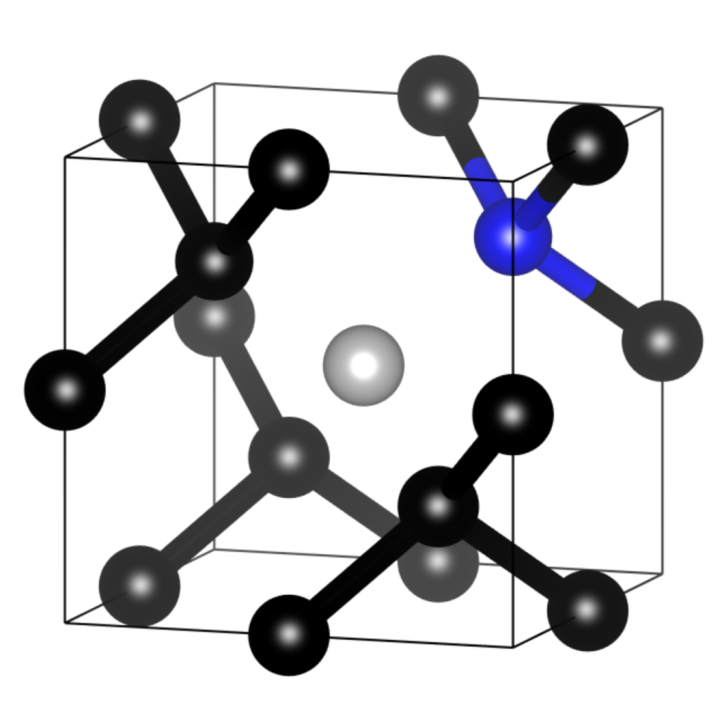
Figure 1. An NV center is a defect in the diamond crystal lattice (black) containing a single nitrogen (blue) and a missing carbon (white) atom. This defect forms an incredibly stable quantum system which is at the heart of the Kawaii QuBit.
Solution
The Kawaii QuBit Educational Quantum Teaching Tool is a learning kit which will offer an affordable, accessible platform for interacting directly with a diamond-based spin qubit, specifically the nitrogen-vacancy (NV) centre. The NV centre is a well-understood qubit which is stable at room temperature and is addressed using visible light and microwaves, avoiding the expensive and complicated systems needed for many other qubit architectures.
Building on Python-programmable hardware, the Kawaii QuBit will support an open design and understandable code, allowing educators and students to learn about the underlying physics of our quantum world as well as scientific programming. Unlike current offerings, the Kawaii QuBit will emphasise low cost, open construction, and accessibility. This will bring the growing world of quantum hardware to the next generation of researchers and engineers.
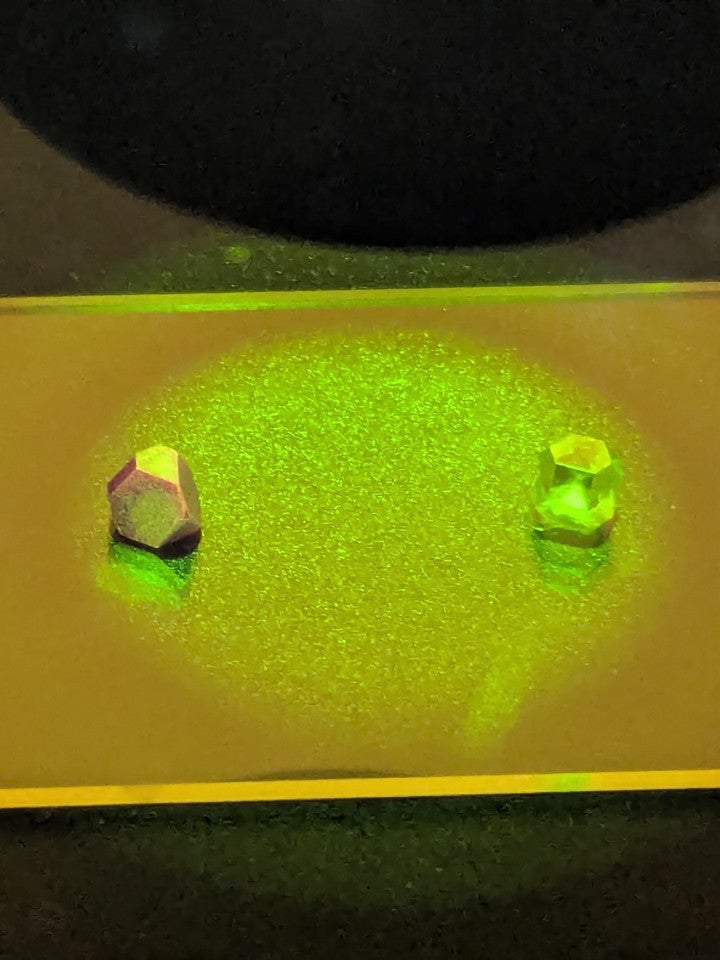
Figure 2. Diamonds containing the NV quantum defect (left) emit red light when under green light, while those without (right) do not.