


- Project team: Luis K. Ono, Ryota Kabe, Ruttapol Malatong, Kaede Kawaguchi, Yuxiang Guan, Chandramouli Kulshreshtha, Shengnan Zuo
- Host unit: Organic Optoelectronics Unit
- Project duration: 1 September 2026 – 31 August 2027
- Keywords: Solar cells, Energy, Photovoltaics, Transparent materials, Perovskite; Building-integrated photovoltaics (BIPV)
Development of Transparent Perovskite Solar Cells

Problem
At first glance, the concept of transparent solar cells appears to be a contradiction. Conventional solar cells generate electricity by absorbing sunlight, whereas transparent materials allow light to pass through without significant absorption. To produce electricity, a solar cell must absorb photons, but excessive absorption reduces transparency and compromises application efficiency. The challenge is therefore to harvest solar energy without noticeably affecting visible light transmission.
Once this challenge is overcome, potential applications of transparent photovoltaic technologies include the integration of transparent photovoltaic modules in building or vehicle skylights, which will provide energy while allowing natural light penetration, or the use in self-powered transparent biosensors for biomedical applications, which enable wireless health monitoring through bio-integrated wearable electronics. Another promising application is agrivoltaics, where transparent photovoltaic panels can be incorporated into greenhouse roofs to generate electricity while supporting crop growth through optimized light transmission.
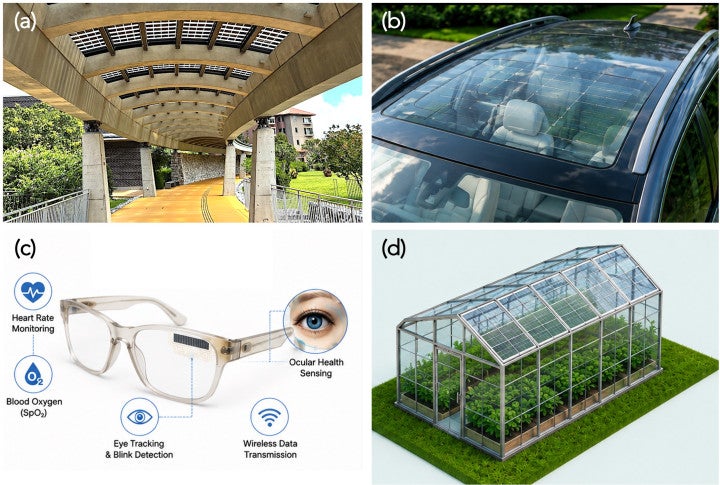
Figure 1. Potential applications of transparent photovoltaic technologies. (a) Skylights; (b) vehicle sunroofs; (c) biosensors for biomedical applications and wearable electronics; (d) agrivoltaics for greenhouse roofs.
Solution
One approach to designing transparent solar cells is to selectively absorb ultraviolet (UV) and near-infrared (NIR) wavelengths, which are invisible to the human eye, while transmitting most visible light. This selective absorption is achieved through compositional engineering of perovskite semiconductors, where the optical properties can be tuned by adjusting the ratios of different cations and anions. Additional defect-passivation, interface-engineering, and encapsulation strategies employing organic molecular designs will be employed to improve efficiency and stability. Solving this problem will expand the development of renewable and sustainable electricity generation by enabling energy harvesting from existing infrastructures, transportation systems, and transparent electronic devices while preserving functionality and aesthetic value.
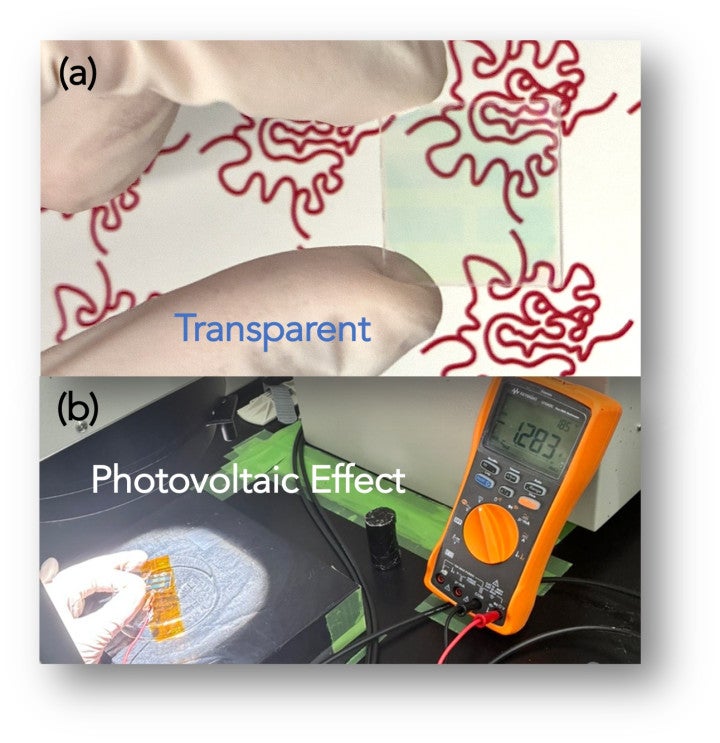
Figure 2. (a) Optical transparency of the perovskite absorber. (b) Demonstration of the photovoltaic response under the artificial sun light illumination.
Other resources: