Ion trap and cavity developments for large-scale quantum computing
Problem
Quantum computers based on trapped ions are among the most promising platforms for solving problems far beyond the reach of classical machines. However, the key challenge remains scalability. Current ion trap systems allow only tens of ions, while millions are needed for practical quantum computing. Researchers are forced to spend over a year designing and fabricating custom ion traps and miniature optical cavities before beginning actual experiments, diverting time and resources from core research.
Commercial ion traps that meet the needs of both academic and industrial researchers are not readily available, and existing solutions are bulky, expensive, or suffer from fundamental design limitations. Solving the scalability barrier of ion traps is essential to accelerate advances in computing, communications, and precision measurement, and to make quantum technologies widely accessible.
Solution
Our project is developing two complementary technologies to address ion trap scalability: barrierless x-junctions and miniature optical cavities. This work builds upon a breakthrough that directly addresses a decade-long bottleneck in the quantum charge-coupled device (QCCD) architecture. As part of the project, we are also developing high-finesse miniature optical cavities that provide efficient photon collection and interconnect multiple ion traps through photonic channels. These two approaches together pave the way toward large-scale trapped-ion quantum processors. By combining fast 3D-printing-based fabrication methods with in-house expertise, we can rapidly deliver tested ion traps and cavities, accelerating research in quantum computing, metrology, and fundamental physics.
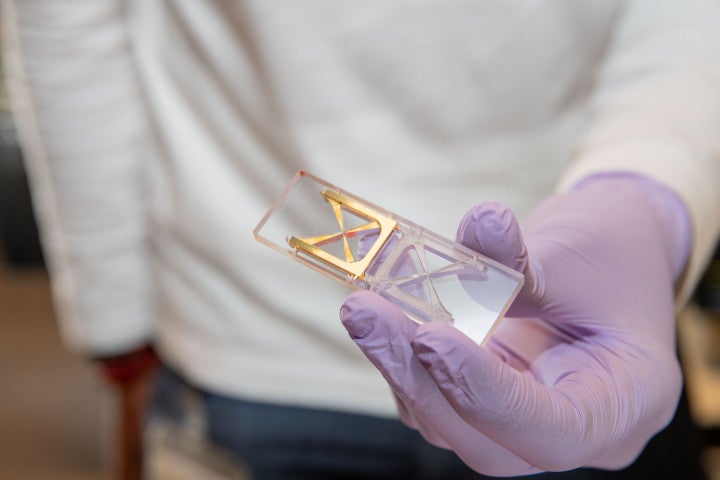
Figure 1. A gold-plated 3D printed ion trap on top of the glass substrate it was machined out of.