Reducing Quadcopter Performance Degradation via Statistical Physics
Problem
The primary performance limitation for battery-driven autonomous vehicles, whether flying or driving, is the peak battery discharge rate. This degrades their performance when responding to unexpected environmental fluctuations (UEFs). Designers often assume a Gaussian distribution for UEFs, although actual fluctuations deviate from this. To mitigate risks, they adopt a fatter Gaussian distribution, leading to overly aggressive controllers and significant energy waste. An optimal trajectory, such as a quadcopter's flight path, is compromised by these aggressive designs, leading to degraded performance and increased energy consumption. Additionally, systems designed to handle peak discharge rates require heavier components like thicker wires and structurally stronger battery cages, further increasing the system’s payload. Moreover, designing for worst-case scenarios necessitates extra cooling structures such as heat sinks, adding dead weight and resulting in overdesigned and inefficient systems.
Solution
We focus on quadcopter flight in unsteady wind with electrical power, mechanical power, and power from interaction with the unsteady flow field (~u^3; u being the relative velocity between quadcopter and wind) as the UEF. The PoC will demonstrate: 1) All three forms of power have non-Gaussian distribution. 2) Using data obtained from collaborator, we will see how the distributions of power and their spectra compares with their corresponding functional forms which we have already derived. 3) We will use the knowledge of the spectrum of power fluctuations to see if this information can help design better control strategies, whether robust, adaptive, or another type, for improved performance of the quadcopter.
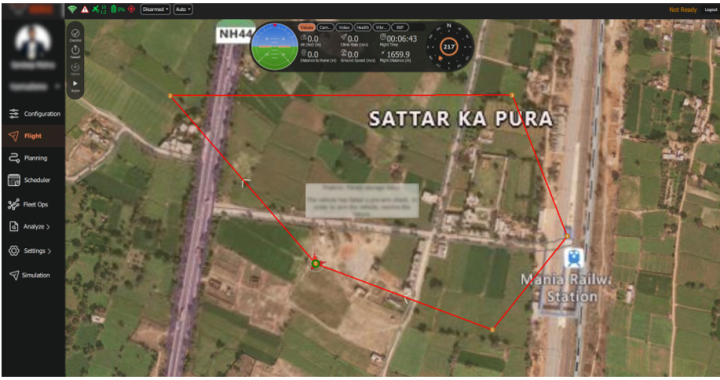
Figure 1. An example of a quadcopter's flight path on the Vyorious Ground Station viewer. Vyorious is the company collaborating on this project.