
SQuIP

Solid State Systems for Quantum Information Processing International Workshop

June 8, 2026 - June 12, 2026

SQuIP

About the Workshop

Quantum Information Processing (QIP) leverages the principles of quantum mechanics—superposition, entanglement, and measurement—to encode, process, and transmit information in ways that classical systems cannot achieve. By overcoming the limitations of conventional digital architectures, QIP promises transformative advances in computing, communication, and sensing.

Silicon-based microelectronics, powered by complementary metal-oxide-semiconductor (CMOS) technology, has driven decades of innovation, but further miniaturization of transistors is approaching fundamental limits. Yet, the vast industrial expertise in high-volume semiconductor fabrication provides an unprecedented opportunity: to merge these mature processes with quantum functionalities and establish solid-state platforms as a scalable basis for quantum technologies.

Solid-state QIP has therefore become one of the most dynamic areas of Quantum Science and Technology. Progress is being made across a spectrum of approaches, including:

  • Superconducting Qubits,
  • Semiconductor Spin Qubits,
  • Defect- and Dopant-Based Spin Qubits,
  • Hybrid Architectures.

Together, these solid-state platforms are advancing toward robust elementary operations, quantum error correction, on-chip networking, and integration with classical control electronics.

The goal of this workshop is to bring together leading scientists and emerging researchers from across these diverse approaches. By sharing recent results, identifying common challenges—such as decoherence, materials engineering, and scalable integration—and exploring new ideas, we aim to foster collaborations that will drive the next phase of solid-state quantum information processing. The program will feature invited and contributed talks, as well as poster presentations, providing ample opportunities for both established and early-career researchers to engage, exchange insights, and build new connections.

Table of Contents

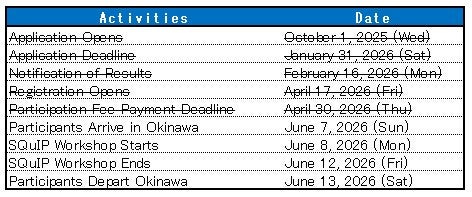
Timeline

SQuIP Timeline

Basic Information

  • Date: June 8 (Mon) -12 (Fri), 2026
  • Location: Okinawa Institute of Science and Technology (OIST), OIST Main Campus Sydney Brenner Lecture Theater (Seminar Room B250), Onna Village, Okinawa, Japan
    Google Map: https://maps.app.goo.gl/68pjmEumVZ1zL3z37 
  • Registration Fee: 40,000 JPY (approx. 235 EUR / 275 USD). Includes meals (lunch, dinner, and refreshments) provided during the workshop. This fee applies to participants only. Invited speakers are exempt from the registration fee.
  • Structure: The workshop will feature invited talks in English by leading Japanese and international experts. These will be complemented by accessible contributed talks from selected participants.
  • Poster Presentation: While poster presentation is not mandatory, we warmly encourage participants to present a poster showcasing their current research.
  • Accommodation: Participants may need to arrange and cover their own accommodation. A limited number of shared twin rooms on the OIST campus might be offered, but this is not guaranteed. Please note: arranging your own accommodation will not reduce the registration fee.

Invited Speakers

  • Nir Bar-Gill, Hebrew University
    Title: "Quantum coherence and control in Diamond"
  • Monica Benito, University of Augsburg
    Title: "Optimal gauge choice for spin-photon coupling effective Hamiltonians"
  • Susan Coppersmith, The University of New South Wales
    Title: "Decoherence of Majorana qubits by 1/f noise"
  • Mayer Feldman, Intel
    Title: "Scaling Spin Qubits in Silicon"
  • Fernando Gonzalez-Zalba, CIC nanoGUNE/ Quantum Motion
    Title: "Recent advances in readout of semiconductor spin qubits"
  • Tanner Janda, University of California, Los Angeles
    Title: "Molecular spectroscopy and scalable microwave control of Si/SiGe spin qubits"
  • Fedor Jelezko, University of Ulm
    Title: "Optically addressable spin systems for light-matter quantum interfaces"
  • Tetsuo Kodera, Tokyo Institute of Technology
    Title: "Fundamental technology research toward the integration of semiconductor spin qubits"
  • Thaddeus Ladd, HRL Laboratories
    Title: "A digitally controlled silicon quantum processing unit"
  • Xinhao Li, Westlake University
    Title: "Coherent multi-qubit operation with electrons on solid neon"
  • Stephen Lyon, Princeton University
    Title: "Efficient Parallel Shuttling of Electron Spin Qubits Above Helium-filled Micro-Channels"
  • Johannes Majer, University of Science and Technology of China
    Title: " Quantum Optics with Spins and Superconducting Circuits"
  • Yuta Matsumoto, Delft University of Technology
    Title: "Semiconductor Spin Shuttling for High-Speed Quantum Gates and Reconfigurable Connectivity"
  • Hiroyuki Moriya, NTT, Inc.
    Title: "Nonreciprocal propagation of surface acoustic wave induced by magnon-phonon coupling in a single magnetic layer"
  • Johannes Pollanen, Michigan State University
    Title: "Strong coupling of a microwave photon to an electron on helium"
  • Anthony Sigillito, University of Pennsylvania
    Title: "Fast, electrical control of multielectron Si-MOS spin qubits via intrinsic spin-orbit coupling"
  • Lars Schreiber, RWTH Aachen University
    Title: "Scalability with conveyor-belt spin-qubit shuttling in Si/SiGe"
  • Kosuke Takiguchi, NTT, Inc.
    Title: "Electronic transport properties of titanium nitride grown by molecular beam epitaxy"
  • Michael Trupke, Austrian Academy of Sciences
    Title: "Quantum technology with spin centres in crystals"
  • Jun Wang, RIKEN
    Title: "Coupling Electrons on Solid Neon to a Superconducting Resonator"
  • Xiao Xue, University of Science and Technology of China/Hefei National Laboratory
    Title: "Quantum computation with spins in silicon: coherence, integration, and scaling"
  • Jun Yoneda, University of Tokyo
    Title: "Exploring Correlated Noise in Silicon Qubit Devices"
SQuIP Workshop Program

Invited and Short Talk Schedule

Monday, June 8

10:15–11:00

  • Fernando Gonzalez-Zalba (CIC nanoGUNE & Quantum Motion, Spain/UK)
    Recent advances in readout of semiconductor spin qubits

11:00–11:45

  • Anthony Sigillito (University of Pennsylvania, USA)
    Fast, electrical control of multielectron Si-MOS spin qubits via intrinsic spin-orbit coupling

13:15–14:00

  • Thaddeus Ladd (HRL Laboratories, USA)
    A digitally controlled silicon quantum processing unit

14:00–14:45

  • Tanner Janda (University of California, Los Angeles, USA)
    Molecular spectroscopy and scalable microwave control of Si/SiGe spin qubits

14:45–15:30

  • Mayer Feldman (Intel Corporation, USA)
    Scaling Spin Qubits in Silicon

16:00–17:00 (Short Talks)

  • Giovanni Francesco Diotallevi (University of Augsburg, Germany)
    The role of electric fields in semiconductor hole spin-qubits
  • Manuel Guatto (Forschungszentrum Juelich, Germany)
    Real-time adaptive quantum error correction by model-free multi-agent learning

17:30–17:55 (SIP Industry Session)

  • Hiroyuki Moriya (NTT Corporation, Japan)
    Nonreciprocal propagation of surface acoustic wave induced by magnon-phonon coupling in a single magnetic layer

Tuesday, June 9

09:00–09:45

  • Fedor Jelezko (University of Ulm, Germany)
    Optically addressable spin systems for light-matter quantum interfaces

10:15–11:00

  • Michael Trupke (Austrian Academy of Sciences, Austria)
    Quantum technology with spin centres in crystals

11:00–11:45

  • Nir Bar-Gill (Hebrew University of Jerusalem, Israel)
    Quantum coherence and control in Diamond

14:45–15:30

  • Stephen Lyon (Princeton University, USA)
    Efficient Parallel Shuttling of Electron Spin Qubits Above Helium-filled Micro-Channels

15:30–16:15

  • Lars Schreiber (RWTH Aachen University, Germany)
    Scalability with conveyor-belt spin-qubit shuttling in Si/SiGe

16:45–17:30

  • Yuta Matsumoto (Delft University of Technology, Netherlands)
    Semiconductor Spin Shuttling for High-Speed Quantum Gates and Reconfigurable Connectivity

17:30-18:15 (Short Talks)

  • Felix Motzoi (University of Cologne, Germany; Forschungzentrum Juelich, Germany)
    Long distance spin shuttling and logical gates enabled by few-parameter velocity optimization
  • David Fernandez-Fernandez (University of Augsburg, Germany; Institute of Materials Science of Madrid (ICMM-CSIC), Spain)
    Spin-orbit-enabled realization of arbitrary two-qubit gates on moving spins

Thursday, June 11

09:00–09:45

  • Monica Benito (University of Augsburg, Germany)
    Optimal gauge choice for spin-photon coupling effective Hamiltonians

10:15–11:00

  • Jun Yoneda (University of Tokyo, Japan)
    Exploring Correlated Noise in Silicon Qubit Devices

11:00–11:45

  • Xiao Xue (USTC & Hefei National Laboratory, China)
    Quantum computation with spins in silicon: coherence, integration, and scaling

14:45–15:30

  • Tetsuo Kodera (Tokyo Institute of Technology, Japan)
    Fundamental technology research toward the integration of semiconductor spin qubits

15:30–16:15

  • Susan Coppersmith (The University of New South Wales, Australia)
    Decoherence of Majorana qubits by 1/f noise

16:45-17:30 (Short Talks)

  • Beatriz Perez Gonzalez (University of Augsburg, Germany)
    Floquet theory for the quantum-to-classical crossover of light-matter models
  • Jose Jesus (Forschungszentrum Juelich, Germany)
    Analytical blueprint for 99.999% single-qubit gate fidelities via multi-photon error suppression on present hardware

Friday, June 12

09:00–09:45

  • Johannes Majer (University of Science and Technology of China, China)
    Quantum Optics with Spins and Superconducting Circuits

10:15–11:00

  • Xinhao Li (Westlake University, China)
    Coherent multi-qubit operation with electrons on solid neon

11:00–11:25 (SIP Industry Session)

  • Kosuke Takiguchi (NTT Corporation, Japan)
    Electronic transport properties of titanium nitride grown by molecular beam epitaxy

13:30–14:15

  • Johannes Pollanen (Michigan State University, USA)
    Strong coupling of a microwave photon to an electron on helium

14:15–15:00

  • Jun Wang (RIKEN, Japan)
    Coupling Electrons on Solid Neon to a Superconducting Resonator

15:30-16:15 (Short Talks)

  • Dimitrios Georgiadis (Forschungszentrum Juelich, Germany)
    Analytical flux-tuned iSWAP pulse suppressing leakage channels
  • Janis Peter (University of Tuebingen, Germany)
    Tunable Dispersive and Dissipative Photon-Pressure Interactions in Superconducting Circuits

Poster Sessions

Poster sessions are scheduled for:

  • Tuesday, June 9: 13:15–14:45
  • Thursday, June 11: 13:15–14:45

Please note that we do not provide a poster printing service. Kindly ensure that your poster is printed before arriving in Okinawa and that you bring it with you.

Posters should be A0 size in portrait orientation.

SIP Industry Events

SIP (Cross-ministerial Strategic Innovation Promotion Program) is a national program led by the Council for Science, Technology and Innovation (CSTI) of the Japanese government. The program promotes scientific and technological innovation through interdisciplinary collaboration across ministries, academia, and industry. OIST participates in the SIP3 Quantum theme of this program.

During SQuIP, the following SIP Industry Events will be held. These events aim to promote networking between international and domestic academic participants and representatives of Japanese industry. They also provide opportunities for researchers to learn more about research activities, collaboration opportunities, and career paths within participating companies.

In addition, participating companies will have the opportunity to showcase their work during the poster session, highlighting their research, potential collaborations, and career opportunities.

June 8 (Monday)

17:00–18:00 | SIP Industry Session

  • 17:00–17:30 | Pitch Talks
    Yuichi Nakamura (NEC Corporation, Japan)
    Introducing the Activities of NEC’s Quantum Technology
    Yu Yamashiro (Jij Inc., Japan)
    Bridging Quantum Research and Industrial Applications: Jij’s Software Approach
    17:30–17:55 | Topical Research Talk
    Hiroyuki Moriya (NTT Basic Research Laboratories, Japan)
    Nonreciprocal Propagation of Surface Acoustic Waves Induced by Magnon–Phonon Coupling in a Single Magnetic Layer

June 9 (Tuesday)

13:15–14:45 | Poster Session

SIP Industry Company Posters

  • Yuichi Nakamura (NEC Corporation, Japan)
    NEC’s Activities in Quantum Technologies
  • Yu Yamashiro (Jij Inc., Japan)
    Quantum, AI, and Optimization for Complex Planning Challenges

June 11 (Thursday)

13:15–14:45 | Poster Session

SIP Industry Company Posters

  • Naoki Takekoshi (IHI Corporation, Japan)
    Diamond NV Center Experimental Training in the SIP Program at OIST
  • Masatoshi Yaji (Toyo Corporation, Japan)
    Connecting Quantum Technologies, Advanced Measurement, and Future Industries: Building a Quantum Ecosystem through a Technology Solutions Provider

June 12 (Friday)

11:00–12:00 | SIP Industry Session

  • 11:00–11:25 | Topical Research Talk
    Kosuke Takiguchi (NTT Basic Research Laboratories, Japan)
    Electronic Transport Properties of Titanium Nitride Grown by Molecular Beam Epitaxy
  • 11:25–11:55 | Pitch Talks
    Naoki Takekoshi (IHI Corporation, Japan)
    Diamond NV Center Experimental Training in the SIP Program at OIST
    Yasunari Tanaka (Toyo Corporation, Japan)
    Connecting Quantum Technologies, Advanced Measurement, and Future Industries: Building a Quantum Ecosystem through a Technology Solutions Provider

Organizers

  • William Munro, Quantum Engineering and Design Unit, OIST (website)
  • Denis Konstantinov, Quantum Dynamics Unit, OIST (website)
  • Yuimaru Kubo, Science and Technology Group, Hybrid Quantum Device Team, OIST (website)

Administrative Support

  • Megumi Ikeda, RUA Group, OIST
  • Slawomir Rosiek, OIST Center for Quantum Technologies (OCQT) Administration Office, OIST
  • Naomi Sato, RUA Group, OIST
  • Taki Tazuke, RUA Group, OIST

Code of Conduct

Purpose
To ensure that all participants have a clear understanding of the behavior that is expected of them.

Code of Conduct
We are committed to making our workshops (workshop(s) organized by OIST, hereinafter “our workshop(s)”) an inclusive space for sharing ideas and knowledge. We will not tolerate disrespectful communication, discrimination, harassment, or bullying in any form. As such, all participants attending our workshops are required to comply with this Code of Conduct. To provide all participants the opportunity to benefit from our workshops, we at OIST are dedicated to a positive, safe and harassment-free experience. Harassment in any form is specifically prohibited.

What is Harassment?
Harassment involves continued antisocial or unreasonable actions that violate a reasonable person’s personal rights and/or dignity and cause mental suffering, and thus worsen the person’s environment or make him/her anxious about participation. Behavior that is acceptable to one person may not be acceptable to another, so we ask that you use discretion to be sure that respect is communicated. Harassment intended in a joking manner nevertheless constitutes unacceptable behavior. Speech that is not welcomed or that is personally offensive, whether it is based on gender, age, sexual orientation, mental or physical disability, ethnicity, national origin, religion etc. will not be tolerated.
 
If you are being harassed, notice that someone else is being harassed, or have any other concerns, please bring this to the immediate attention of the organizers. If you wish to report an issue concerning the organizers, you can contact the Conference and Workshop Section directly and submit a confidential report by sending an email to workshop-codeofconduct@oist.jp or submitting a report through the ⁠webform.

All complaints will be taken seriously and responded to by the Dean of Research promptly. Confidentiality will be maintained to the extent that it does not compromise the rights of others. Individuals found in breach of this Code of Conduct will be dismissed from the workshop immediately. Retaliation for reporting harassment is also a violation of Code of Conduct, as is reporting an incident in bad faith.

Be Aware of Travel Arrangement Scam!

Workshop organizers and invited speakers are often contacted by number of "travel agencies" to which OIST is not related, based on the publicly available information on the web.

Please refrain from replying to those agencies unless OIST organizers or secretariat have explicitly contacted you beforehand.
When in doubt, please send a copy of any email communication to the SquIP Organizing Team (squip [at] oist.jp) and OIST Conference and Workshop Section (workshop [at] oist.jp).

Contact

Secretariat

  • Email: squip [at] oist.jp
  • Mail: OIST Center for Quantum Technologies
    1919-1 Tancha, Onna-son, Okinawa 904-0495 JAPAN
SQuIP Poster