The last hundred years have seen a revolution in quantum science. But how close are we to quantum computers that can tackle real-world problems? Researchers at OIST explain what it takes to build a quantum computer — and why it matters.
How to build a quantum computer
The last hundred years have seen a revolution in quantum science. But how close are we to quantum computers that can tackle real-world problems? Researchers at OIST explain what it takes to build a quantum computer — and why it matters.
Going beyond the classical computer
From the room-sized calculators of the 1950s to the slimline laptops and smartphones of today, classical computers have become astonishingly fast and powerful. Yet there are still many problems they struggle to solve — especially those involving complex interactions, enormous numbers of possibilities, or the behavior of matter at the smallest scales.
Quantum computers are not faster versions of classical machines, but fundamentally different devices designed to solve specific classes of computational problems.
Instead of processing information using only 0s and 1s, they harness the laws of quantum physics to explore many possibilities at once.
From global logistics and climate modeling to chemistry and materials science, many of the challenges we face today are extraordinarily complex. Quantum computers give us a new way to approach these problems.
Unlike classical computers, whose power grows roughly linearly, quantum computers have the potential to tackle problems that grow exponentially in complexity. If realized at scale, this could enable:
Deeper insights into fundamental science
More secure communication and cryptography
Smarter use of resources in energy and logistics
Faster discovery of new drugs and materials
However, today’s quantum computers are still early prototypes. Major challenges — such as error correction, fault tolerance, and scalability — must be overcome before they can be widely useful. These challenges are at the heart of OIST’s quantum research.”
Introducing our quantum experts
Are you a researcher looking for your next lab or collaborator, or a journalist looking for a quantum research quote? Have a browse of OIST’s quantum researchers.
Building a quantum computer requires much more than a single breakthrough. It is a carefully engineered system that combines physics, materials science, electronics, software, and cryogenic engineering.
A classical computer is founded on binary code, formed of bits—cascading series of 0s and 1s that, when strung together, represent data.
In quantum computers, quantum bits, or qubits, can be 0s, 1s or a superposition of both states at once. Multiple qubits can also become entangled, meaning their states are linked in ways that have no classical equivalent. Together, these properties allow quantum computers to represent and process information far more efficiently for certain tasks.
There are several physical ways to make qubits. At OIST and around the world, researchers are exploring different platforms, each with its own advantages and challenges. Find out more in our video.
Qubits are the foundations of quantum computing. Compared to classical bits, they have special properties that enable quantum computers to represent and process information far more efficiently for certain tasks. But how are qubits made?
Qubits are the foundations of quantum computing. Compared to classical bits, they have special properties that enable quantum computers to represent and process information far more efficiently for certain tasks. But how are qubits made?
No method for qubit creation is perfect; each comes with its own challenges, such as stability or scalability. And once qubits are made, we still need to be able to manipulate and read the data, so there are many aspects that need to come together to build practical quantum computers.
Together with global collaborators, OIST researchers use theoretical, experimental and engineering approaches to tackle challenges in qubit generation, quantum computing and communication, and beyond.
Creating qubits is only the first step. To perform calculations, researchers must precisely control how qubits change and interact.
This is done using quantum gates — basic operations that manipulate qubits. Some gates flip a qubit’s state, others place it into superposition, and others entangle pairs of qubits.
Sequences of quantum gates form a quantum circuit, which is executed on a quantum processor or chip. Designing circuits that perform useful calculations while minimizing errors is a major area of research.
At the end of a quantum computation, the quantum state of each qubit must be measured.
Readout systems convert fragile quantum information into classical signals — ordinary 0s and 1s — that can be processed and analyzed using conventional computers. Designing accurate and reliable readout methods is crucial, as measurement errors can obscure the results of a computation.
Building quantum tech hardware: proof-of-concepts at OIST
Most quantum systems are extremely sensitive to their environment. Heat, vibrations, or stray electromagnetic signals can quickly destroy quantum behavior — a process known as decoherence.
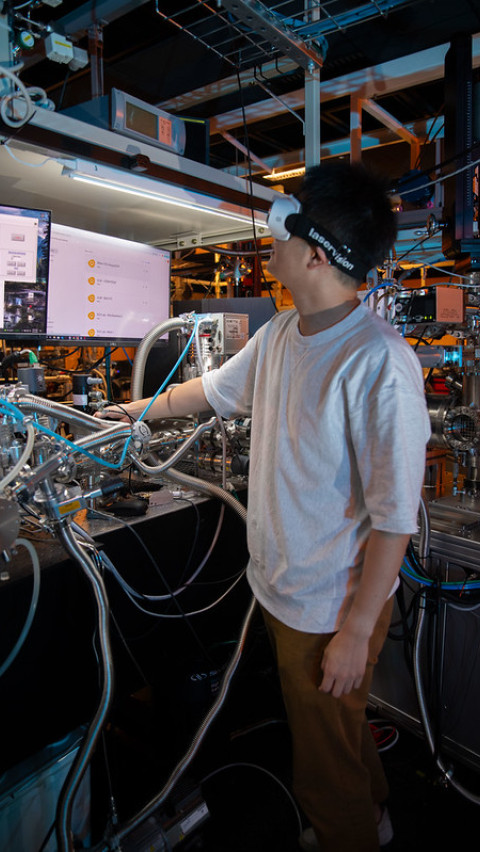
To prevent this, many quantum processors operate at temperatures just fractions of a degree above absolute zero, inside specialized cryogenic refrigerators. They are controlled using precisely timed electronic and microwave pulses.
At OIST, researchers such as Dr. Yuimaru Kubo are developing next-generation quantum hardware that integrates qubits, control electronics, and readout systems more efficiently.
Interested in building the next generation of quantum computers?
Quantum research is highly interdisciplinary, bringing together physicists, engineers, computer scientists, and materials researchers. There are many ways to work with OIST.
PhDs and internships
Develop a secure foundation in the fundamentals of your field and encounter unparalleled opportunities for cross-disciplinary research in our PhD and research internship programs.
So, why aren’t quantum computers commonplace in everyday life yet? The answer lies in a set of formidable scientific and engineering challenges that researchers are actively working to overcome. Hear how OIST researchers are tackling some of these complexities.
Quantum systems are inherently fragile. Interactions with the environment, imperfect gate operations, or inaccurate measurements can introduce errors into calculations.
Researchers can address this problem using quantum error correction and fault-tolerant architectures, which encode information across many qubits. This means that errors can be detected and corrected without destroying the computation.
Today’s quantum computers typically operate with tens or hundreds of qubits. Practical applications may require thousands or millions.
However, as more qubits are added:
Errors tend to increase
Qubits become harder to control and synchronize
Software and error-correction demands grow rapidly
This makes scaling up one of the defining challenges of quantum computing.
Even with a powerful quantum computer, success depends on how it is used.
Which problems truly benefit from quantum approaches? How do we design algorithms that make effective use of quantum resources? It is important to identify meaningful applications as quantum technology continues to mature.
Building fault-tolerant quantum computers requires interdisciplinary collaboration across disciplines and institutions.
The OIST Center for Quantum Technologies (OCQT) serves as a hub for this effort, bringing together researchers working on theory, experiments, engineering, and applications. Through its projects, events, and training programs, OCQT supports the next generation of quantum scientists and drives progress toward practical quantum technologies. Learn more about the OCQT’s people, projects, events and job openings on their website.