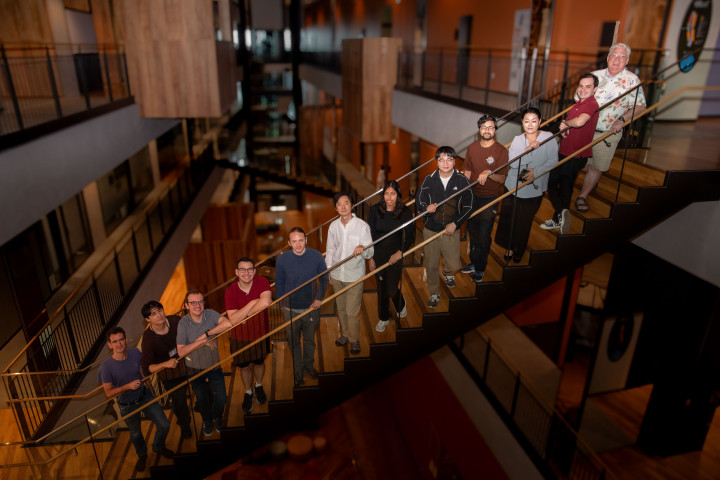
1. MEMBERS
・ Dr. Seungbum Chin, Staff Scientist
・ Dr. Ivan Iakoupov, Postdoctoral Scholar
・ Dr. Heitor Peres Casagrande, Postdoctoral Scholar
・ Dr. Oliver Bellwood, Postdoctoral Scholar
・ Dr. Peizhe Li, Postdoctoral Scholar
・ Dr. Steven Sagona Stophel, Postdoctoral Scholar
・ Hideaki Kawai, PhD Student
・ Alexandra Berenice Barbosa Gonzalez, PhD Student
・ Kacper Nowak, PhD Student (formerly Rotation Student)
・ Biswaranjan Panda, Rotation Student
・ Ms. Naomi Sato, Research Unit Administrator
2. PRIZES AND AWARDS
・ Alexandra Berenice Barbosa Gonzalez, Best poster prize at W4Q Quantum Science conference, March 23-25 (2026)
・ William John Munro, Fellow of SPIE, January 06 (2026)
3. COLLABORATIONS
3.1 Quantum Communication, Repeaters and Networks
Type of collaboration: Joint Research
Researchers:
• Dr Koji Azuma, NTT Basic Research Laboratories (Japan)
• Dr Hiroki Takesue, NTT Basic Research Laboratories (Japan)
• Dr Hsin-Pin Lo, NTT Basic Research Laboratories (Japan)
• Prof Kae Nemoto, OIST (Japan)
3.2 Superconducting Quantum Processors
Type of collaboration: Joint Research
Researchers:
• Prof Xiaobo Zhu, USTC (China)
• Prof Jian-Wei Pan, USTC (China)
• Prof Ming Gong, USTC (China)
• Prof Kae Nemoto, OIST (Japan)
3.3 Hybrid Quantum Systems
Type of collaboration: Joint Research
Researchers:
• Prof Jorg Schmiedmayer, Atominstitut (Austria)
• Prof Johannes Majer, USTC (China)
• Prof Kae Nemoto, OIST (Japan)
3.4 Quantum Batteries
Type of collaboration: Joint Research
Researchers:
• Dr James Quach, CSIRO (Australia)
• Dr Josephine Dias, UQ (Australia)
• Dr Arkady Fedorov,UQ (Australia)
3.5 Quantum Machine Learning
Type of collaboration: Joint Research
Researchers:
• Prof Kae Nemoto, OIST (Japan)
3.6 Architecture and applications for small to large scale quantum computation [MEXT, Quantum Leap Flagship Program] (Principal Investigator: Kae Nemoto)
Type of collaboration: Joint Project
Researchers:
• Prof Kae Nemoto, OIST (Japan)
• Prof Mio Murao, University of Tokyo (Japan)
• Prof Takeaki Uno, National Institute of Informatics (Japan)
3.7 Large-scale distributed quantum computer architecture [JSPS, Grant-in-Aid for Scientific Research(A)] (Principal Investigator: Kae Nemoto)
Type of collaboration: Joint Project
Researchers:
• Prof Kae Nemoto, OIST (Japan)
4.ACTIVITIES AND FINDINGS
4.1 Self-Induced Superradiant Masing
This activity examined collective emission dynamics in a hybrid spin–cavity system and their relevance to stable microwave quantum devices. The work focused on ensembles of nitrogen-vacancy centre spins in diamond coupled to a superconducting microwave cavity, providing a platform for studying many-body effects in solid-state quantum systems. In most treatments of cavity quantum electrodynamics and superradiance, emitters are assumed to be independent and coupled only through the shared cavity field. Direct dipole–dipole interactions between emitters are usually regarded as a source of decoherence that degrades collective behaviour. In this work we showed that such interactions can instead play a constructive role by driving the superradiant dynamics of the spin ensemble. Following an initial superradiant burst, the system produced a sequence of emission pulses that evolved into quasi-continuous masing lasting up to about one millisecond. Measurements and microscopic modelling indicate that this behaviour arises from spectral hole refilling, where spin inversion is redistributed into the subset of spins resonant with the cavity mode. Control experiments ruled out alternative cavity-related mechanisms and confirmed that dipole–dipole interactions between the spins are responsible for the observed dynamics. These results identify a regime in which interacting spin ensembles can sustain long-lived superradiant emission and provide a realistic pathway towards narrow-linewidth solid-state masers. The work also contributes to the broader understanding of collective effects in dense hybrid quantum systems.
4.2 Powering quantum computation with quantum batteries
This activity examined the use of quantum batteries as intrinsic energy sources for cryogenic quantum processors and their potential role in scalable quantum computing architectures. The work addresses a fundamental limitation of present-day quantum computers, where quantum operations depend on continuous energy delivery from room-temperature control electronics, leading to wiring complexity and heat dissipation constraints at cryogenic temperatures. We proposed a scheme in which a bosonic quantum battery provides the energy required to implement quantum logic operations directly within the cryogenic environment. In contrast to classical power sources, a quantum battery can maintain coherence with the computational system and allow stored energy to be reused during the computation. Initializing the battery in a Fock state enables the implementation of arbitrary unitary operations independent of circuit depth through recycling of the precharged energy. The scheme permits entanglement between the quantum battery and the qubits during operation, reducing the initial energy required below conventional energy–fidelity bounds. A universal gate set can be implemented using a single control parameter per qubit, namely its resonant frequency relative to the shared battery mode. Detuning from the battery resonance produces dispersive interactions suitable for multiqubit parity measurements, while operation near resonance enables controlled energy exchange supporting population transfer and entanglement generation. The architecture exploits the all-to-all connectivity of a shared resonator to support multiqubit operations on timescales of order π/g, where g is the qubit–resonator coupling strength. By eliminating the need for individual drive lines, the approach substantially reduces wiring overhead and heat load at cryogenic temperatures, potentially allowing significantly larger quantum processors to be realized. This work establishes quantum batteries as a viable architectural element for scalable quantum computing and provides a framework for integrating energy management directly into quantum processor design.
4.3 Quantum optical reservoir computing powered by boson sampling
This activity investigated the use of boson-sampling photonic systems as platforms for quantum reservoir computing and their potential for practical quantum information processing. The work addresses the broader question of whether computational complexity associated with sampling-based quantum processors can be harnessed for useful tasks.Recent demonstrations of quantum computational advantage have largely been based on sampling problems generated by random quantum circuits. Boson sampling is a prominent example of this approach, where indistinguishable photons propagate through a linear optical interferometer to produce output distributions that are believed to be hard to simulate classically. While such experiments demonstrate computational complexity, identifying practical applications for these systems remains an open challenge. In this work we showed that the random interferometers used in boson-sampling architectures naturally provide the complex high-dimensional mappings required for quantum reservoir computing. The resulting quantum optical reservoir was used to perform image-classification tasks in regimes where the number of optical modes substantially exceeds the number of single-photon inputs. The approach makes use of multi-photon interference to generate the reservoir dynamics, allowing useful information processing without requiring universal quantum control. The results demonstrate that boson-sampling architectures can be used as practical quantum machine-learning devices and provide a pathway for applying sampling-based quantum processors to real computational problems. This work supports the development of photonic quantum processors that can perform useful tasks in the near term without requiring full-scale fault-tolerant quantum computation.
4.4 Fractal path strategies for efficient two-dimensional density matrix renormalization group simulations
This activity investigated algorithmic improvements for tensor-network simulations of two-dimensional quantum many-body systems by examining how different mappings from a two-dimensional lattice to a one-dimensional ordering affect density matrix renormalization group (DMRG) performance. Standard “snake” paths are simple but do not optimally preserve locality. We systematically studied Hamiltonian paths on square lattices up to 8 \times 8 sites and found that fractal space-filling curves consistently improve convergence in ground-state searches. Analysis of locality measures explains the performance gains. A scalable construction based on tiling optimized paths enables improved simulations on larger lattices of strongly correlated quantum systems.
4.5 Quality of service in aggregated quantum networks
This activity examined routing strategies for multipath quantum networks and introduced a quality-of-service (QoS) framework for allocating quantum resources across paths of different lengths. The work analyzed how path assignment, quantum memory coherence times, and quantum error correction jointly affect end-to-end communication fidelity. Both encoded and unencoded transmissions were studied, showing that fidelity cannot be optimized independently of memory lifetimes and resource distribution. While quantum error correction can improve performance in some regimes, it also introduces additional constraints. The results provide a basis for QoS-aware routing strategies for near-term quantum repeater networks.
4.6 Continuous-variable multiplexed quantum repeater networks
This activity investigated continuous-variable quantum repeater architectures based on cat codes for long-distance quantum communication. Conventional cat-code repeater schemes achieve low secret key rates despite recent experimental progress. We proposed multiplexed repeater protocols incorporating a small number of quantum memories or cat-state graph states as additional resources. These approaches significantly increase achievable key rates by several orders of magnitude while remaining compatible with realistic device parameters. The results identify practical routes for improving the performance of continuous-variable repeater systems and support the development of scalable long-distance quantum communication networks.
4.7 Efficient charging of multiple open quantum batteries through dissipation and pumping
This activity investigated scalable charging protocols for open quantum batteries. We studied a scheme in which multiple batteries are charged in parallel by a single charger collectively coupled to a thermal reservoir. While collective dissipation alone becomes inefficient when batteries interact with independent reservoirs, we showed that combining dissipation with incoherent collective pumping enables efficient parallel charging. The mechanism exploits collective bright and dark states that emerge from reservoir-mediated interactions, allowing stable energy storage without global control operations. The results provide a scalable approach to powering distributed quantum devices and contribute to the development of practical quantum battery architectures.
5. PUBLICATIONS
- Pei-Zhe Li, Soumyakanti Bose, Hyunseok Jeong, William J Munro, Kae Nemoto and Nicolò Lo Piparo, Loophole-free Bell-inequality violation between atomic states in cavity-QED systems mediated by hybrid atom–light entanglement, Quantum Sci. Technol. 11, 025027 (2026).
- Shashank Gupta and William John Munro and Carlos Cid, Threshold (Q, P) Distillation of Multipartite Quantum Correlations, Phys. Rev. Research 8, L012036 (2026).
- Yaniv Kurman, Kieran Hymas, Arkady Fedorov, William John Munro, and James Quach, Powering quantum computation with quantum batteries, Phys. Rev. X 16, 011016 (2026).
- Josephine Dias, Hui Wang, Kae Nemoto, Franco Nori and William John Munro, Efficient charging of multiple open quantum batteries through dissipation and pumping, Phys. Rev. A 113, 012617 (2026)
- Hon Wai Lau, Aoi Hayashi, Akitada Sakurai, William John Munro, and Kae Nemoto, Modular quantum extreme reservoir computing, Phys. Rev. A 113, 012429 (2026).
- Wenzel Kersten, Nikolaus de Zordo, Oliver Diekmann, Elena S. Redchenko, Andrew N. Kanagin, Andreas Angerer, William John Munro, Kae Nemoto, Igor E. Mazets, Stefan Rotter, Thomas Pohl, and Jorg Schmiedmayer, Self-Induced Superradiant Masing, Nat. Phys. (2026). https://doi.org/10.1038/s41567-025-03123-0
- Oliver R. Bellwood, Heitor P. Casagrande and William John Munro, Fractal path strategies for efficient two-dimensional density matrix renormalization group simulations, Phys. Rev. B 112, 224433 (2025)
- V. M. Bastidas, H. L. Nourse, A. Sakurai, A. Hayashi, S. Nishio, Kae Nemoto and William John Munro, Equilibration of noninteracting photons and quantum signatures of chaos, Phys. Rev. B 112, 134304 (2025)
- Hiroo Azuma, William John Munro, and Kae Nemoto, Quantum phase transitions in the multiphoton Jaynes-Cummings-Hubbard model, Phys. Rev. A 112, 033709 (2025)
- Nicolò Lo Piparo, William John Munro and Kae Nemoto, Quality of service in aggregated quantum networks, Phys. Rev. A 112, 022611 (2025)
- Akitada Sakurai, Aoi Hayashi, William John Munro, and Kae Nemoto, Quantum optical reservoir computing powered by boson sampling, Optica Quantum 3(3), 238-245 (2025)
- Nicola Montaut, Agnes George, Monika Monika, Farzam Nosrati, Hao Yu, Stefania Sciara, Benjamin Crockett, Ulf Peschel, Zhiming Wang, Rosario Lo Franco, Mario Chemnitz, William John Munro, David J. Moss, José Azaña and Roberto Morandotti, Progress in integrated and fiber optics for time-bin based quantum information processing, Adv. Opt. Technol. 11, 1560084 (2025)
- Pei-Zhe Li, William John Munro, Kae Nemoto, and Nicolo Lo Piparo, Continuous-variable multiplexed quantum repeater networks, Quantum Sci. Technol. 10, 025057 (2025)
- Akitada Sakurai, Aoi Hayashi, William John Munro and Kae Nemoto, Simple Hamiltonian dynamics as a powerful resource for image classification, Phys. Rev. A 111, 052432 (2025)
6. PRESENTATIONS
- Alexandra Barbosa Gonzalez and William Munro, Hybrid Quantum Systems for Quantum Battery Design and Simulation, W4Q Quantum Science conference, Mallorca, Spain, March 23-25 (2026)
- Heitor P. Casagrande, Dario Poletti, Vinitha Balachandran and William Munro, Bath-driven quantum spin transistor, APS Global Physics Summit, Denver, USA, March 15-20 (2026)
- William John Munro, Akitada Sakurai, Aoi Hayashi and Kae Nemoto, Modular photonic quantum reservoir computation for image recognition, Photonics West 2026, San Francisco, USA, January 17 - 22 (2026)
- Ivan Iakoupov and William Munro, Optimized master-equation simulations of strongly-driven transmon-resonator systems, APS Global Physics Summit, Denver, USA, March 15-20 (2026)
- Oliver Bellwood, Heitor P. Casagrande and William Munro, Studying 2D quantum magnetism using fractal path DMRG, APS Global Physics Summit, Denver, USA, March 15-20 (2026)
- Oliver Bellwood, Heitor Casagrande, William Munro, Fractal Path DMRG for the Heisenberg antiferromagnet on the triangular lattice, AIP Condensed Matter and Materials Conference, Wagga Wagga, Australia, February 9-13 (2026)
- William John Munro, Akitada Sakurai, Aoi Hayashi and Kae Nemoto, Modular photonic quantum reservoir computation for image recognition, Photonics West 2026, San Francisco, USA, January 17 - 22 (2026)
- (Invited) Stefania Sciara, Hao Yu, Mario Chemnitz, Monika Monika, Farzam Nosrati, Agnes George, Nicola Montaut, Bennet Fischer, Benjamin Crockett, Robin Helsten, Benjamin Wetzel, Thorsten A. Goebel, Ria G. Kraemer, Brent E. Little, Sai Tak Chu, Stefan Nolte, Zhiming Wang, Jose Azana, William John Munro, David J. Moss, Ulf Peschel, Rosario Lo Franco, Roberto Morandotti, Quantum information processing and communication protocols based on time-bin entangled photonic qudits, Photonics West 2026, San Francisco, USA, January 17 - 22 (2026).
- (Invited) Nicola Montaut, Monika Monika, Farzam Nosrati, Hao Yu, Stefania Sciara, Mario Chemnitz, Ulf Peschel, Zhiming Wang, Rosario Lo Franco, William John Munro, David J. Moss, Jose Azana, and Roberto Morandotti, Fiber and Chip-based Time-bin Analyzers for Scalable Quantum Photonics PhotonIcs & Electromagnetics Research Symposium (PIERS2025), Chiba, Japan, November 5-9 (2025)
- Seungbeom Chin, Yong-Su Kim, Marcin Karczewski, Junghee Ryus and William John Munro, Graph-based design of linear quantum networks for the heralded multipartite entanglement generation, 25th Asian Quantum Information Science Conference, The University of Hong Kong (HKU), Aug. 4 – 8 (2025)
- Hiroo Azuma, William John Munro and Kae Nemoto, A heralded single-photon source based on a superposition of oppositely squeezed states, 25th Asian Quantum Information Science Conference, The University of Hong Kong (HKU), Aug. 4 – 8 (2025)
- Peizhe Li, William John Munro, Kae Nemoto and Nicolò Lo Piparo Continuous-Variable Multiplexed Quantum Repeater Networks, 25th Asian Quantum Information Science Conference, The University of Hong Kong (HKU), Aug. 4 – 8 (2025)
- (Invited) William John Munro, Nicolo Lo Piparo and Kae Nemoto, Quantum Routung, Quantum Communications and Quantum Imaging XXIII, SPIE Optics + Photonics, San Diego, USA, August 03 - 07 (2025)
- (Invited) Kae Nemoto, Akitada Sakurai, Aoi Hayashi and William John Munro, Information processing through lossy optical quantum networks, Quantum Communications and Quantum Imaging XXIII, SPIE Optics + Photonics, San Diego, USA, August 03 - 07 (2025).
- Heitor Peres Casagrande, Vinitha Balachandran, Dario Poletti and William John Munro, A Bath-Driven Quantum Spin Transistor, Quantum Innovation, Osaka, Japan, Jul 29 - Aug 02 (2025)
- Peizhe Li, Soumyakanti Bose, Nicolò Lo Piparo, Hyunseok Jeong, and William John Munro, Bell nonlocality based on cavity-QED and coherent states, Quantum Innovation 2025, Osaka, Japan, July 29-Aug 02 (2025)
- William John Munro, Akitada Sakurai, Aoi Hayashi, Hon Wai Lau and Kae Nemoto, Image Recognition Powered by Photonic Reservoir Computation, Optica Quantum 2.0 Conference and Exhibition, Hilton San Francisco Union Square, San Francisco, California, USA, 01 - 05 June (2025)
- (Tutorial) William John Munro and Kae Nemoto, Quantum Networking and the Future Quantum Internet, Optica Quantum 2.0 Conference and Exhibition, Hilton San Francisco Union Square, San Francisco, California, USA, 01 - 05 June (2025)
- (Invited) William John Munro and Kae Nemoto, Quantum networking: the road ahead, Workshop: Near-Term Quantum Networks: Applications, Implementations, and Opportunities, Optica Quantum 2.0 Conference and Exhibition, Hilton San Francisco Union Square, San Francisco, California, USA, 01 - 05 June (2025)
- Agnes George, Monika Monika, Farzam Nosrati, Stefania Sciara, Riza Fazili, André Luiz Marques Muniz, Arstan Bisianov, Nicola Montaut, Rosario Lo Franco, William John Munro, Mario Chemnitz, Ulf Peschel and Roberto Morandotti, Quantum walks for time-bin entanglement generation and processing in synthetic photonic lattices, Photonics North 2025, Rogers Centre, Ottawa, Canada, May 20-23 (2025)
- (Tutorial) Imtiaz Alamgir, Luigi Di Lauro, Stefania Sciara, Monika Monika, Abdul Aadhi, Farzam Nosrati, Pavel Dmitriev, Agnes George, Celine Mazoukh, Nicolas Perron, Bennet Fischer, Riza Fazili, Arstan Bisianov, Armaghan Eshaghi, Piotr Roztocki, Evgeny A. Viktorov, Anton Kovalev, Shervin Vakili, Rosario Lo Franco, William John Munro, Mario Chemnitz, Ulf Peschel, Brent E. Little, Sai T. Chu, David J. Moss and Roberto Morandotti, Advances in quantum and smart photonics in fiber-based system, Photonics North 2025, Rogers Centre, Ottawa, Canada, May 20-23 (2025)
- Stefania Sciara, Hao Yu, Mario Chemnitz, Nicola Montaut, Benjamin Crockett, Bennet Fischer, Robin Helsten, Benjamin Wetzel, Thorsten Albert Goebel, Ria G. Kraemer, Brent E. Little, Sai T. Chu, Stefan Nolte, Zhiming Wang, José Azaña, William John Munro, David J. Moss and Roberto Morandotti, Telecom-compatible quantum key distribution implemented via time-bin entangled photonic qudits, Photonics North 2025, Rogers Centre, Ottawa, Canada, May 20-23 (2025)
- (Invited) William John Munro and Kae Nemoto, Collective Relaxation: exploring fundamental physics to designing future quantum technologies, Quantum 2025, From Foundations of Quantum Mechanics to Quantum Information and Quantum Metrology & Sensing, Unione Industriali, Torino, Italy, May 18 – 24 (2025)
- Seungbeom Chin, Junghee Ryu, and Yong-Su Kim, Exponentially Enhanced Scheme for the Heralded Qudit GHZ State in Linear Optics, International Conference on Quantum Computing 2025, Paris, France, May 12-16 (2025)
- (Invited) William John Munro, Nicolò Lo Piparo and Kae Nemoto, Tomorrow’s Quantum Internet, CLEO 2025, Long Beach Convention Center, Long Beach, California, USA, May 04 – 09 (2025)
- William John Munro, Nicolò Lo Piparo and Kae Nemoto, Key operating principles for large scale quantum networks, CLEO 2025, Long Beach Convention Center, Long Beach, California, USA, May 04 – 09 (2025)
- Stefania Sciara, Hao Yu, Mario Chemnitz, Nicola Montaut, Benjamin Crockett, Bennet Fischer, Robin Helsten, Benjamin Wetzel, Thorsten A. Goebel, Ria G. Krämer, Brent E. Little, Sai T. Chu, Stefan Nolte, Zhiming Wang, José Azaña, William John Munro, David J. Moss, and Roberto Morandotti, Time-bin photonic qudits for entanglement-based quantum key distribution protocols, CLEO 2025, Long Beach Convention Center, Long Beach, California, USA, May 04 – 09 (2025)
- Agnes George, Monika Monika, Farzam Nosrati, Stefania Sciara, Riza Fazili, André Luiz Marques Muniz, Arstan Bisianov, Nicola Montaut, Rosario Lo Franco, William John Munro, Mario Chemnitz, Ulf Peschel, and Roberto Morandotti, Quantum Walks in Scalable Synthetic Temporal Photonic Lattices for Time-Bin Entanglement Generation and Processing, CLEO 2025, Long Beach Convention Center, Long Beach, California, USA, May 04 – 09 (2025)
- (Invited) William John Munro, Superradiant Masing in an electron spin ensemble of NV- centers, The 10th Quantum Solid Flagship Seminar / Quantum Metrology and Sensing, Institute of Science Tokyo, Tokyo, Japan, April 08 (2025)
7. EVENTS
・2026/02/13【Seminar】"Activities in Singapore’s National Quantum-Safe Network Testbed"
・2026/01/28【Seminar】"Quantum photonics with vanadium in 4H-SiC"
・2025/09/24【Seminar】"A Bayesian approach to optimal quantum measurement - Magnetometry and POVMs"
・2025/07/24【Seminar】"Bosonic Boosts: Dual-Rail Encoding and Nonlinear Vibronic Simulation on Oscillator–Qubit Platforms"
・2025/07/09【Seminar】"Locally recoverable codes from projective spaces"
・2025/05/28【Seminar】"Master Equations and the Mean Force Gibbs State"
・2025/04/16【Seminar】"Quantum key distribution over an encoded repeater chain with sequential swapping"
・2025/04/02【Seminar】"Clock precision and the second law of thermodynamics"
8. QED VISITORS
・ 2026/02 Professor Johannes Mafer, University of Science and Technology China
・ 2025/12 Professor Matthew Middleton, University of Southampton
・ 2025/12 Dr. Charlotte Bridgett, University of Southampton
・ 2025/12 Dr. Marion Cromb, University of Nottingham
・ 2025/12 Professor Matthew Middleton, University of Southampton
・ 2025/04 Mr. Jaehee Kim, Sungkyunkwan University