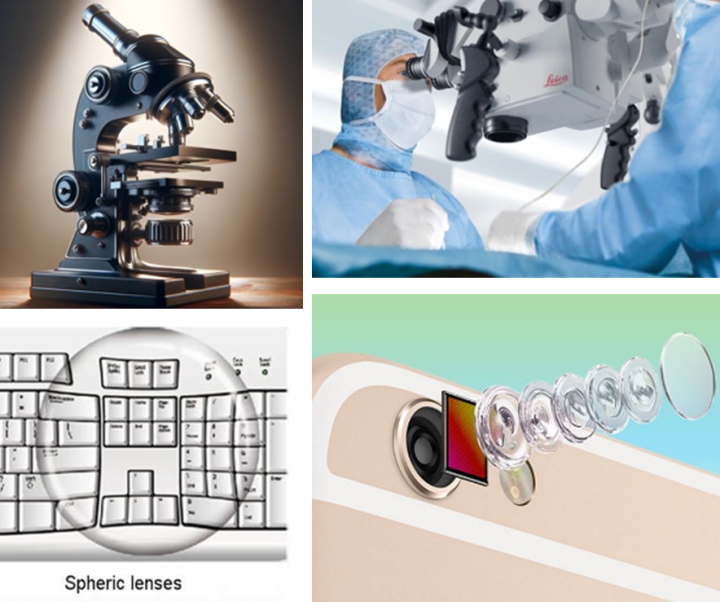
Lenses have numerous applications in microscopy, surgical devices, smart phones and so on. Their primary goal is to project light from one point to another within an optical system. Lenses are traditionally built from specific types of glass and have spherical surfaces and are fixed – they typically cannot be varied. Designs for variable lenses suffer from various defects and aberrations. One such aberration is spherical aberration, and this restricts the useful area of a variable lens to be very small. Many optical devices would benefit from using a variable lens which do not suffer from such defects. This would allow the optical systems to change focus, field of view etc. without the requirement of bulky moving mechanical setups. Drawback of traditional varifocal (tunable focus), optical systems:
Aberrations
Bulky – with mechanical zoom
Sensitive to alignment
Slow in adjusting the focus if adjustable
Figure 1. (top row) Various applications of lenses, (bottom row) a distorted/aberrated image of a keyboard when imaged through a spherical lens and a smart phone lens system – which has no tunable/variable lens components.
Solution
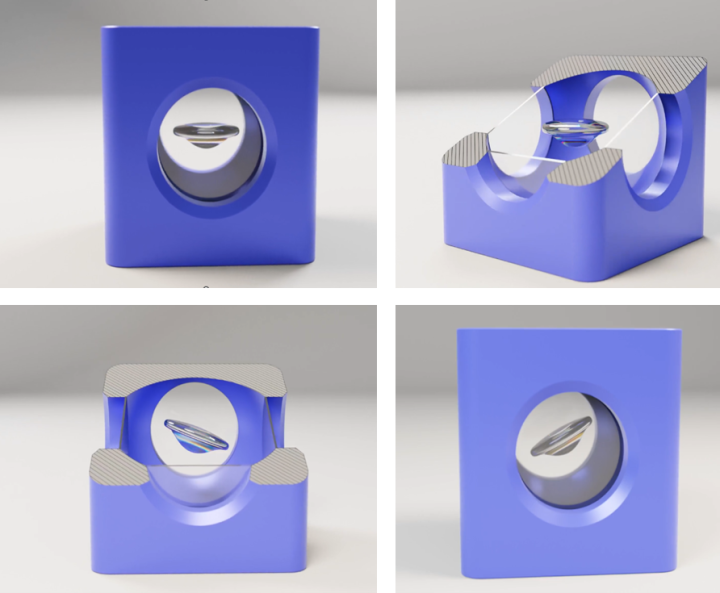
We have invented and are building a universal tunable lens using magnetically engineered liquids. The shape of the lens will be controlled using magnetic field. This will give us the ability to tune the focal length and correct aberrations such as spherical, coma and astigmatism. Moreover, we will be able to magnetically modulate the position and orientation of the lens enabling us to steer the beam in real time. Our Technology Advantages:
Detailed sculpting of the lens shape
Modulation of the position and orientation/beam steering
Miniaturization
No moving mechanical parts
Figure 2. Schematic of the magnetically tunable lens in different configurations, with changing focal length, pitch and yaw. The shape corrects for spherical aberration.