Spin-Based Ultra-Low Noise Amplifier for Microwave Quantum Technologies
Problem
Quantum computing hardware systems, especially those that operate at microwave frequencies and in a millikelvin temperature environment, such as superconducting or semiconducting ones, require amplification of microwave signals without adding noise. These systems are crucial for the development of scalable quantum computing technologies.
However, current state-of-the-art superconducting Josephson parametric amplifiers may suffer from limited saturation power in the near future where those microwave quantum computers scale up more. Moreover, they stop operating under modest static magnetic fields, which may also be an obstacle for other applications such as ultra-sensitive magnetic resonance spectroscopy at millikelvin temperature.
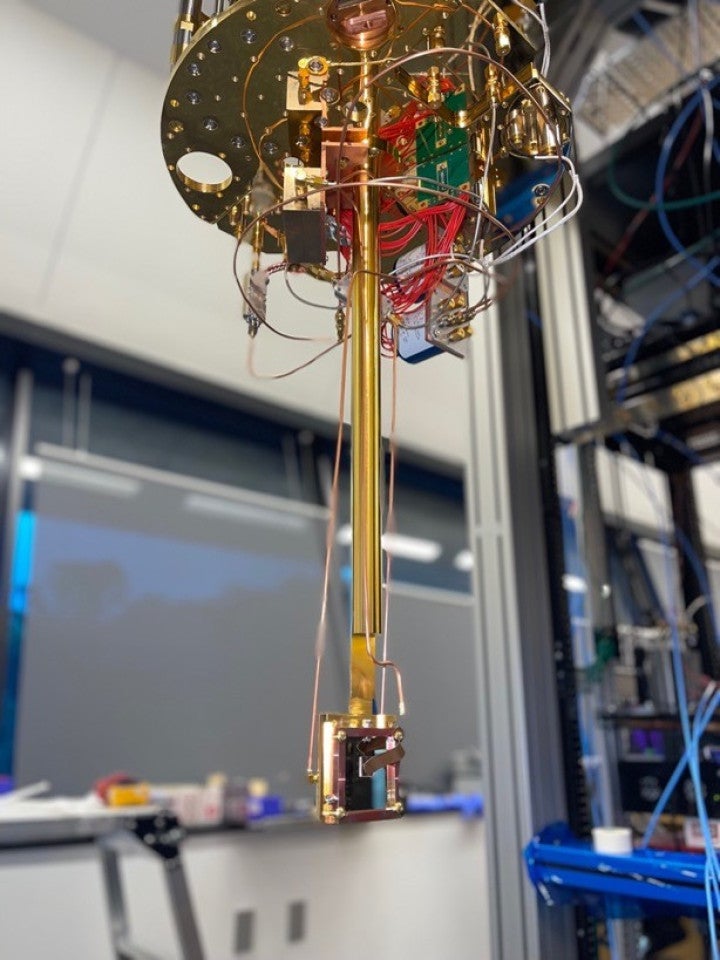
Figure 1. A test device installed in a dilution refrigerator that cools the device down to approximately 10 millikelvin temperature.
Solution
To address the limitations of current technology, we are developing a new cryogenic ultra-low noise amplifier based on the stimulated emission of impurity spins in gem crystals. The process of microwave amplification by stimulated emission of radiation, maser, is the same principle used in lasers. Our solution involves creating a traveling-wave maser device that provides significantly broader bandwidth.
Importantly, it has a larger saturation power by many orders of magnitude compared to existing superconducting Josephson parametric amplifiers. This technology aims to achieve a power gain of over 100 with a bandwidth of about a gigahertz and a saturation power of more than a microwatt.
The new technology may lead to a paradigm shift for cryogenic microwave quantum technologies, particularly for qubit integration or detection circuit design. Additionally, the maser amplifier may be implemented as the first amplifier in a magnetic resonance spectrometer, such as electron spin resonance, which may also significantly enhance the detection sensitivity.
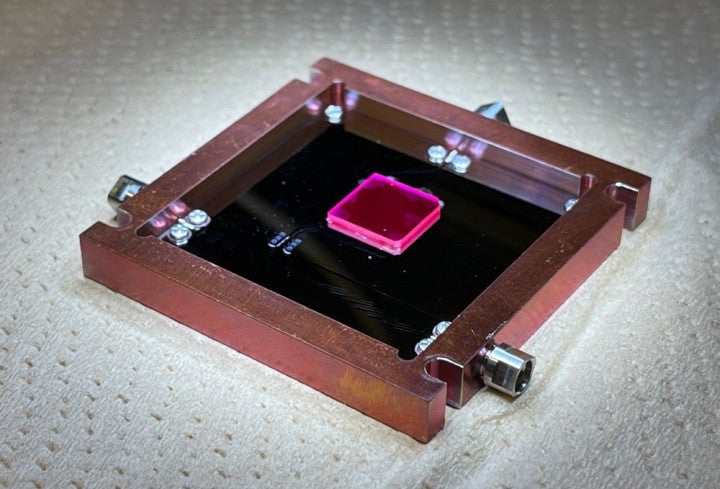
Figure 2. The tested traveling-wave maser device. A ruby crystal is placed on top of a broadband superconducting waveguide.