The tremendous development of quantum computing R&D has attracted investment from big IT companies such as Google, IBM, Microsoft, Amazon, and Alibaba. The superconductor- or semiconductor-based quantum computing hardware systems are the leading platforms, especially in terms of
scalability. Importantly, these systems operate at microwave frequencies and in a millikelvin temperature environment in a special but commercially available refrigerator called a dilution refrigerator.
Amplification of microwave signals at millikelvin temperature without adding noise is one of the essential keys to quantum computing and related technologies. However, the current state-of-the-art device, the superconducting Josephson parametric amplifiers, suffer from a limited saturation power of about 0.1 picowatts. Furthermore, they stop operating even under modest static magnetic fields of ∼10 millitesla.
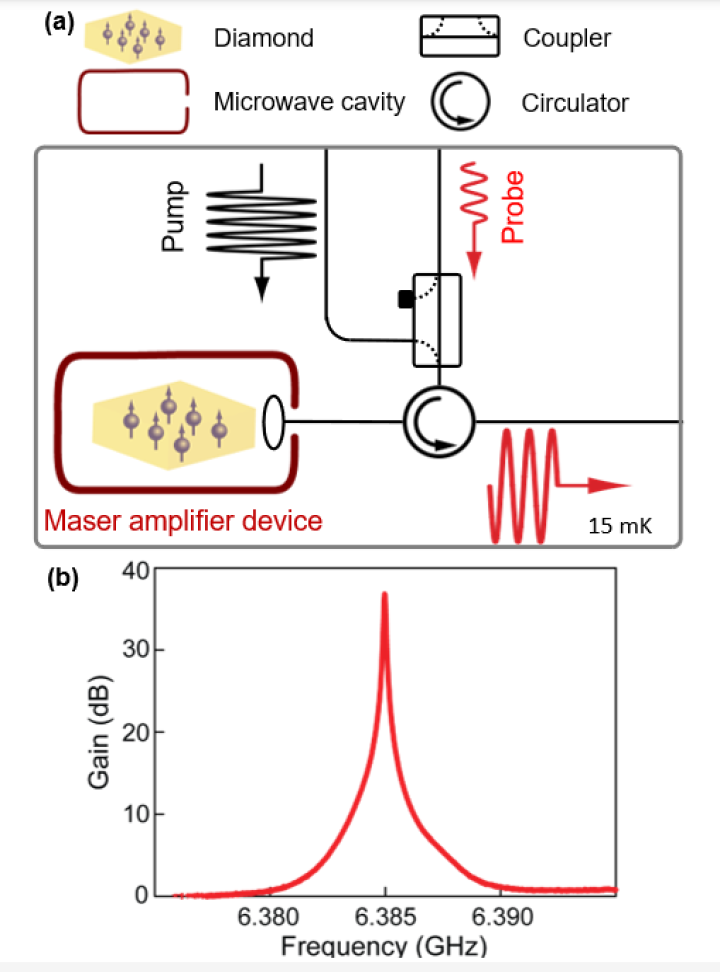
Figure 1. The first demonstration of maser amplification at millikelvin. (a) Setup schematic and (b) obtained gain (about 36 dB).
Solution
To challenge these issues, we develop a new cryogenic ultra-low noise amplifier based on the stimulated emission of impurity spins in gem crystals. We achieved the first proof-of-concept demonstration using paramagnetic impurity spins in a diamond crystal placed in a microwave resonator at around 6 GHz (see Fig. 1). However, the amplifier’s bandwidth is relatively narrow (∼100 kilohertz) because of the microwave cavity, which limits the gain bandwidth product of the maser amplification.
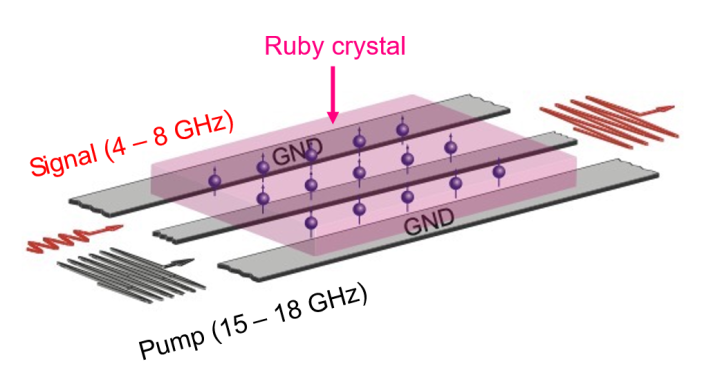
To mitigate this bandwidth problem, in this POC project, we will realize a spin-maser device in a traveling wave geometry (see Fig. 2), and an overwhelming performance (more than a power gain of 100 with about a bandwidth of about gigahertz, and a saturation power of microwatt or more) is expected. The new technology may lead to a paradigm shift for cryogenic microwave quantum technologies, particularly for the qubit integration or detection circuit design. Besides, the maser amplifier may be implemented as the first amplifier in a magnetic resonance spectrometer, such as electron spin resonance, which may also significantly enhance the detection sensitivity.
Figure 2. Schematic of the traveling-wave maser device. A broadband two-dimensional microwave waveguide is interacted with spins.