



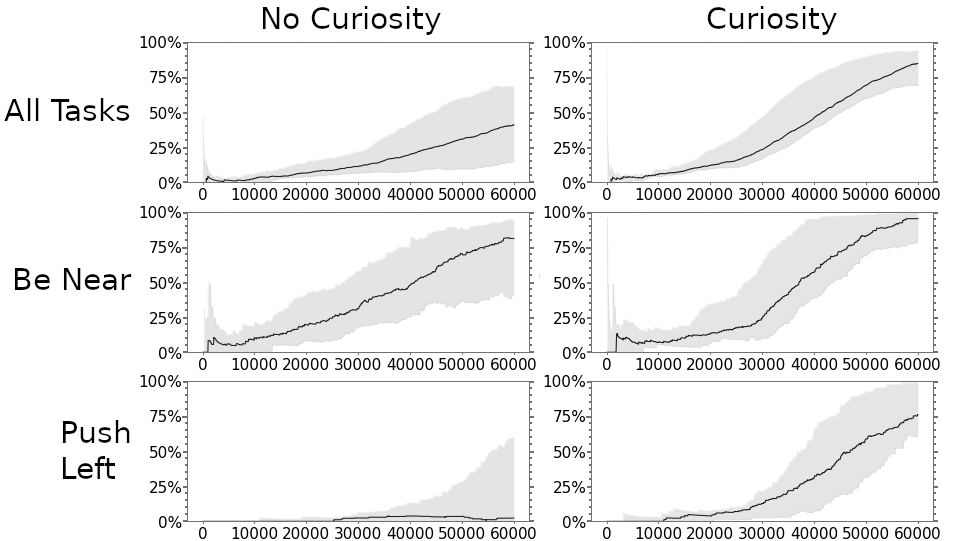
Success rate of robots with and without curiosity

The success rate of robots in completing language tasks such as “be near green pillar” and “push left magenta dumbbell,” over 60,000 epochs. Robots that were rewarded for satisfying their curiosity learned tasks significantly faster than those that weren’t, especially on complex tasks like pushing objects, which require the robot to first identify the right shape and color, then move to it, and finally push it in the correct direction. The shaded area represents 99% confidence intervals.
Date:
24 July 2026
Credit:
Adapted from Tinker et al., 2026.
Copyright OIST (Okinawa Institute of Science and Technology Graduate University, 沖縄科学技術大学院大学). Creative Commons Attribution 4.0 International License (CC BY 4.0).
Share on:


