



Information Theory is a field that brought forth the information age. It provides a rigorous mathematical framework that connects and unifies diverse areas of mathematics, including probability theory, statistics, and optimisation.Through its formalism, Claude Shannon was able to characterise and analyse the fundamental limits of compression and communication, laying the theoretical groundwork for modern digital technologies such as data compression algorithms, error-correcting codes, and contemporary communication systems ranging from 3G to 5G and beyond.
Beyond its historical role in communication, Information Theory has evolved into a versatile and powerful collection of conceptual and analytical tools. Owing to its inherently interdisciplinary nature, it now plays a central role in a wide range of modern fields, including statistical learning, inference and estimation theory, probability theory, and statistics, as well as applications in biology, neuroscience, and data science.
The purpose of this meeting is to showcase and explore the use of information-theoretic ideas and methods in contemporary research. The programme will feature a combination of lectures and presentations of recent results, illustrating how Information Theory can be leveraged to address modern scientific and technological problems, particularly in high-dimensional and data-driven settings.
We are excited to announce that two Best Poster Awards will be presented, each including a monetary prize, generously sponsored by Entropy.

In addition, we are also very pleased to announce that we will host an industry session on Wednesday July 8th at 11:30 am.
The speakers are from Toyota Konpon and Toyota Central R&D Labs., two leading industrial research institutions conducting cutting-edge work in both fundamental and applied research.
Organizer
- Amedeo Roberto Esposito , OIST Graduate University
For inquiries, please contact the ITMS organizers at itms@oist.jp.

Frank Nielsen, Sony CSL
Title: Geometric information theory: A hub to information sciences
Abstract: In this talk, I will first present an overview of geometric information theory emphasizing that fundamental quantities such as the Kullback-Leibler divergence, Shannon entropy, and Fisher information are not merely formulas, but arise from principled geometric structures endowed with duality relations. I will further discuss the deep interplay between information measures and geometry more broadly, and explain the links of their variational characterizations with geodesics. From this perspective, many optimization problems in information theory including inference and model approximation can be interpreted as geometric projection problems on statistical manifolds. In the second part, I will present several recent developments including curved Bregman divergences, duo Bregman pseudo-divergences, generalized convexity/Legendre transforms and information measures, and maximal invariants and divergences. I will illustrate how these geometric concepts and methods extend classical frameworks and provide new tools and opportunities in information sciences.

Taro Toyoizumi, RIKEN
Title: Information theoretical approaches to model synaptic plasticity
Abstract: We adapt our behavior through experience, a process widely believed to depend on activity-dependent synaptic plasticity. In this talk, I present a top-down theoretical framework in which synaptic plasticity rules are understood as optimizing information transmission between neurons. This perspective yields a neuro-inspired algorithm for uncovering hidden independent sources in sensory inputs, extendable to scenarios in which the sources are nonlinearly mixed. The framework also accounts for experimental observations by reproducing distinct plasticity outcomes during the up and down states of non-REM sleep. Together, these findings offer insight into how memory consolidation is shaped by brain state and the spatial scale of slow waves.

Pierre Alquier, ESSEC Business School
Title: Generalization bounds in machine learning, information theory and predictions
Abstract: A key question in machine learning theory is to control the generalization error of learning algorithms, that is, the discrepancy between the accuracy of the algorithm on the data it is trained on, and its ability to predict future data. Many approaches are available. Among them, PAC-Bayes bounds and mutual information bounds are deeply related, as they make use of measure of informations to quantify this gap. In a first time, I will introduce PAC-Bayes bounds and mutual information bounds. I will illustrate on examples how these bounds can be used in practice to guide algorithm training and to perform model selection.
Most PAC-Bayes bounds and information bounds were proven for independent data. In a second time, I will discuss the difficulties encountered when we try to extend these theories to time series prediction. I will introduce a new approach to derive practical bounds for Markov chains, based on the estimation of the pseudo-spectral gap of the chain.
The first part will be based on my lecture notes: User-friendly introduction to PAC-Bayes bounds (2024); the second part is a joint work with Vahe Karagulyan (ESSEC Business School): Empirical PAC-Bayes bounds for Markov chains, to appear at AISTATS 2026.

Ayfer Özgür, Stanford University
Title: Information-Constrained Optimal Transport
Abstract: Optimal transport studies how to transform one probability distribution into another in the most efficient way, and has found wide-ranging applications across mathematics, statistics, and machine learning. In this talk, we will introduce an information-constrained formulation of optimal transport, in which the transport plan is subject to a mutual information constraint.
We will highlight several applications of this formulation. First, we will show that it provides a solution to a longstanding relay channel problem posed by Cover in 1987. Second, it mitigates the curse of dimensionality in Wasserstein GANs, enabling principled training of generative models, including from privatized data. Third, it leads to a natural framework for compression-based denoising and semantic representation. We will conclude by highlighting open questions and directions

Lalitha Sankar, Arizona State University
Title: Theoretical Foundations and Practical Challenges of Diffusion (Generative) Models
Abstract: Diffusion models have achieved impressive performance in generating high-quality and diverse synthetic data. This talk will first review the underlying theory of discrete-time diffusion models, their relationships to SDEs, and the setting of classifier-free guidance for conditional diffusion models. We will then focus on two emerging challenges for these models: (i) enhancing diffusion models to produce high-fidelity and diverse samples when trained on class-imbalanced data, and (ii) quantifying generalization and memorization of diffusion models when the training data has class-imbalances. We will briefly discuss a solution to this via CORAL (Contrastive Regularized Alignment of Latents), a framework that leverages supervised contrastive losses to encourage well-separated latent class representations and present theoretical results on memorization resulting from training with class-imbalanced data.

Andre Wibisono, Yale University
Title: Mixing Times of the Langevin Dynamics and the Proximal Sampler for Sampling under Isoperimetry
Abstract: Sampling is a fundamental algorithmic task with many connections to optimization, for example via the perspective of sampling as optimization in the space of probability distributions. In particular, the Langevin dynamics is the gradient flow for minimizing relative entropy on the space of probability distributions with the Wasserstein metric. In this talk, we survey the mixing times of the Langevin dynamics in continuous time and its algorithmic implementations in discrete time, under isoperimetric conditions on the target distribution, emphasizing the connections to optimization. A basic discretization of the Langevin dynamics is the Unadjusted Langevin Algorithm, which suffers from an asymptotic bias and results in low-accuracy sampling guarantees. We survey another discretization of the Langevin dynamics known as the Proximal Sampler, which is unbiased, and achieves the current state-of-the-art iteration complexity for high-accuracy sampling in discrete time. We illustrate the proof technique via the strong data processing inequality along the Gaussian channel and its time reversal under isoperimetry.

Shun Watanabe, Tokyo University of Agriculture and Technology
Title: Distributed Hypothesis Testing: Old and New
Abstract: Distributed hypothesis testing is a problem that lies at the intersection of two fundamental disciplines: information theory, which studies coding for communication systems, and statistics, which provides a framework for decision making. The problem was first introduced by Berger in the late 1980s and has since been extensively studied. More recently, it has attracted renewed attention due to its practical relevance in modeling systems with a large number of sensors and communication networks with bandwidth constraints, such as those arising in IoT applications.
In the first part of this talk, we begin with the basic problem formulation and provide an overview of classical results established up to the 1990s. In particular, we discuss the information geometric perspective on distributed hypothesis testing introduced by Amari.
In the second part, we review several open problems and recent developments in distributed hypothesis testing. In particular, from the viewpoint of goal-oriented communication, which has gained increasing attention in recent years, we also touch upon its connections to distributed function computation and discuss the importance of structured coding and multi-letter characterizations.

Sinho Chewi, Yale University
Title: Shifted composition and applications in log-concave sampling
Abstract: The shifted composition rule, developed in a series of works together with my collaborators Jason M. Altschuler and Matthew S. Zhang, allows for controlling information-theoretic divergences between stochastic processes via coupling methods. I will discuss this principle and its applications in log-concave sampling, such as progress toward accelerated rates of convergence and algorithmic warm starts for algorithms with Metropolis–Hastings filters.

Yihong Wu, Yale University
Title: Next-symbol Prediction from Compression: Information-theoretic Optimality and Practical Algorithms
Abstract: Next-symbol prediction is a central task in modern generative models, yet its statistical and computational foundations for dependent data remain poorly understood. This tutorial introduces an information-theoretic framework that connects prediction to universal compression, revealing a fundamental distinction between prediction and parameter estimation. Addressing model classes with finite memory (Markov chains) and infinite memory (Hidden Markov Model and renewal processes), we characterize the minimax prediction risks without imposing mixing conditions, and show how optimal prediction can be achieved using ideas from universal compression. We further quantify the impact of memory and mixing on statistical efficiency, and establish computational hardness results demonstrating that achieving statistically optimal prediction may be computationally infeasible for certain models. Finally, we discuss the prediction performance of transformers on these models in both well-specified and mis-specified settings.
Program
-
Program
-
Text
July 6–10, 2026 · OIST, Okinawa
MONDAY, JULY 609:15 Open Registration
09:50 Open Address
10:00 – 11:30 Talk 1: Pierre Alquier (Auditorium)
11:30 – 13:30 Lunch break
13:30 – 15:00 Talk 2: Frank Nielsen(Auditorium)
15:00 Break
15:30 – 18:00 Open Discussion (Conference Center Meeting Room 1)
TUESDAY, JULY 7
09:30 – 11:00 Talk 3: Ayfer Ozgur(Auditorium)
11:00 Break
11:30 – 13:00 Whiteboard Session — Open Problems (Conference Center Meeting Room 1)
13:00 – 14:30 Lunch break
14:30 – 16:00 Talk 4: Taro Toyoizumi (Auditorium)
16:00 Break
16:30 – 18:00 Poster Session (Conference Center Meeting Room 1)
WEDNESDAY, JULY 8
09:30 – 11:00 Talk 5: Amedeo Roberto Esposito (Tentative) (Auditorium)
11:00 Break
11:30 – 13:00 Industry Session: Toyota Konpon and Toyota Central R&D Labs. (Auditorium)
13:00 – 13:10 Group Photo Session13:10 – 14:30 Lunch break
14:30 – 16:00 Talk 6: Andre Wibisono (Auditorium)
16:00 Break
16:30 – 18:00 Open Discussion (Conference Center Meeting Room 1)
THURSDAY, JULY 9
09:30 – 11:00 Talk 7: Lalitha Sankar (Auditorium)
11:00 Break
11:30 – 13:00 OIST Information Session (Conference Center Meeting Room 1)11:30 – 13:00 Open Discussion
13:00 – 14:30 Lunch break
14:30 – 16:00 Talk 8: Sinho Chewi (Auditorium)
16:00 Break
16:30 – 18:00 Open Discussion (Conference Center Meeting Room 1)
FRIDAY, JULY 10
09:30 – 11:00 Talk 9: Shun Watanabe (Auditorium)
11:00 Break
11:30 – 13:00 Open Discussions (Conference Center Meeting Room 1)
13:00 – 14:30 Lunch break
!Travel Arrangement Scam Notice!
Workshop organizers and invited speakers may be contacted by third-party “travel agencies” not affiliated with OIST, using publicly available information.
Please do not respond unless you have been explicitly contacted by the OIST organizers or secretariat.
Registration Information
Upon completion of the abstract submission form above, and after review by the organizing committee, a payment link will be emailed to participants based on their registration category.
| Registration Type | Registration Fee | Accommodation | Included Meals |
|---|---|---|---|
| Speakers | ¥30,000 | Yes |
Lunch is provided from July 6 through July 10. |
| Participants (non-students) | ¥30,000 | TBA | |
| Students | ¥20,000 | TBA |
Meals
Registration includes 5 lunches and four dinners during the workshop period:
– Three standard dinners
– One banquet dinner
Dinner will be provided from July 6th to July 9th. Notice that Dinner will not be provided on July 10th.
Both registration categories include access to all talks and all scheduled meals.
Cancellation and Refund Policy
Participation fees will be refunded if cancellations are made in written form via email to workshop@oist.jp not later than 15 business days prior to the start of the workshop.
In case of a natural disaster (typhoon, earthquake, etc.), which results in the cancellation of the workshop, participant fees will be refunded after subtracting the processing fee of 3.6%.
For inquiries, please contact the ITMS organizers at itms@oist.jp.
Access to OIST
Address
OIST Conference Center,
Okinawa Institute of Science and Technology Graduate University
and
OIST The Gardens (on-campus housing)
(In Japanese: 沖縄科学技術大学院大学)
1919-1 Tancha, Onna-son, Kunigami-gun, Okinawa, 904-0495, Japan
(In Japanese: 〒904-0495 沖縄県国頭郡恩納村字谷茶 1919-1)
Check in: 2026/07/05 (Sun)@ 15:00 or later
Check out: 2026/07/11 (Sat) @ 10:00 or before
Transportation options beyond the scheduled busses
Airport Shuttle Bus
- Okinawa Airport Shuttle Bus
- Airport Limousine Bus
-
Local Bus Schedule
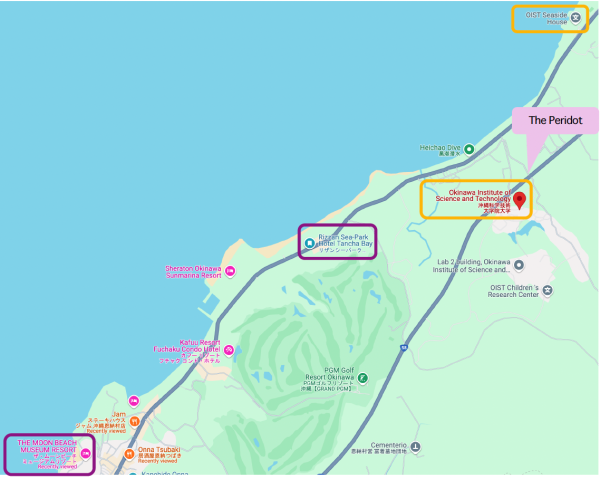
Hotel Recommendation and Map
Other Information
Information for participants
- Weather: The climate of Okinawa is subtropical and experiences its wet season in May-June. Umbrellas (available at any convenience store) and footwear that can get wet are recommended. The daytime temperatures range from 25 to 30 degrees Celsius (77-87 degrees F). Please plan your dress accordingly!
- Money: Most ATMs and businesses accept cards from major companies (Visa, Mastercard, Discover, etc). Cash is accepted everywhere.
- Currency Exchange: ATMs [Naha Airport, Post Offices, Convenience Store & Aeon Store at OIST]
- Electricity: The AC outlet in Japan is 100 volt, and fits plugs with two parallel blades (Type A). Please check if the AC adapter of your laptop is compatible with Japanese style and bring a plug adapter or a voltage converter if necessary
- Restaurants near Onna/OIST: please see the PDF below.
 Near By Restaurant Information
Code of Conduct
We are committed to making our workshops (workshop(s) organized by OIST, hereinafter “our workshop(s)”) an inclusive space for sharing ideas and knowledge. We will not tolerate disrespectful communication, discrimination, harassment, or bullying in any form. As such, all participants attending our workshops are required to comply with this Code of Conduct. To provide all participants the opportunity to benefit from our workshops, we at OIST are dedicated to a positive, safe and harassment-free experience. Harassment in any form is specifically prohibited.
Harassment involves continued antisocial or unreasonable actions that violate a reasonable person’s personal rights and/or dignity and cause mental suffering, and thus worsen the person’s environment or make him/her anxious about participation. Behavior that is acceptable to one person may not be acceptable to another, so we ask that you use discretion to be sure that respect is communicated. Harassment intended in a joking manner nevertheless constitutes unacceptable behavior. Speech that is not welcomed or that is personally offensive, whether it is based on gender, age, sexual orientation, mental or physical disability, ethnicity, national origin, religion etc. will not be tolerated.
If you are being harassed, notice that someone else is being harassed, or have any other concerns, please bring this to the immediate attention of the organizers. If you wish to report an issue concerning the organizers, you can contact the Conference and Workshop Section directly and submit a confidential report by sending an email to workshop-codeofconduct@oist.jp or submitting a report through the webform.
All complaints will be taken seriously and responded to by the Dean of Research promptly. Confidentiality will be maintained to the extent that it does not compromise the rights of others. Individuals found in breach of this Code of Conduct will be dismissed from the workshop immediately. Retaliation for reporting harassment is also a violation of Code of Conduct, as is reporting an incident in bad faith.