Ion trap and optics developments for quantum networking
Problem
A key challenge facing quantum computing is scalability. A possible solution inspired by classical distributed computing is to form a network of quantum processors, each containing a few qubits. For trapped ion architectures, like the type EQuIP works on, this would involve linking separate ion traps using single photons. Previous attempts to do this have resulted in rate-limited connectivity; a promising solution is to place an optical cavity around ions to increase collection efficiency.
The market problem is that there are no reliable commercial suppliers of the apparatus (ion traps and cavities). Therefore, many researchers resort to designing and building their own system, investing more than a year to design and develop their ion traps, taking up time and resources: a significant amount of time is spent away from core research by students and postdocs; associated with that is the monetary cost of multiple iterations in refining the design.
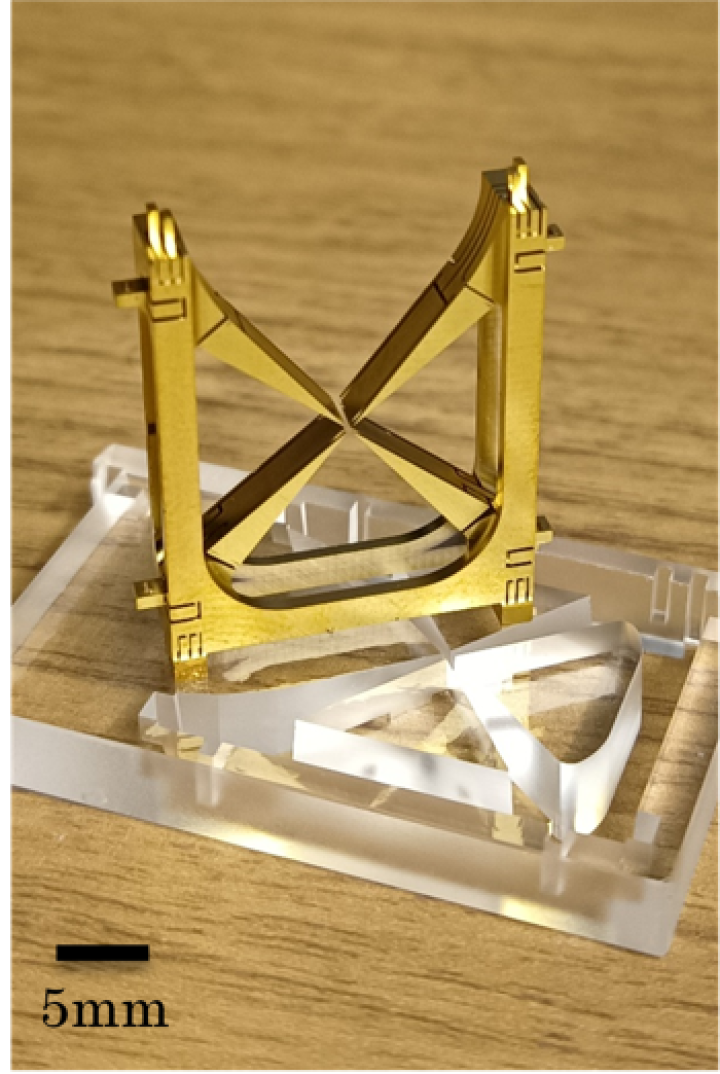
Figure 1. A gold-plated 3D printed ion trap on top of the glass substrate it was machined out of.
Solution
We employ a novel fabrication method known as selective laser-induced etching (SLE). SLE is a subtractive 3D printing process which lifts the complexities in producing and assembling ion traps and cavities. EQuIP has already manufactured our own ion traps in-house; we would like to design miniature optical cavities, which could be integrated into a monolithic structure with our existing ion trap designs.
We have experience developing cavities using mirrors machined into fiber optic tips, and OIST has the equipment to create waveguides and spot size converters to interlink these cavities using fiber optics. By combining our expertise with state-of-the-art facilities, we aim to develop ion traps integrated with miniature optical cavities, taking the first significant step towards establishing an efficient link between remote quantum processors. This endeavour represents an essential step towards scaling up quantum systems and accelerating progress in quantum computing.
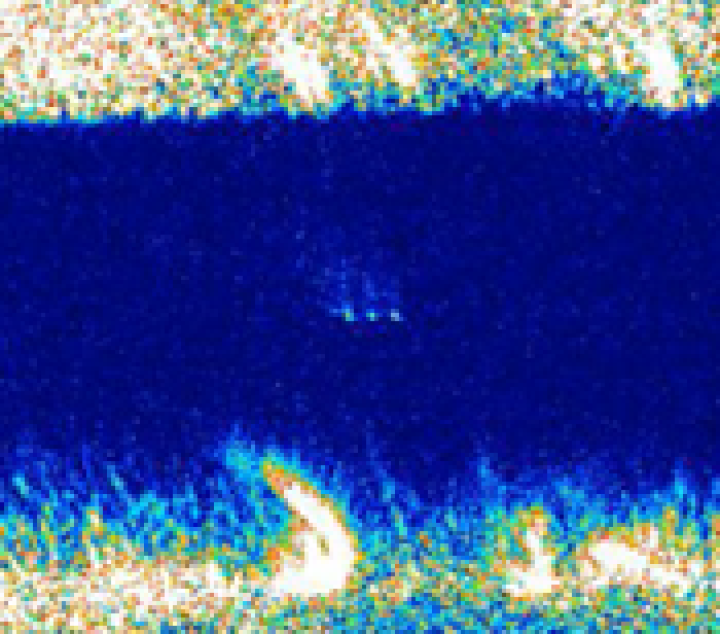
Figure 2. Image of 3 individual atoms (ions) trapped in our in the center of our ion trap.