Personalized Synapse Proteomics of living psychiatric patients
The project combines stem cell programming and deep proteomics to analyze the brain synapses of living psychiatric patients from simple blood samples.
Problem
Psychiatry still has no cure. Brain diseases (BDs) such as Alzheimer’s disease, depression, schizophrenia, and other types of dementia represent a major problem of health and disability in developed countries. Despite extensive efforts, there is still no drug that can cure or even slow efficiently BDs (e.g., 99.6% failure rate for Alzheimer’s disease drugs in the last 20 years).
Reasons for two decades of BD clinical trial failures are largely attributed to underestimated molecular variability and complexity among patients. For example, two schizophrenia patients can look similar in symptoms, but their disease being caused by distinct proteins. Therefore, Patient-personalized knowledge will be essential for the development of next-gen precision therapies against complex conditions such as psychiatric disorders.
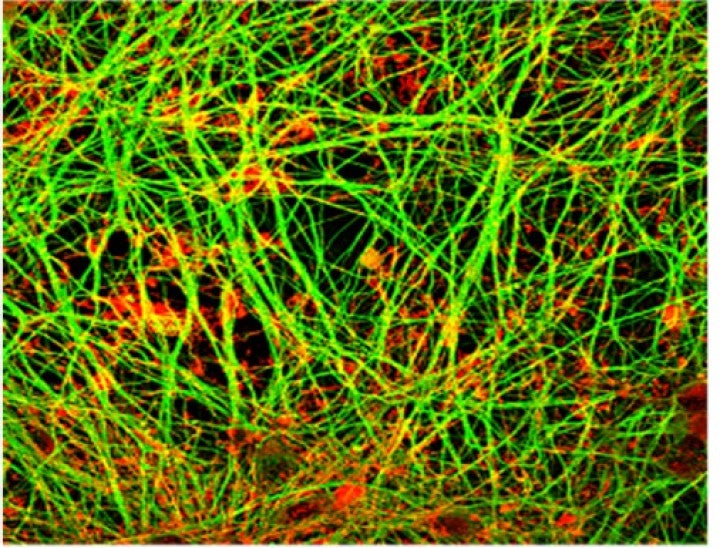
Figure 1. Stem cell-derived Neurons made from an Okinawan local schizophrenia patient. iPSC-derived neurons are visualized using confocal fluorescence microscopy. Green labeling: ‘skeleton’ of the neurons. Red labeling: synapses (neuronal junctions).
Solution
A synapse proteomics strategy:
Synapses are specialized structures connecting neurons that are essential to communication within the brain. They receive-process-store-control all information that flows within neuronal networks. Alterations of synaptic protein expression often accompany human mental disorders. Therefore, there is a tremendous interest in dissecting their proteome.
What is our technology?
Brain sampling on living individual is key but remains unethical. To overcome the issue, we have been developing a non-invasive and harmless method to dissect brain synapses from living patients, by combining stem cell programming and deep proteomics approaches. Our new ‘Personalized Synapse Proteomics’ (PSP) technology generates for the first-time high amount of quantitative molecular information on the brain of living patients. Therefore, PSP may help for BD patient stratification and ultimately be a gateway toward success for BD clinical trials
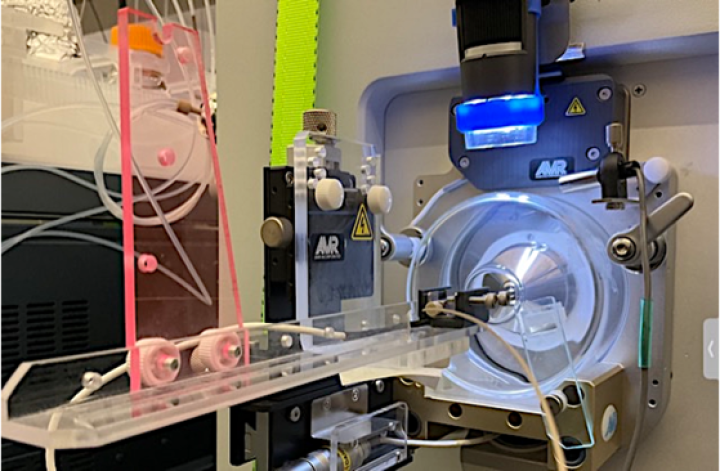
Figure 2. Mass spectrometry device that analyzes molecular content of living patients’ neuronal synapses. Mass spectrometer inlet is shown where samples are injected and hit by a laser for ionization and protein sequencing, identification, quantification.