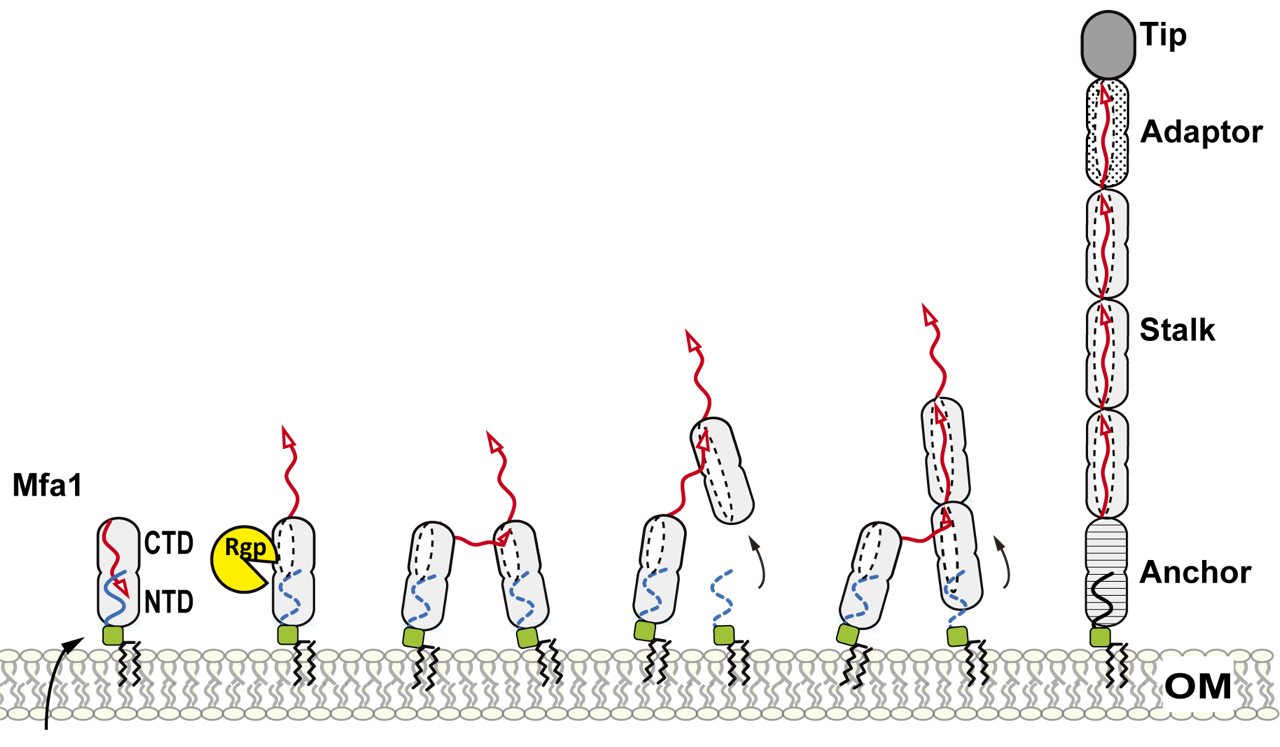



Strand-exchange assembly mechanism for Mfa filaments

Mfa filaments form in a process called strand-exchange assembly. Each subunit has two ends, known as the N-terminal (NTD) and C-terminal (CTD) regions. When the N-terminal region of Mfa1 is cleaved by a protease enzyme (depicted here as Rgp), a conformational change is triggered in the C-terminal, exposing a hydrophobic groove. Neighboring filaments insert themselves into this groove, linking the molecules together. Repetition of this reaction produces the mature Mfa filament, shown on the right of the diagram. Because a similar mechanism occurs in Fim pili, this appears to be a universal assembly principle of this type of filament.
Date:
25 June 2026
Credit:
Shibata et al., Communications Biology, 2026. DOI: 10.1038/s42003-026-10515-2
Available Open Access from Shibata et al., Communications Biology, 2026. DOI: 10.1038/s42003-026-10515-2
Share on: