



HiSci-Lab 2026

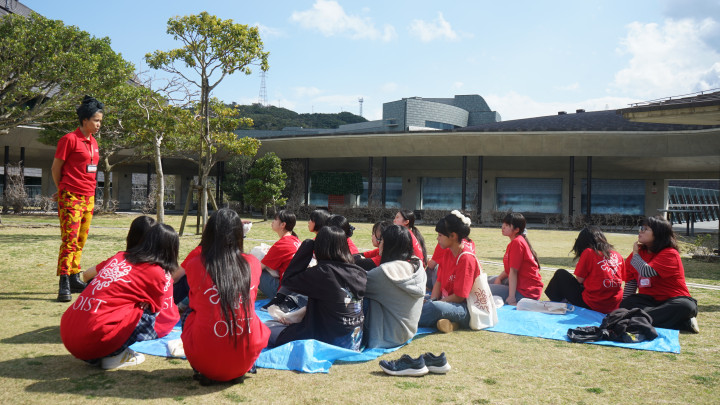
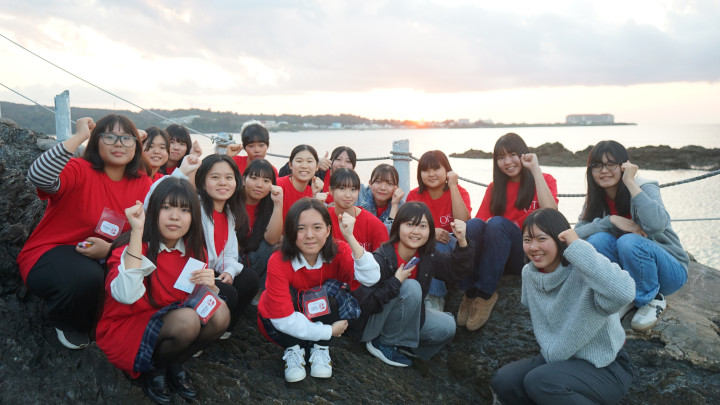
Over the two days of February 21–22, 2026, HiSci-Lab 2026, a workshop for female high school students in Okinawa, was held with the participation of 17 students from across Okinawa Prefecture. The workshop is designed to encourage girls’ interest in STEM fields (science, technology, engineering, and mathematics).
HiSci-Lab 2026 was made possible through the generous support of the Matsuro and Tsuruko Nakasone Fund, established within the OIST Foundation. In addition, with support from Okinawa Prefecture, one student from Ishigaki Island was also able to participate.
This year’s HiSci-Lab 2026 focused on sound as a gateway to science. By exploring the many different sounds that surround us in everyday life, participants used a basic understanding of how sound is perceived as a starting point for discovering how sound connects to a wide range of research fields at OIST, including physics, biology, and ecology. Over the course of the two days, participants reexamined familiar everyday phenomena through a scientific lens and discovered new ways to connect science with their own lives and interests.
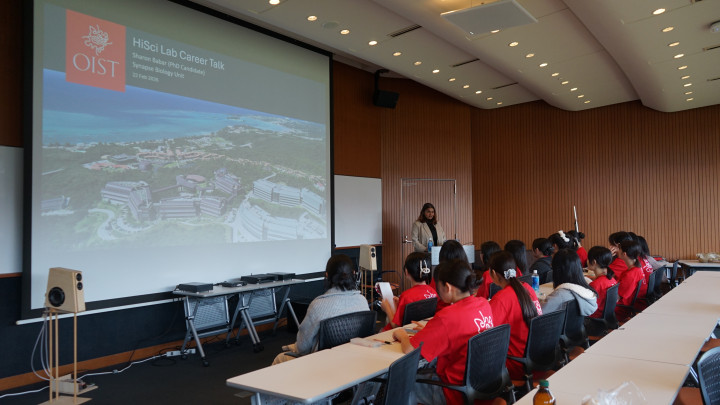
As female role models, OIST PhD student Riko Chinen (Evolution, Cell Biology, and Symbiosis Unit), who is originally from Okinawa, and OIST PhD student Sharon Babar(Synapse Biology Unit) gave career talks during the workshop. They shared what inspired them to pursue PhD studies, the research they are currently engaged in, the excitement of research, their paths to OIST, and the importance of embracing challenges. Their stories created an encouraging and inspiring experience for the participants.
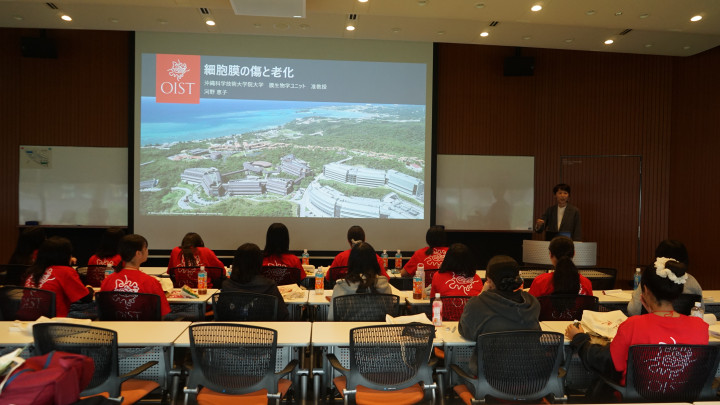
The workshop also featured a lecture by Associate Professor Keiko Kono on cell membrane damage, repair, and aging. In her talk, she introduced how the membranes surrounding our cells are damaged in everyday life, how they are repaired, and how these processes relate to our health and aging. Participants also visited Membranology Unit, where they had the opportunity to see firsthand the environment in which cutting-edge research is conducted at OIST.
In addition, Samuel Ross, Staff Scientist in the Integrative Community Ecology Unit at OIST, gave a lecture introducing research that uses sound to observe ecosystems. In Okinawa, his work uses a network of sensors distributed across the island to record sound and study changes in ecosystems through the local soundscape unique to each place. His talk showed how sound can serve as an important clue for understanding living organisms and natural environments, and how the nature around us can become the subject of advanced scientific research.
The hands-on activity began with a session led by Shuma Oya, an OIST PhD student in the Experimental Quantum Information Physics Unit
, exploring the physics behind sound and speakers. He introduced the basic mechanisms of how speakers work, how sound is reproduced, and how speaker frequency characteristics can be measured. The session concluded with each participant assembling her own speaker.
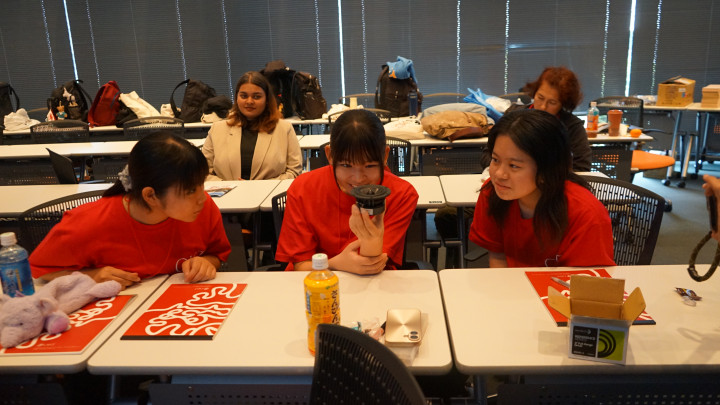
Throughout the two-day workshop, participants explored a variety of scientific fields through the familiar theme of sound. Through interactions with researchers active at OIST, they gained new perspectives for thinking scientifically about everyday phenomena and encountered new knowledge and ideas.
As they spent time together with peers who shared similar interests, natural connections formed among the students, and the workshop became a place where they could inspire one another and deepen their learning.
Comments from HiSci-Lab Participant:
“Through the activities at HiSci-Lab, I was able to connect with people I would not normally have the chance to meet. I made new friends, and I feel that I also grew as a person.”
“By participating in this event, I was deeply influenced by the talks from researchers who ask questions about small things I might never have noticed and work to uncover the answers. In the future, when I struggle with choosing my path, I want to remember to value my own feelings.”
“After hearing from women scientists, I now want to continue gaining different kinds of experience and think carefully about the path I want to choose.”
This workshop was made possible through the warm support and cooperation of many individuals and organizations, allowing us to provide meaningful opportunities for learning and connection to students across Okinawa. We extend our heartfelt thanks to all those whose support and collaboration made HiSci-Lab 2026 possible.


