


10 December 2025
The evolutionary mysteries of a rare parasitic plant

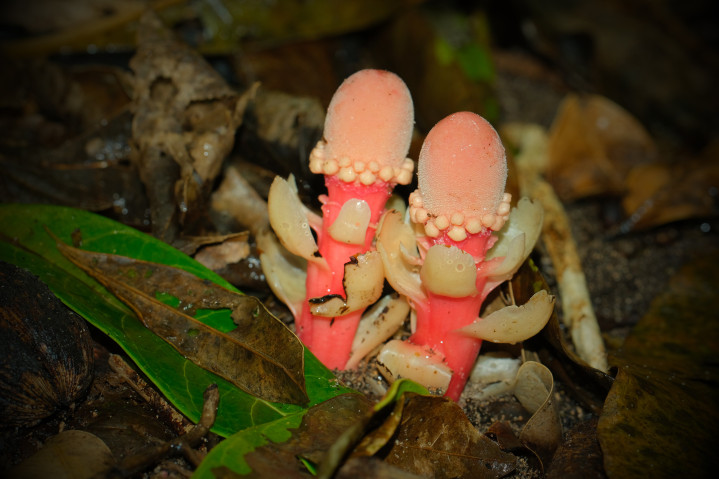
At the base of mossy trees, deep in the mountains of Taiwan and mainland Japan or nestled in the subtropical forests of Okinawa, grows what most might mistake for a mushroom – but what is actually a very unique plant with some of the smallest flowers and seeds in the world. With no chlorophyll to photosynthesize with and no root system to supply it with water from the ground, Balanophora has evolved a series of extreme traits to survive entirely as a parasite on the roots of specific, local trees. Some species and populations produce seeds only without fertilization – something which is exceedingly rare in the plant kingdom.
The enigmatic genus Balanophora, named for its resemblance to acorns (Greek: balanos, acorn; phoros, bearing), has long puzzled biologists, and given its rarity and affinity for very specific environments that are under threat by human interference, it has been difficult to study beyond individual populations. But now, researchers from the Okinawa Institute of Science and Technology (OIST), Kobe University, and the University of Taipei have joined forces to survey Balanophora across its sparse and inaccessible habitats. Their work, recently published in New Phytologist, charts the evolutionary history of the plant, shows how its plant organelles function in unexpected ways to accommodate its parasitic lifestyle, and paves the way for future research into this ancient oddball. As study lead author Dr. Petra Svetlikova, Science and Technology Associate at OIST, puts it: “Balanophora has lost much of what defines it as a plant, but retained enough to function as a parasite. It’s a fascinating example of how something so strange can evolve from an ancestor that looked like a normal plant with leaves and a normal root system.”

Shrinking plastids, genomes, and island habitats
A common trait across parasitic plants is that as they increase their reliance on their host plant, their plastids – a broad term for plant organelles including chloroplasts in photosynthetic plants – tend to lose genes, or even disappear altogether. But despite being entirely dependent on their host trees for all their nutritional needs, Balanophora has retained its plastids, albeit drastically reduced. In non-parasitic plants, as many as 200 separate genes may encode for the structure of plastids, whereas in Balanophora, just 20 genes remain. At the same time, the researchers found that over 700 proteins are imported to the plastids from the cytoplasm, suggesting that even in this reduced form, Balanophora plastids still play a vital role. “That Balanophora plastids are still involved in the biosynthesis of many compounds unrelated to photosynthesis was surprising. It implies that the order and timing of plastid reduction in non-photosynthetic plants is similar to other eukaryotes, such as the malaria-causing parasite, Plasmodium, which originated from a photosynthetic ancestor,” says Professor Filip Husnik, head of the Evolution, Cell Biology, and Symbiosis Unit at OIST.
By sampling across multiple populations of Balanophora, the team was able to construct the tree of life for the plant genus and how it diversified across the subtropics of East Asian islands. Balanophoraceae, the family to which the Balanophora genus belongs, is one of the oldest families of entirely parasitic plants, having diversified in the mid-Cretaceous period around 100 million years ago – and as such, it is one of the first land plants to have lost photosynthesis.
Another fascinating question left open by the plants is their reproduction, which varies wildly from population to population. Some species require fertilization to set seeds; others have the additional ability to produce seeds without fertilization, so-called facultative agamospermy, and some are obligately agamospermous, meaning they never reproduce sexually. “Obligate agamospermy is exceedingly rare in the plant kingdom, because it typically carries a lot of negative downsides – lack of genetic diversity, accumulation of bad mutations, dependence on specific conditions, higher extinction risk, and so on,” explains Dr. Svetlikova. “Fascinatingly, we found that the obligately agamospermous Balanophora species were all island species – and we speculate that more Balanophora species may be facultative, or even obligate, agamosperms.” One upside to this reproductive strategy is that it allows single female plants to propagate across new islands, rapidly colonizing the highly specific niche in which they thrive: the dark, moist undergrowth, where not many other plants can survive.
Despite the ability to clone itself, Balanophora is very picky in its choice of host: individual populations of the plant parasitize just a few tree species. This, unfortunately, also makes these rare and unique flowers vulnerable. “We’re very thankful to our collaborators Dr. Huei-Jiun Su and Dr. Kenji Suetsugu, experts on parasitic plants, for their help in sampling the studied Balanophora species, and to local authorities in Okinawa that allowed us to study these extraordinary plants,” says Dr. Svetlikova. “Most known habitats of Balanophora are protected in Okinawa, but the populations face extinction by logging and unauthorized collection. We hope to learn as much as we can about this fantastic, ancient plant before it’s too late. It serves as a reminder of how evolution continues to surprise us.”
Article Information
Specialties
Research Unit
Submit a press inquiry


