



We investigate how the brain forges durable yet plastic memory by studying scales ranging from individual synapses to large-scale population dynamics.
A Central Question
A fleeting scent, a sudden fear, experiences lasting mere seconds can forge memories that persist for a lifetime. However, memory is not a static transcript. It is a dynamic and highly distributed process, implemented across large networks of neurons whose synaptic connections are subject to perpetual remodeling. How the brain continuously acquires, encodes, consolidates, and retrieves information while remaining adaptive to ever-changing environments remains one of the most fundamental questions in neuroscience.
The Hippocampus
At the heart of this question lies the hippocampus, a structure in the medial temporal lobe sitting at the interface between sensory inputs, internal representations, and behavioral output. Hippocampus has been proven indispensable for many cognitive processes and memories (episodic, contextual, relational, cognitive ...), hence attracts most of the investigations in our lab.
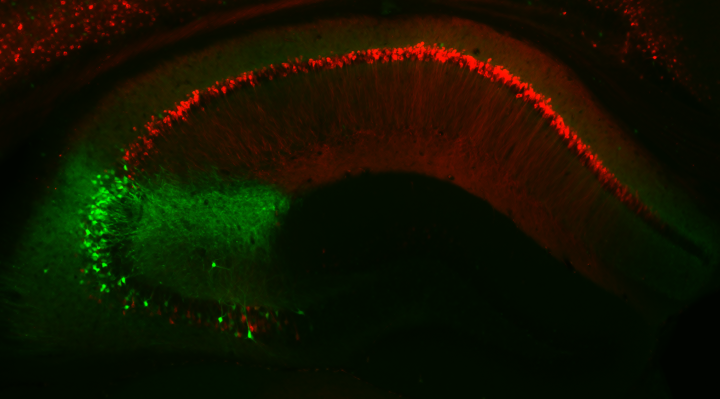
(green: CA3, red: CA1)
(green: CA3, red: CA1)
Research Aims :
Dynamics and Stability
We are particularly interested in the dynamic aspects of the memory system. Recent evidence suggests that neuronal networks are characterized by a high turnover of dendritic structures and "representational drift" over time (e.g., Ziv et al. Nature Neuroscience 2013; Pfeiffer et al., eLife 2018).
Our research focuses on the hippocampal memory engram, the subset of neurons responsible for later memory recall (e.g., Liu et al., Nature 2012; Tanaka et al., Neuron 2014). Interestingly, these engrams show high instability and remodeling of location-specific responses (place cells) while maintaining overall coherence (Tanaka et al., Science 2018). We aim to uncover these unexpected facets of memory to understand the fundamental scheme of how information is encoded in a changing brain.
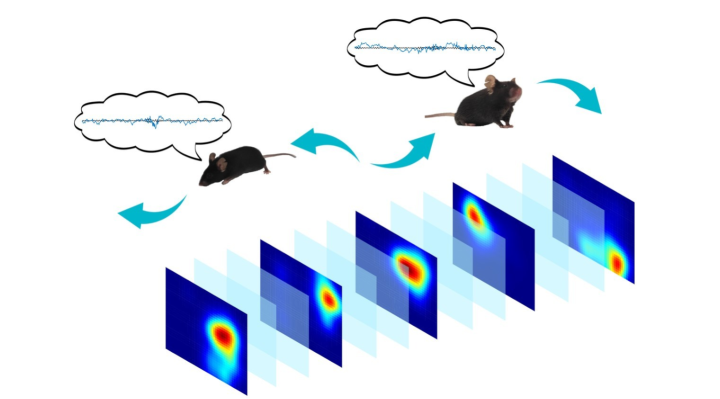
A single cell place field (preferential location at which the cell fires) is drifting over time.
A single cell place field (preferential location at which the cell fires) is drifting over time.
Memory Robustness Under Extreme Remodeling
A prime focus of our research is the stability of memory representations under conditions of profound structural changes (natural or pathological). In winter, when resources are scarce, many animals enter hibernation, a state characterized by extreme hypothermia and metabolic depression. Interestingly, despite massive synaptic remodeling during hibernation, prior memories remain intact after arousal. In our lab, we use optogenetically or chemogenetically induced artificial hibernation to probe the mechanisms preserving and restoring memory when neural connectivity is radically disrupted (Lin et al., Science 2026). This model yields key insights into circuit resilience and the principles governing structural and functional plasticity.
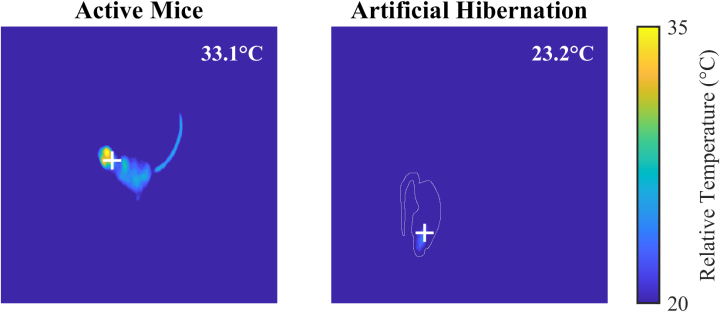
Left panel : normal metabolic activity, free exploration; Right panel : reduced metabolism, entering artificial hibernation
Left panel : normal metabolic activity, free exploration; Right panel : reduced metabolism, entering artificial hibernation
A Multi-Scale Experimental Approach
To obtain a comprehensive understanding of memory, we explore how memory operates across multiple scales: from the coordinated activity of neuronal populations (population coding, memory engrams) to the distinctive firing properties of individual cells (place cells), and down to the dynamic plasticity of synapses. To achieve this, we utilize multi-disciplinary approaches.
- Large-Scale Neural Recording: In vivo electrophysiology (tetrodes & silicon probes) and $Ca^{2+}$ imaging (miniature microscopes) in freely behaving mice to capture high-resolution neural activity.
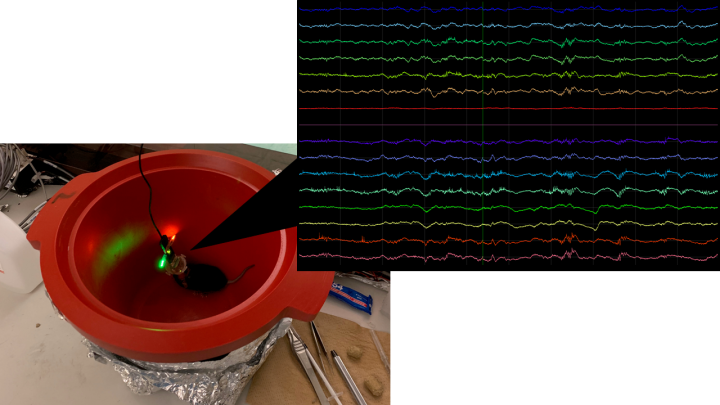 Tetrode recording of the neuronal activity from the mouse hippocampus.
Tetrode recording of the neuronal activity from the mouse hippocampus. - Behavioral Analysis: Sophisticated paradigms to assess episodic, contextual, and relational memory.
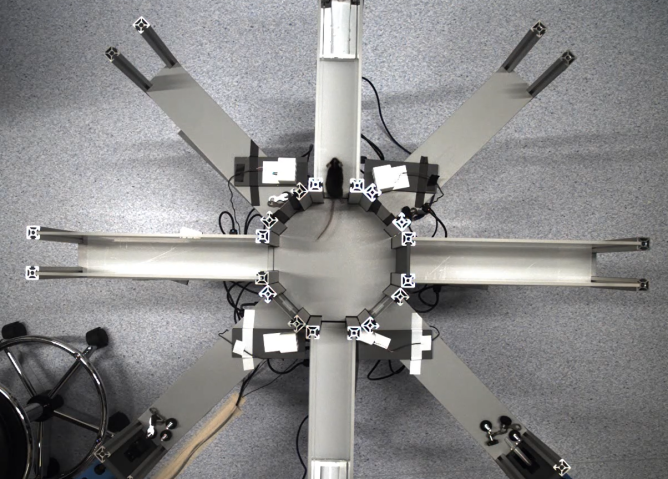 A mouse learning a reward location.
A mouse learning a reward location. - Genetic Tools: Activity-dependent labeling (engram labeling) and optogenetic/chemogenetic manipulations to selectively modulate neural ensembles.
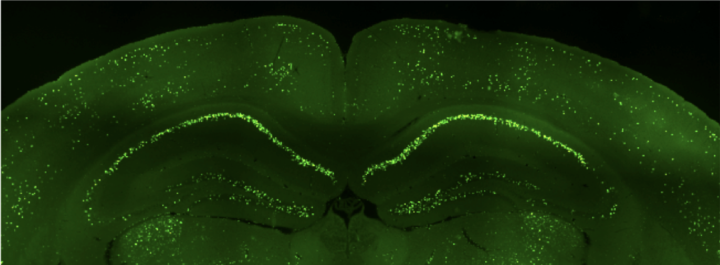 Fluorescently labeled memory engram in the mouse brain.
Fluorescently labeled memory engram in the mouse brain. - Structural Imaging: Optical and Electron Microscopy (including TEM and SEM) for 3D reconstruction of neuronal/non-neuronal networks, synaptic contacts, and subcellular structures at nanometer resolution.
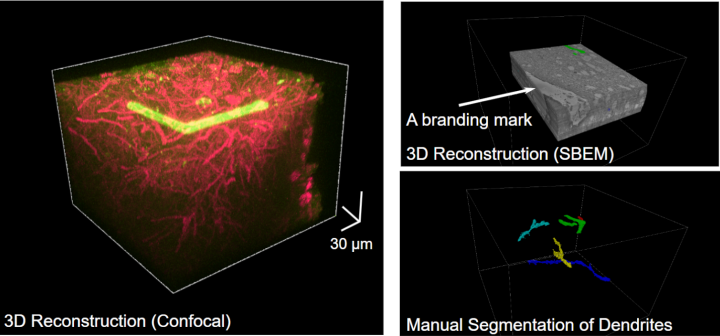 Correlative Light and Electron Microscopy imaging.
Left : Laser-branding mark left on a sample Right : An electron miscroscopy reconstructed 3D sample aligned with the branding; bellow, the delineated dendritesCorrelative Light and Electron Microscopy imaging.
Left : Laser-branding mark left on a sample Right : An electron miscroscopy reconstructed 3D sample aligned with the branding; bellow, the delineated dendrites
Our ultimate goal
Our team investigates memory across an exceptionally broad range of scales, from the ultrastructure of individual synapses, to the population dynamics of hippocampal circuits in behaving animals. By bridging these levels, we aim to uncover the fundamental principles by which transient neural activity is transformed into durable, plastic memory traces. This multiscale perspective provides a unique framework for dissecting the circuit-level dysfunctions that underlie neurological conditions impairing memory.
Join us in this pursuit.
Keywords:
Hippocampus • Neural circuits • Memory encoding • Episodic memory • Spatial navigation • Place cells • Memory engrams • Population coding • Synaptic plasticity • Representational drift • In vivo electrophysiology • Calcium imaging • Optogenetics • Volume EM • SBF-SEM • Artificial hibernation