


Fluid Mechanics Unit
Professor Pinaki Chakraborty
Abstract
We studied boundary-layer flows, landfalling hurricanes, and turbulent Taylor-Couette flows.
1. Staff
- Pinaki Chakraborty, Professor
- Tapan Sabuwala, Group Leader
- Julio Manuel Barros Junior, Staff Scientist
- Kalale Chola, Postdoctoral Scholar
- Vishnu Ravindran, Postdoctoral Scholar
- Christian Butcher, Research Unit Technician
- Florian Fritsch, Research Unit Technician (- September, 2023)
- Yuna Hattori, Ph.D. Student, Junior Research Fellow (- September, 2023)
- Hanley Andrean, Ph.D. Student
- Tomoe Owan, Research Unit Administrator
2. Collaborations
2.1 Theory of spectral link in turbulent flows
- Type of collaboration: Scientific collaboration
- Researchers:
- Professor Gustavo Gioia, OIST
2.2 Turbulent Rayleigh-Taylor instability
- Type of collaboration: Scientific collaboration
- Researchers:
- Professor Marco Rosti, OIST
- Professor Gustavo Gioia, OIST
2.3 Turbulent Taylor-Couette flows
- Type of collaboration: Scientific collaboration
- Researchers:
- Professor Gustavo Gioia, OIST
3. Activities and Findings
3.1 Self-similarity of the Falkner-Skan equation
The Falkner-Skan equation is a classic example of self-similarity in boundary layer flows. Despite being a textbook problem, we show that its derivation does not provide a clear resolution to a fundamental question: are the standard conditions invoked to derive them necessary for self-similarity? We use the machinery of Lie groups to prove rigorously that the standard conditions are both necessary and sufficient for self-similarity.
3.2 Spin-down vortex model of hurricane decay past landfall
When a hurricane makes landfall, it is cut off from its source of fuel--heat and moisture from the warm ocean. As a result, its intensity decays. The current understanding of this decay is based on modeling the hurricane as a giant vortex spinning down due to friction with the land underneath. This “spin-down vortex” model is often used to understand simulation and real-world observational data on landfilling hurricanes. In ongoing work, we are critically analyzing this model. Our preliminary results suggest that it may not be possible to determine one of the key model parameters (the vortex height) objectively, which raises questions about the physical interpretation of the model.
3.3 Benchmarking OIST-TC
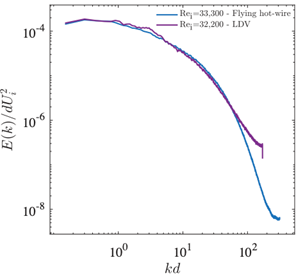
We conducted comprehensive benchmarking tests for the OIST Taylor-Couette setup (OIST-TC). We tested the mean-velocity profile (in the radial direction), torque on the inner cylinder, and energy spectra in the mid-gap. For the mean-velocity profile and torque, we compared our data with previous studies and found them to be in excellent accord. For the energy spectra, we compared the data we obtained using our novel "flying hot-wire setup" with that we obtained using the well-established technique of Laser Doppler Velocimetry (LDV). Within the range of wavenumbers where LDV measurements are reliable, we found excellent agreement between the two approaches, validating our novel approach. Additionally, the flying hot-wire spectra extended significantly deeper into the dissipation range than LDV spectra, underscoring the advantage of our approach. We show a representative example of this comparison below.
4. Publications
4.1 Journals
- Hattori, Numerical simulations of Sakiadis boundary-layer flow, Physics of Fluids 35, 123601 (2023); Featured as Editor’s choice.
4.2 Books and other one-time publications
Nothing to report
4.3 Oral and Poster Presentations
- C. Kalale. Symmetry Analysis of the Turbulence Dissipation Rate, JSFM Annual Meeting, Tokyo, Japan, September 20 (2023).
- Y. Hattori. Measuring boundary-layer flows over a dynamic boundary, JSFM Annual Meeting, Tokyo, Japan, September 22 (2023).
- J. Barros. Small-scale universality in turbulent Taylor-Couette flows, JSFM Annual Meeting, Tokyo, Japan, September 22 (2023).
- C. Butcher. Introducing the OIST Taylor-Couette (OIST-TC) setup, JSFM Annual Meeting, Tokyo, Japan, September 22 (2023).
- H. Andrean. Towards new conceptual understanding of the decay of landfalling typhoons, 1st International Workshop on Typhoon Research Center (IWTRC), Yokohama, Japan, November 8 (2023)
- H. Andrean. Towards new conceptual understanding of the decay of landfalling typhoons, OIST-RIKEN Joint Workshop on Prediction Science, Okinawa, Japan, December 20 (2023)
- P. Chakraborty. The spectral link in turbulent frictional drag, Indian Institute of Science Education and Research, Pune, India, February 29 (2024)
- P. Chakraborty. Surprising thermodynamics of landfalling hurricanes, Indian Institute of Tropical Meteorology, Pune, India, March 1 (2024)
5. Intellectual Property Rights and Other Specific Achievements
Nothing to report
6. Meetings and Events
6.1 Exploring multiphase flow processes via particle-resolving simulations
- Date: April 7, 2023
- Venue: OIST Campus Lab3, C700
- Speaker: Prof. Eckart Meiburg (University of California at Santa Barbara)
6.2 Impacting droplets on solid surfaces and mediation of entrapped air film using dielectrophoretic effect
- Date: June 5, 2023
- Venue: OIST Campus Lab1, C016
- Speaker: Prof. Tuan Tran (Nanyang Technological University)
6.3 Transition to turbulence in pipe flow
- Date: June 27, 2023
- Venue: on Zoom
- Speaker: Prof. Marc Avila (University of Bremen)
6.4 Influence of bubbles on the hydrodynamic loading of marine structures
- Date: December 11, 2023
- Venue: on Zoom
- Speaker: Prof. Céline Gabillet (French Naval Academy /Ecole Navale)
6.5 Tropical Cyclone Projections using Environmental Proxies and Statistical-Dynamical Downscaling
- Date: March 11, 2024
- Venue: OIST Campus Lab3, B700
- Speaker: Prof. Suzana J. Camargo (Columbia University)
6.6 OIST-RIKEN Joint Workshop on Prediction Science
- Date: December 20 - 22, 2024
- Venue: OIST Campus Sydney Brenner Lecture Theater, B250, Center Bldg.
- Co-organizers:
- Prediction Science Laboratory, RIKEN
- Data Assimilation Research Team, RIKEN
- Interdisciplinary Theoretical and Mathematical Sciences Program, RIKEN
- Disaster Resilience Science Team, RIKEN
- Environmental Metabolic Analysis Research Team, RIKEN
- Computational Climate Science Research Team, RIKEN
- Medical Data Deep Learning Team, RIKEN
- Medical Data Mathematical Reasoning Team, RIKEN
- Laboratory for Physical Biology, RIKEN
- Machine Learning and Data Science Unit, OIST
7. Other
Nothing to report.