



Seeking Nirai Kanai

(This article is the English version of the column article published on the Asahi Shimbun GLOBE+ on January 24, 2026.)
Nirai Kanai is the godly realm beyond the sea in Okinawan mythology, where deities dwell and life both comes from and returns to. It is also the guiding image of one researcher at the Okinawa Institute of Science and Technology (OIST), who’s made it his mission to trace the source of a humble group of fish: amphidromous gobies, which travel between fresh- and saltwater.
In 2013, Dr. Ken Maeda, described a new species in this group, discovered in Okinawa. “It’s never been found outside the archipelago, but even here, it is extremely rare. The population is too small to be self-sustaining, so they must come from somewhere else beyond the Okinawan seas, but like Nirai Kanai, no one knows the exact place,” he explains. “That is why I named the species Stiphodon niraikanaiensis.”
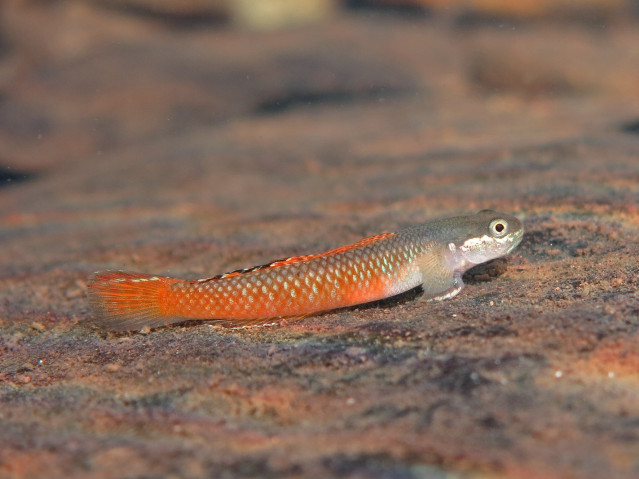
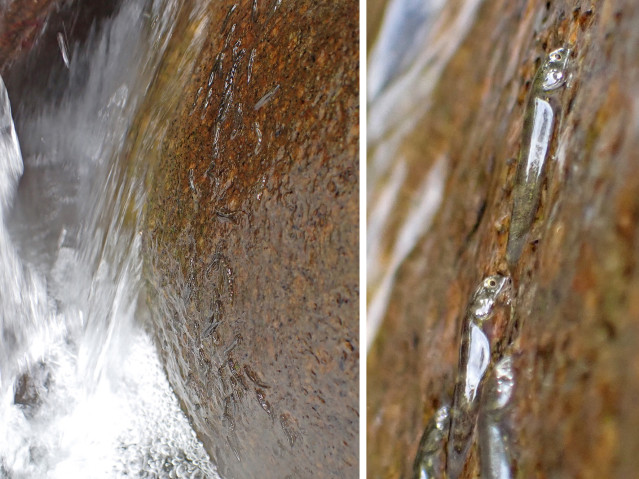
Gobies are one of the most diverse fish groups. Encompassing more than 2000 species, they vary greatly in size, shape, and lifestyle. Okinawa alone is home to a wide variety of species: from Pandaka trimaculata measuring just 1 cm in length at maturity, to Bunaka gyrinoides weighing over 1 kg; and from the Sicyopterus japonicus climbing waterfalls to the unique mudskippers crawling and jumping across mudflats. The habitats of gobies vary depending on the species, from coral reefs and the deep sea to rivers and lakes. Some live in gaps between gravel or in burrows in the mud, while others are free-swimming species.
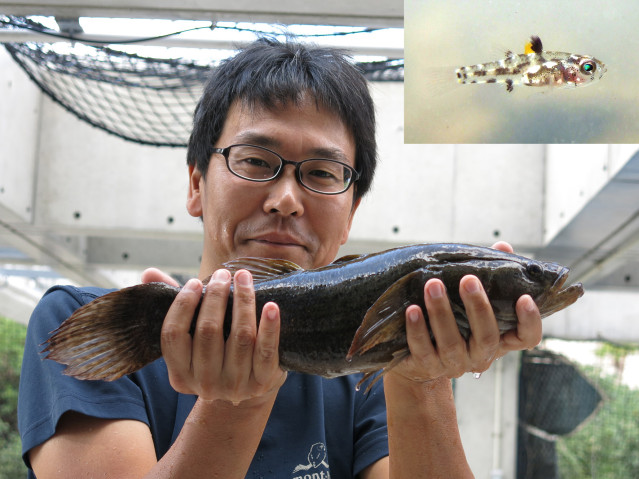
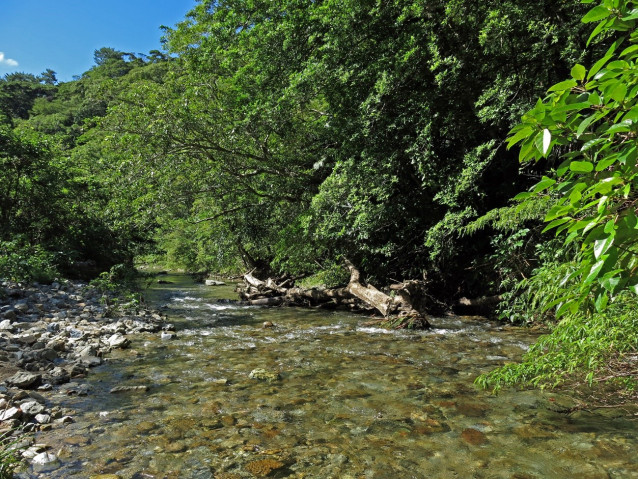
Beginning their lives by hatching in freshwater streams, amphidromous gobies are carried by the gentle flow to the ocean. Here, they embark on grand adventures across the seas, carried far and wide by ocean currents, before swimming up through river mouths and settling in new streams as adults to start the cycle anew. The Ryukyu Archipelago receives many of these travelers due to its location in the middle of the Kuroshio ocean current, leading to a lot of rare and unique amphidromous goby species in the small streams across the islands.
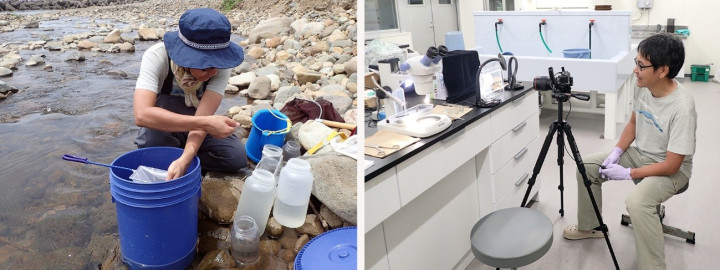
Over his thirty-year-long scientific career, Dr. Maeda has published many papers on the life history of gobies, revealing how they reproduce and their migration between adult and larval habitats. He has also conducted numerous studies updating the goby family tree and described thirteen new goby species – but still, his research is far from done. And in addition to his scholarly work, he is deeply engaged in important conservation work, serving scientific committees informing the Red Lists of Threatened Species of both the Japanese Ministry of Environment and Okinawa Prefecture. “I want to know everything there is to know about Okinawan gobies. And I want to conserve them.” As he points out, it’s important to keep in mind that while gobies are one of the most diverse fish groups in the world, the individual species – particularly the ones relying on small habitats – are still at risk.
Like the gobies, Dr. Maeda came to Okinawa from inland streams far away. Born and raised in Gifu Prefecture, it wasn’t a given that he would study the seafaring animals. “I went to the University of the Ryukyus to study marine science, and happened to join a lab that studied fish,” he explains. “I started studying the ocean because I was interested in new environments, but maybe it’s because I came from a landlocked prefecture that I was naturally drawn to freshwater fish instead. I went to rivers and found that there are a lot of gobies there – it so happens that 30-40% of all fish species in Okinawan streams and estuaries are gobies.”
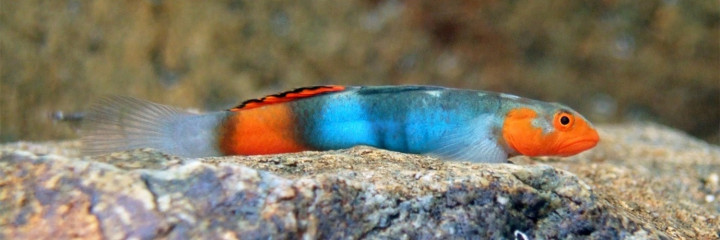
It was during this period that he became fascinated with the amphidromous fish. For why would some gobies, which are so well-adapted to sedentary lives, risk everything during their most vulnerable period as larvae at sea? As it turns out, they do so in order to survive: “Unlike on the continents or larger islands such as mainland Japan, streams on small islands are not stable – they frequently dry out or change course. Their habitats are also very small and often separated by ocean currents,” explains Dr. Maeda. “Dispersing widely to colonize many different islands could help avoid extinction. That’s a very powerful evolutionary pressure.”
The movement patterns of amphidromous gobies remain mysterious, so Dr. Maeda often acts as a detective, travelling all over Southeast Asia in search of Nirai Kanai. “I found an unfamiliar goby in Okinawa, but I could not identify it. Then I observed specimens of similar goby at a museum in Singapore. It was from Vietnam. And so, I investigated rivers in Vietnam and discovered that the goby was Stiphodon multisquamus, a species that has barely been investigated since it was described on Hainan Island in China. It is mainly distributed in the western part of the South China Sea, and somehow it occasionally shows up in Okinawa even though there is no direct connection between the two areas."
Often, his detective work is complicated by ghosts from the past – some species have only been described in vague text references, and the historical collection in the Philippines, located near the origin of the Kuroshio Current – which is a strong contender for the source of the rare gobies that is transported to Okinawa – was destroyed during World War 2, making it hard to determine the identity of the goby species.
It has been suggested that the dispersal strategies of larval amphidromous gobies are quite unique and diverse. Some species remain in one place, in contrast to the species with widespread dispersal mentioned above. These unique fish are threatened by their reliance on vulnerable streams. In July 2026, Dr. Maeda and collaborators published results of their study surveyed the genetic diversity of Luciogobius ryukyuensis across four islands in Okinawa Prefecture. Here, they found that even though populations were at times just 23km apart, they had distinct genomes, meaning that these groups do not mingle. The population on Kume Island was confined to a habitat just 10m2 in size. “If this habitat is damaged, we’ll forever lose these genetically unique fish,” warns Dr. Maeda.
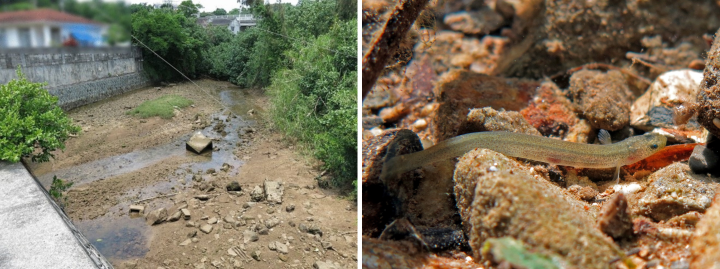
Human interference is a particular threat to these unique fishes. Climate change threatens both humans and fish, but unlike the fish, we humans can protect ourselves from extreme weather. And while he recognizes that these human safety measures are important, his role is to be the voice of the gobies, to help prevent the extinction of these unique and beautiful fishes. “Flood prevention like damming or dredging can destroy vulnerable goby habitats,” he warns, “or indirectly harm other species. For example, dams can landlock amphidromous fishes, putting them in competition with freshwater fish.”
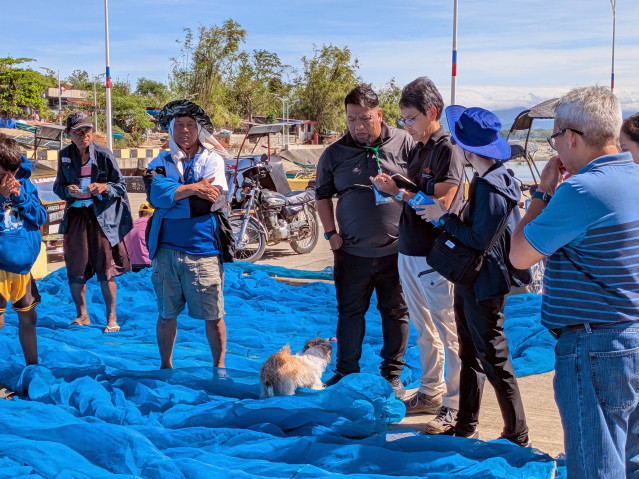
By extension of his advocacy work, Dr. Maeda is invested in the education of the next generation of scientists, having contributed to the OIST Children’s School of Science since its inception in 2010. He also actively cooperates with local educational outreach centers, giving lectures and supporting observation sessions and other events: “I hope to contribute a small part to science literacy, to improve decision-making in the future.”
So, what’s next for this dedicated marine biologist? Last year, he started a project in the Philippines with the support of the Nagao Natural Environment Foundation to study the fauna and the life history of freshwater and estuarine fishes in the islands, helping us better understand the elusive gobies and their larval dispersal. “It’s been more than ten years since I named the Stiphodon niraikanaiensis,” says Dr. Maeda. “And we have yet to find its origin. That is my mission.” And so, the quest for Nirai Kanai continues.
Dr. Ken Maeda
Originally from Gifu Prefecture, Dr. Ken Maeda graduated with a PhD in Marine and Environmental Sciences from the University of the Ryukyus in 2008.
Shortly after, he joined the Marine Genomics Unit under Prof. Satoh at the Okinawa Institute of Science and Technology (OIST), before the first campus buildings were constructed.
Since then, he has conducted research into the life history and taxonomy of fish in the Marine Genomics and Marine Eco-Evo-Devo Units at OIST, focusing on fish migration and larval dispersal.
---
Written by: Adrian Skov, Science Writer in the OIST Science Communications Section
Specialties


