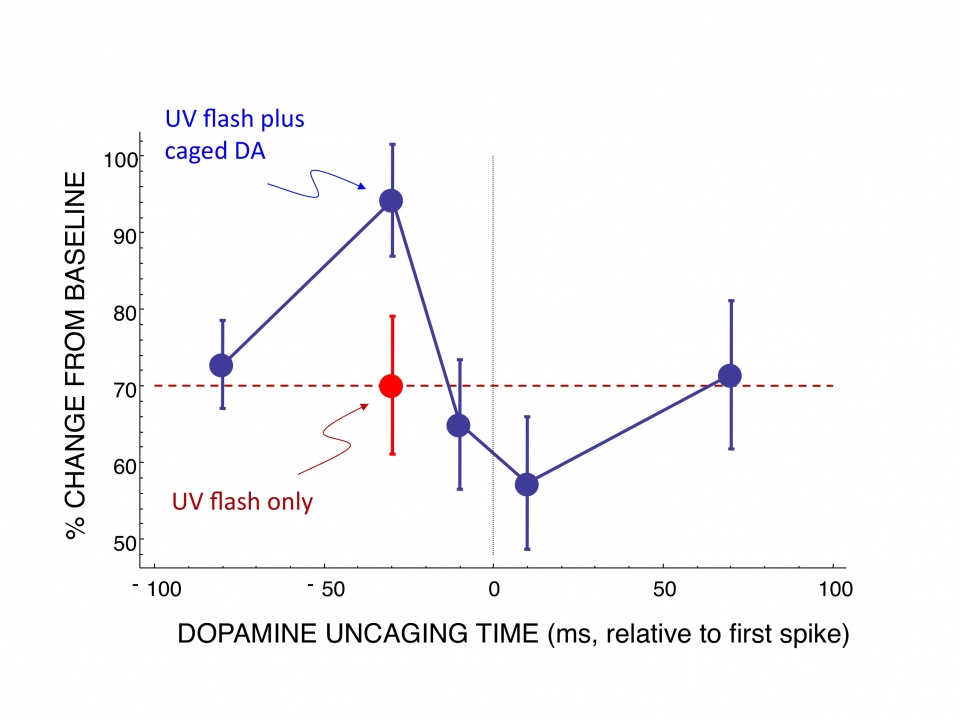
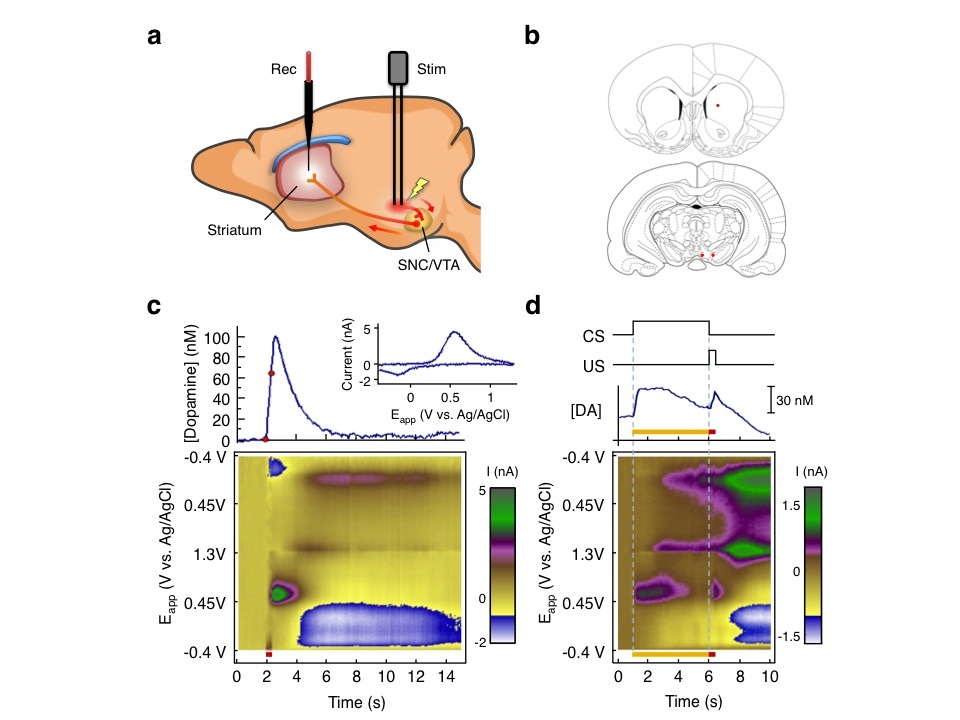
Using this preparation we investigated the mechanism of action of methylphenidate (Ritalin). Methylphenidate is widely used in treatment of attention-deficit hyperactivity disorder (ADHD). We found that dopamine release in response to a classically conditioned cue that precedes reward is deficient in an ADHD rat model. We also found that methylphenidate specifically rescued the deficit in anticipatory dopamine release, at doses commonly used therapeutically (data not shown). This specific action of methylphenidate led us to propose a novel basis for its therapeutic action: by facilitating anticipatory release of dopamine, methylphenidate helps to bridge delays between actions and rewarding outcomes, enhancing the ability to stay on task when reward is delayed, and improving the performance of children with ADHD in classroom situations.
3.3 Optogenetic inhibition of nucleus accumbens neurons
OIST Researchers: Dr Luca Aquili, Dr Mayumi Shindou, Dr Tomomi Shindou, Mr Andrew Liu (Technician)
The ability to learn from errors is critical for survival. Reversal learning provides an exacting test of this ability, by requiring an animal to flexibly alter behavior in response to the unpredictable switching of stimulus-reward contingencies. Several studies have shown that the nucleus accumbens is important in modulating various forms of behavioral flexibility, including reversal learning. However, until the recent introduction of optogenetic methods, we have been unable to experimentally perturb neural systems during specific timeframes in relation to task planning and behavioral execution. One of our main technical goals has been to develop expertise in using light activated halorhodopsin (eNpHR) to inhibit neural activity in specific timeframes. Using this method we were able to tease out the contribution of nucleus accumbens neurons during the planning, performance (choosing a lever) and waiting for feedback (reward delivery or omission because of an incorrect choice). We found that optogenetic inhibition of accumbal activity in the period preceding bar presses for food rewards had no effect on behavior in a reversal learning task. However, inhibition occurring in the period between bar presses and rewards or non-rewards had the somewhat surprising effect of reducing errors during reversal. Our results demonstrate a critical time window during which accumbens neurons modulate learning.
3.4 Activity dynamics of the striatal network
OIST Researcher: Dr Adam Ponzi
The principal neurons of the striatum are projection neurons with local inhibitory collaterals. We have suggested that they form a lateral inhibition type of neural network with sparse excitatory input from the cerebral cortex. Using computational models we simulated realistic networks and investigated the effect of lateral inhibition on network dynamics. We found that sparse lateral inhibition, which is the reality in the striatum, played an important role in dynamics, and was optimal for spontaneous generation of assemblies that fire in sequence in response to unstructured input. This is a in important new insight into the functional role of sparse lateral inhibition in the striatum, which may be relevant to neural activity sequences encoding behavior. Further work has investigated the effects of more structured inputs.
3.5 Implications for attention deficit hyperactivity disorder (ADHD)
Collaborators: Professor Gail Tripp (Human Developmental Neurobiology Unit, OIST) and members of D'Or Institute for Research and Education (IDOR), Rio de Janeiro, Brazil
Our theoretical and experimental studies have also contributed to understanding the neurobiology of ADHD. In collaboration with Gail Tripp of the Human Developmental Neurobiology Unit (OIST), we developed an influential theory to explain altered processing of reward in children with ADHD, in terms of a dopamine-transfer deficit (DTD). The DTD theory proposes that deficient transfer of dopamine signaling to cues that predict reward underlies key symptoms of ADHD. To test this theory we first developed an animal version of tasks used in children with ADHD and then applied these to the validation of animal models for the disorder. Based on the results of our animal studies we collaborated with Professor Tripp (OIST) and colleagues in Brazil (IDOR) in the design of a human study using functional magnetic resonance imaging (fMRI) to measure brain activation in response to classically conditioned cues predicting reward. We found increased activation in the caudate, nucleus accumbens and ventral putamen during reward anticipation in controls but not in ADHD. In contrast, increased activation was observed during reward delivery in ADHD but not in controls (Furukawa et al., submitted). These findings support our hypothesis that impaired transfer of phasic dopamine release from reward to cues predicting reward may underlie altered reinforcement sensitivity in ADHD.
4. Publications
4.1 Journals
- Tripp, G., and Wickens, J.R. (2012) Reinforcement, dopamine and animal models in drug development for ADHD. [Invited review] Neurotherapeutics, in press.
- Aggarwal, M., Hyland, B.I. and Wickens, J.R. (2012) Neural control of dopamine release: implications for reinforcement learning. European Journal of Neuroscience 35: 1115-1123.
- Ponzi, A., and Wickens, J.R. (2012) Input dependent cell assembly dynamics in a model of the striatal medium spiny neuron network. Frontiers in Systems Neuroscience 6: 1-14.
- Aggarwal, M. and Wickens, J.R. (2011) A role for phasic dopamine neuron firing in habit learning. [Invited Preview] Neuron, 72, 892-894 [Impact factor 14.027]
- Shindou, T., Ochi-Shindou, M. and Wickens, J.R. (2011) A Ca2+ threshold for induction of spike-timing dependent depression in the mouse striatum. Journal of Neuroscience 31: 13015-22. [Impact factor 7.271] (Featured in This Week in the Journal)
- Schulz, J.M., Pitcher, T.L., Savanthrapadian, S. Wickens, J.R., Oswald, M.J. and Reynolds, J.R. (2011) In vivo membrane potential and spike dynamics in projection neurons and interneurons of the striatum show distinct frequency-dependence. Journal of Physiology 589: 4365-81. [Impact factor 5.139]
- Dejean, C., Arbuthnott, G., Wickens, J. R., Le Moine, C., Boraud, T. and Hyland, B. I. (2011) Power fluctuations in beta and gamma frequencies in rat globus pallidus: association with specific phases of slow oscillations and differential modulation by dopamine D1 and D2 receptors. Journal of Neuroscience 31: 6098-6107. [Impact factor 7.271] (Awarded “best paper” prize for 2011, University of Otago, School of Medical Sciences).
- Wickens, J.R., Hyland, B.I. and Tripp, G. (2011) Animal models to guide clinical drug development in ADHD: Lost in translation? British Journal of Pharmacology 164: 1107–1128. [Impact factor 5.204]
4.2 Books and other one-time publications
- Ponzi, A., and Wickens, J.R. (2012) Input dependent variability in a model of the striatal medium spiny neuron network. Proceedings of The 3rd International Conference on Cognitive Neurodynamics (ICCN), Advances in Cognitive Neurodynamics (III), Yamaguchi, Y. (Ed) Springer, 600p. [ISBN 978-94-007-4791-3]
4.3 Oral Presentations
- Wickens, J.R. A cellular mechanism for reinforcement learning: dopamine-dependent plasticity in the corticostriatal pathway. Plenary lecture for the 2012 Korean Society for Brain and Neural Science annual meeting (ISN-Wiley-Blackwell-JNC-International Lecturer). Seoul National University, Seoul, September 25, 2012.
- Tripp, G., Wickens, J.R., Furukawa, E. Dopamine, Reinforcement and ADHD. D’Or Institute for Research and Education. Rio de Janeiro, Brazil, August 10, 2012.
- Wickens, J.R. Basal ganglia circuitry. RIKEN BSI Summer Program, July 5, 2012.
- Wickens, J.R. Synaptic Plasticity and Learning. RIKEN BSI Summer Program, July 6, 2012.
- Wickens, J.R. Methylphenidate-mediated rescue of deficient dopamine reward prediction in an ADHD model. SHIONOGI & OIST Collaborative Seminar, Shionogi R&D Center, Toyonaka-city, Osaka, April 26, 2012.
- Wickens, J.R., Plasticity and neural dynamics in the corticostriatal network, The Japan-France Joint Symposium on Neural Dynamics and Plasticity: from Synapse to Network. Kyoto, Japan. January 13, 2012
- Wickens, J.R. Fun and challenges in combining theoretical and experimental neurosciences. Japan Neural Network meeting satellite symposium. Okinawa Institute of Science and Technology, Japan. December 15, 2011
- Ponzi, A. Input dependent cell assembly dynamics in a spiking model of the striatal MSN network, OIST Junior Researcher Retreat, Okinawa, Japan. October 28, 2011
- Ponzi, A. Input dependent cell assembly dynamics in a model of the striatal MSN network, Young Computational Neuroscientist Workshop. Daejeon, South Korea. December 5, 2011
- Shindou, T., Ochi-Shindou, M., Wickens, J.R., A Ca2+ threshold for induction of spike-timing dependent depression in the mouse striatum, 12th RIES-Hokudai International Symposium, Sapporo, Japan. November 22, 2011
- Tripp, G., Wickens, J.R. Dopamine, reinforcement and ADHD, The 22nd European Network for Hyperactivity Disorders meeting: The next 10 years, Budapest, Hungary. October 1, 2011
- Wickens, J.R., Ponzi, A. Cell assemblies in the neostriatal network, The 3rd International Conference on Cognitive Neurodynamics, Dynamic Brain Forum, Niseko, Hokkaido, Japan. June 12, 2011
- Ponzi, A. Input dependent variability in a model of the striatal medium spiny neuron network. The 3rd International Conference on Cognitive Neurodynamics (ICCN 2011), Dynamic Brain Forum, Niseko, Hokkaido, Japan. (June 12, 2011)
- Wickens, J. R. Cell assemblies in the neostriatal network, The Japan-Germany Workshop, Okinawa, Japan, March 5, 2011
4.4 Poster Presentations
- Furukawa, E., Bado, P., Tripp, G., Mattos, P., Wickens, J., Bramati, I E., Alsop, B., Lima, D., Tovar-Moll, F., Sergeant, J. A., Moll, J. Reward sensitivity in ADHD: Exploring distinctive effects of reward cues and outcomes using functional MRI. International Neuroethics Society, 2011 Annual Meeting, Washingon, USA, November 2011.
- Ponzi, A., Wickens J.R., Interaction of signal and noise in a computational model of the striatal medium spiny neuron network. The 41st Annual Meeting of the Society for Neuroscience, San Diego, USA. November, 2011
- Aquili, L., Wickens, J.R., NAcc neurons inhibition during reversal learning: a pharmacological and an optogenetic approach, The 41st Annual Meeting of the Society for Neuroscience. Washington DC, USA. November 2011
- Parr-Brownlie, L.C. Wickens, J.R., Hutchison, M., Hyland, B.I. Levodopa selectively increases high gamma power in the globus pallidus during functional but not dyskinetic movements in the hemiparkinsonian rat. The 41st Annual Meeting of the Society for Neuroscience. Washington DC, USA. November, 2011
- Parr-Brownlie, L.C. Wickens, J.R., Hutchison, M., Hyland, B.I. Globus pallidus neuronal activity does not underlie L-DOPA induced dyskinesias in parkinsonian rats. Australasian Winter Conference on Brain Research, Queenstown, New Zealand, August 29, 2011.
- Ochi-Shindou, M., Shindou, T., Wickens, J.R., State-dependent expression of spike-timing dependent plasticity in dopamine D2 receptor expressing spiny neurons in the neostriatum of adult mice, 34th Annual Meeting of the Japan Neuroscience Society. Yokohama City, Japan. September 15, 2011
- Ponzi, A, Wickens J.R., Signal and noise in a biologically realistic spiking neural network model of the striatum, 34th Annual Meeting of the Japan Neuroscience Society, Yokohama City, Japan. September 17, 2011
- Aquili, L., Wickens J.R., VTA and NAcc neurons inhibition during reversal learning: a pharmacological and an optogenetic approach, 34th Annual Meeting of the Japan Neuroscience Society. Yokohama City, Japan. September 17, 2011
- Nakano, T., Otsuka, M., Spiking Neural Network Model of Free-Energy-based Reinforcement Learning, 20th Computational Neuroscience Meeting (OCNS). Stockholm, Sweden. July 25, 2011
- Ponzi, A. Input dependent cell assembly dynamics in an inhibitory spiking network model, Japan-Germany Joint Workshop on Computational Neuroscience, Okinawa, Japan, Mar 4, 2011
- Aquili, L. & Wickens, J. R. VTA and NAcc neurons' inhibition during reversal learning: a pharmacological and an optogenetic approach, Australian Neuroscience Society, Auckland, New Zealand, Jan 31-Feb 3 2011
5. Intellectual Property Rights and Other Specific Achievements
Nothing to report
6. Meetings and Events
6.1 Seminar
- Date:March 5, 2012
- Venue: OIST Campus Lab1
- Speaker: Professor Min Han Jun, Neuroscience Laboratory, Institute for Medical Sciences, Ajou University, Korea
7. Other
Nothing to report.