


Academic Career
Shingo is a senior scientist and bioinformatician leading comparative fungal genomics, evolution, and multi-omics integration with 28 years of international experience across five countries. He holds a MSc from New Zealand and a PhD from Australia, completed postdocs at INRAE (France) specialising in fungal multi-omics, served as departmental bioinformatician at the Max Planck Institute (Germany) focusing on plant–microbe interactions, and joined the Okinawa Institute of Science and Technology (OIST), Japan in 2022.
Research
Comparative fungal genomics
Fungi are vital for regulating Earth’s carbon cycles and impacting the global climate. Symbiotic fungi absorb 13.12 gigatons of CO2 each year, which is about 36% of the CO2 emissions from fossil fuels. Over the past 400 million years, fungi have evolved alongside plants, significantly reducing CO2 levels during the Paleozoic Era. Studying the evolutionary pathways and molecular mechanisms of fungi through their genomes is essential.
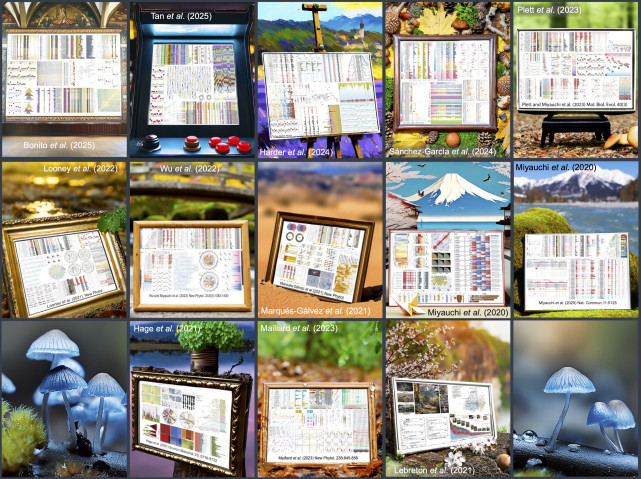
I raise awareness about the significance of fungi through my data visualisations. I turn complex data into artistic graphs using colours inspired by various artworks of the impressionists, Ukiyo-e, and modern artists. My aim is to create a sense of peace and harmony with nature. Please remember - fungi are important for our planet!

Artistic graphic pipelines - Visual Omics Tools
The field of fungal biology is experiencing a flood of genome data. There is a huge demand for interpreting such data into biological context. My passion is to extract and visualise meaningful patterns from complex biological data. I have developed a creative visual-omics suite called the ‘Visual Omics Tools,’ which includes SHIN+GO, TINGO, PRINGO, SynGO, VINGO, and SIMGO (coming soon). On social media, these tools are also known as ‘SHINGO-Tools.’ This visual approach accelerates discovery in large genomic data. The tools have been used by over 30 researchers in 14 countries.
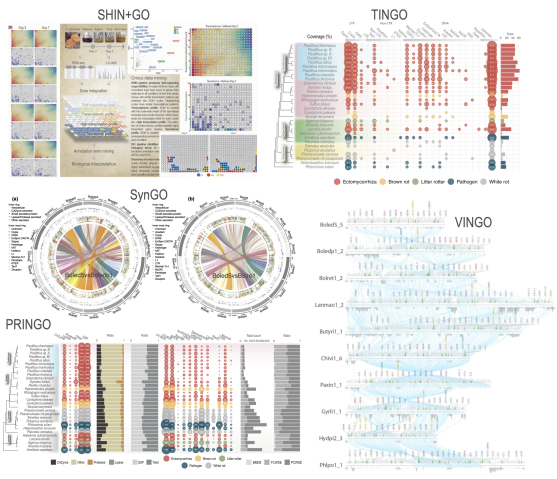
This suite of cutting-edge bioinformatics tools has revolutionised fungal genomics research with avant-garde visuals and artistic color schemes. We have made a significant impact in understanding fungal evolution and the ecological roles of forest fungi such as wood and litter decayers, endophytes, mycorrhizal and edible fungi.
Deep-Sea Fungal Genome Project (2024-2027)
In the deep ocean, where there’s no sunlight, fungi live in very harsh conditions like extreme temperatures, high salt levels, and intense pressure. These fungi have special traits that help them survive. However, we don’t know much about them. This project aims to sequence and study genomes of these deep-sea fungi to understand how they survive in such tough environments. Our collaborators are US Department of Energy Joint Genome Institute, INRAE France, and Japan Agency for Marine-Earth Science and Technology (JAMSTEC). The project is funded by JSPS Grants-in-Aid for Scientific Research (24K09580).

Key Publications
- Bonito et al. (2025) Pangeneric analyses reveal the divergent genome evolution and ecologies between morels and truffles in the Morchellaceae. Current Biology. Sep 8;35(17)
- Harder et al. (2024). Extreme overall mushroom genome expansion in Mycena ss irrespective of plant hosts or substrate specializations. Cell Genomics 4 (7)
- Plett et al. (2023). Speciation Underpinned by Unexpected Molecular Diversity in the Mycorrhizal Fungal Genus Pisolithus. Molecular biology and evolution 40 (3)
- Looney et al. (2022). Evolutionary transition to the ectomycorrhizal habit in the genomes of a hyperdiverse lineage of mushroom‐forming fungi. New Phytologist 233 (5), 2294-2309
- Wu et al. (2022). Evolutionary innovations through gain and loss of genes in the ectomycorrhizal Boletales. New Phytologist 233 (3), 1383-1400
- Lebreton et al. (2021). Evolution of the mode of nutrition in symbiotic and saprotrophic fungi in forest ecosystems. Annual Review of Ecology, Evolution, and Systematics 52 (1), 385-404
- Miyauchi et al. (2020). Large-scale genome sequencing of mycorrhizal fungi provides insights into the early evolution of symbiotic traits. Nature communications 11 (1), 5125