


FY2023 Annual Report
Coordination Chemistry and Catalysis Unit
Associate Professor Julia Khusnutdinova
Abstract
During this fiscal year (April 2023-March 2024), our group has further studying organometallic chemistry and catalytic reactivity of naphthyridine nickel complexes, which allowed us to uncover unusual C-F bond aerobic oxygenation chemistry and photocatalytic C-N and C-O cross-coupling reactions. Further looking into organometallic reactivity of first-row metals, we have found that transmetalation to manganese(III) complexes from zinc trifluoromethyl reagents results in difluorocarbene generation, further utilized in preparation of difluoro-cyclopropanes. These research directions revealed that C-F bond, generally seemed inert, features quite rich reactivity with first-row transition metal complexes.
Our group has further expanded the library of heterobimetallic complexes to make Pt/Sn and Pt/Si complexes. This allowed us to observe unusual “reverse” transmetalation reactivity with Me group transferred from Pt to Sn directly, or induced by B-H, Si-H bond, or H2 activation.
We have also developed mechanoresponsive polymers containing copper-based mechanophores emitting in red/near-infrared region, which may find potential applications in imaging due to better penetration through biological tissue and bulk material.
This year, Shubham Deolka successfully defended his PhD degree in May 2023.
1. Staff
- Dr. Ayumu Karimata, Postdoctoral Scholar
- Dr. Govindarajan Ramadoss, Postdoctoral Scholar
- Dr. Dilip Pandey, Postdoctoral Scholar
- Dr. Vardhanapu Pavan Kumar, Research Technician
- Shubham Deolka, Graduate Student
- Hoan Dinh, Graduate Student
- Tatiana Gridneva, Graduate Student
- Aleksandr Sorvanov, Graduate Student
- Daria Sherstiukova, Graduate student
- Mitsuyuki Oshiro, graduate student
- Hanieh Moradi, Research Intern
- Maria Howard, Research Intern
- Azamat Yessengazin, Research Intern
- Kyoko Chinen, Research Unit Administrator
2. Collaborations
2.1 DFT study of the mechanism of Fe-catalyzed hydrogenation
- Type of collaboration: Computational studies of reaction mechanisms
- Researchers: Dr. Shrinwantu Pal (University of Calgary)
3. Activities and Findings
3.1 Deep-red emitting mechanoresponsive materials
In 2024, we have reported tunable copper amide systems which displayed emission in the red/near-IR region that would potentially allow for better penetration through biological tissue or bulk material (Scheme 1). When incorporated into poly(butyl acrylate), the resulting polymer films showed an increase in photoluminescence intensity during mechanical stretching, which is repeatable over multiple cycles (Figure 1).18 Computational studies were used to elucidate the role of complex dynamics and the dependence of photophysical properties on the N4-ligand conformation. These results will be the basis of the thesis of PhD student Tatiana Gridneva, with a PhD defense scheduled in June 2025.
Scheme 1. Synthesis of poly(butyl acrylate) samples cross-linked with pyridinophane copper amide complexes.
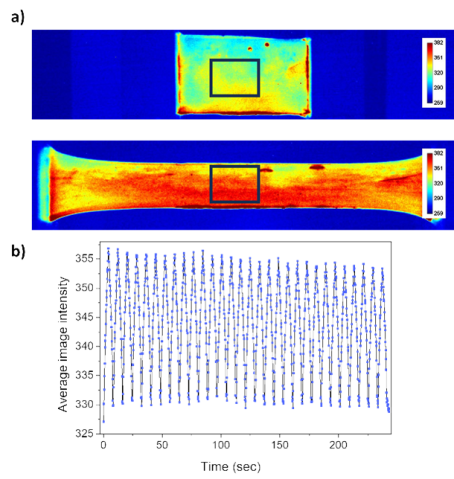
Figure 1. Optical imaging of PBA1 film at 0% (top) and 200% (bottom) strain (in pseudocolor based on grayscale pixel intensity). b) Change of average image intensity of the selected area of the film (black square) during 30 continuous stretch/release cycles measured by a CCD camera.
3.2 Metal-metal cooperation
Heteromultimetallic assemblies play an essential role in enzymes, promoting challenging multielectron and multiproton transfer reactions and strong chemical bond activation via cooperation between multiple metal centers, for example in Fe/Mo and V/Fe nitrogenases, Ni/Fe hydrogenase, Fe/Ni and Cu/Mo CO dehydrogenases, or in the oxygen evolving center of the Photosystem II. Multimetallic cooperation plays an equally important role in artificial catalysis, in particular, during transmetalation in cross-coupling reactions in the presence of a noble metal catalyst and a d10 metal or main group metal. Studying heterobimetallic complexes as model species to elucidate the modes of bimetallic cooperation has been a longstanding challenge in organometallic chemistry as it requires a site-selective assembly of the heteromultimetallic core with each metal taking a well-defined position, avoiding random scrambling of metal atoms in the multimetallic core.
In our group, we have developed a family of unsymmetrical multinucleating ligands, all based on a naphthyridine core, which provide a highly differentiated environment, allowing for site-selective formation of heterobimetallic or multimetallic chains. For example, ligand L1 features a soft, phosphinite terminus, and a hard, N-donor terminus, providing a tool to selectively build a heterobimetallic core. Ligand L2 features a single N-donor chelate as a terminus, while leaving an open naphthyridinone core allowing to extend metal chains to include more than two atoms (up to 4 or sometimes 5 metal atoms). Its phosphine analogue, L3, differs by having a soft, phosphine terminus, which has different coordination preferences at the terminus of a multimetallic chain.
During this year, we have expanded our library of heterobimetallic complexes to include a combination of platinum with main group metals and metalloids, Sn and Si. Interestingly, a rare event of a “reverse” transmetalation from a platinum group metal to a main group metal was observed in bimetallic Pt complexes with Sn (Scheme 2). This is in contrast to the normally observed transmetalation from a main group metal to a platinum group metal. Evidence for reverse transmetalation can be observed during C‒C cross-coupling catalysis through the presence of homocoupled products.
In the case of Pt-Sn complexes, “reverse” Me group transfer from a PtMe2 center was observed during the bimetallic core formation, to give dimer 1, along with the by-product 2 (Scheme 2a). Interestingly, 2 showed further reactivity in B-H, Si-H, or H2 activation, which triggered another event of a single Me group transfer from a monomethyl Pt center to tin to give platinum hydride 24 (Scheme 2b). DFT calculations were done in collaboration with Dr. Pal and QTAIM and electronic potential analysis was done in collaboration with Dr. Fayzullin to elucidate the mechanisms of these transformations and understand the nature of metal-metal bonding in these complexes.
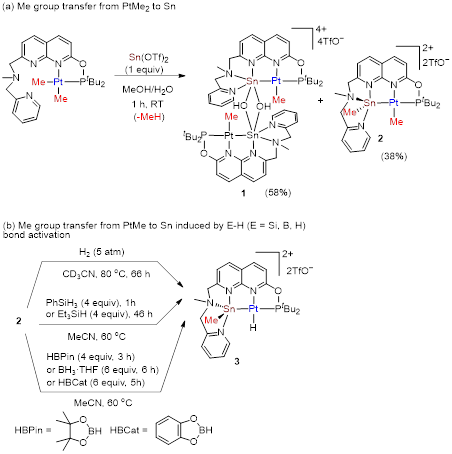
Scheme 2. Reverse transmetalation reactivity in Pt···Sn, Pt···Ga, and Pt···In complexes.
3.3 Organometallic reactivity and catalysis by Ni and Mn complexes
Our group has previous reported the application of nickel trifluoromethyl complexes supported by naphthyridine-based ligands in catalytic, photoinduced trifluoromethylation of C-H bonds of arenes and heteroarenes and aerobic oxidation to nickel(III) trifluoromethyl complexes (Scheme 3).
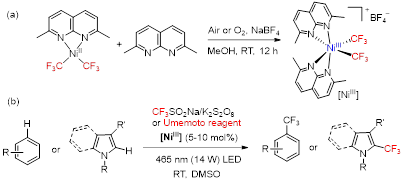
Scheme 3. Aerobic oxidation to form NiIII complexes and photoinduced catalytic C-H bond trifluoromethylation.
This year, we turned out attention to previously reported combined precious metal/nickel photocatalytic reactions such as C‒O and C‒N cross-coupling of aryl bromides with alcohols and amines, respectively. We were able to show that indeed, in the absence of precious metal additives, our naphtyridine nickel complexes act as catalysts for light-promoted C‒N and C‒O cross coupling (Scheme 4).6
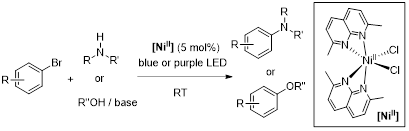
Scheme 4. C-O and C-N cross-coupling catalyzed by 3.
As there are currently several examples of small molecule drugs that contain longer-chain prefluoroalkyl groups, we were also interested in developing general methodologies for perfluoroalkylation. Despite our initial expectations that naphthyridine nickel perfluoroethyl and perfluoropropyl complexes will behave similarly to their trifluoromethyl analogs (Scheme 3), we observed an unexpectedly facile oxygenation of C‒F bonds induced by aerobic oxidation of nickel or other redox-active metal complexes. Aerobic oxidation of NiII perfluoroethyl and perfluoropropyl complexes produced perfluorocarboxylate complexes by oxygenation of the α-CF2 fragment into carboxylate under ambient conditions (Scheme 5a). Mechanistic investigation and isotope labeling studies suggested that this occured via a radical process, which allowed us to exploit it for aerobic, Ni-mediated oxygen atom transfer to an organic substate, sulfide, phosphine or even an alkene where it is accompanied by C=C bond splitting (Scheme 5b). Interestingly, mixed-valent nickel(IV)-nickel(II) intermediates were structurally characterized during low temperature oxidation by O2 showing that this reactivity involves high oxidation state nickel species obtained using O2 as the sole oxidant (Scheme 5c).8
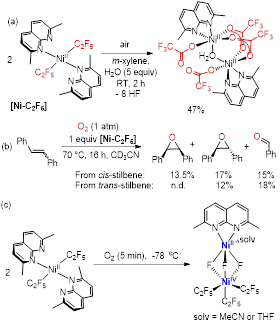
Scheme 5. Reactivity of naphthyridine Ni perfluoroethyl and perfluoropropyl compexes with O2 or air.
Along a related line of research, while studying C‒C bond formation using N3C-pyridinophane manganese(III) complexes relevant to Mn-mediated cross-coupling, we have found that attempted transmetalation to make MnIII trifluoromethyl complex instead results in an immediate α-fluorine elimination and extrusion of difluorocarbene, which was applied to preparation of difluorocyclopropanes from alkenes (Scheme 6).
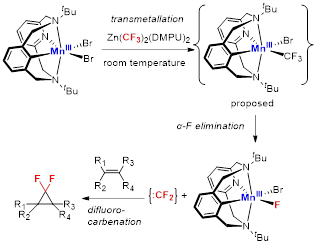
Scheme 6. α-Fluoride elimination during transmetalation of MnIII complexes and difluorocarbene trapping by an alkene.
4. Publications
4.1 Journals
- Gridneva, T.; Karimata, A.; Bansal, R.; Fayzullin, R. R.; Vasylevskyi, S.; Bruhacs, A.; Khusnutdinova, J. R.* "Deep-red photoluminescent mechanoresponsive polymers with dynamic CuI-arylamide mechanophores" Chem. Commun. 2024, 60, 212-215. https://doi.org/10.1039/D3CC04643E
- Govindarajan, R.; Fayzullin, R. R.; Deolka, S.; Khaskin, E.; Vasylevskyi, S.; Vardhanapu, P. K.; Pal, S.; Khusnutdinova, J. R.* "Facile access to cationic methylstannylenes and silylenes stabilized by E‒Pt bonding and their methyl group transfer reactivity" Chem. Eur. J. 2024, 30, e202303789 https://doi.org/10.1002/chem.202303789
- Bahri, J.;+ Deolka, S.;+, Vardhanapu, V. K.; Khaskin, E.; Govindarajan, R.; Fayzullin, R. R.; Vasylevskyi, S.; Khusnutdinova, J. R.* "Photoinduced Carbon-Heteroatom Cross-Coupling Catalyzed by Nickel Naphthyridine Complexes" (+ indicates equal contribution) ChemCatChem 2023, 15, e202301142 https://doi.org/10.1002/cctc.202301142
- Deolka, S.; Govindarajan, R.;+ Gridneva, T.;+ Roy, M. C.; Vasylevskyi, S.; Vardhanapu, P. K.; Khusnutdinova, J. R.; Khaskin, E.* (+ indicates equal contribution) "General High-Valent Nickel Metallocycle Catalyst for the Perfluoroalkylation of Heteroarenes and Peptides" ACS Catal. 2023, 13, 13127-13139. https://doi.org/10.1021/acscatal.3c03705
- Pandey, D. K.; Khaskin, E.*, Khusnutdinova, J. R.* "PNP-Pincer Ligands Armed With Methyls: New Tools To Control Sterics and Non-Innocence" ChemCatChem 2023, 15, e202300644 https://doi.org/10.1002/cctc.202300644
- Dinh, M. H.; He, Y.-T.; Fayzullin, R. R.; Vasylevskyi, S.; Khaskin, E.; Khusnutdnova, J. R.* "Synthesis of Aryl-Manganese(III) Fluoride Complexes via α-Fluorine Elimination from CF3 and Difluorocarbene Generation" Eur. J. Inorg. Chem. 2023, 26, e202300460 https://doi.org/10.1002/ejic.202300460 (special invited issue on Manganese Homogeneous Catalysis)
- Deolka, S.; Govindarajan, R.; Khaskin, E.; Vasylevskyi, S.; Bahri, J.; Fayzullin, R. R.; Roy, M. C.; Khusnutdinova, J. R.* "Oxygen transfer reactivity mediated by nickel perfluoroalkyl complexes using molecular oxygen as a terminal oxidant" Chem. Sci. 2023, 14, 7026-7035. DOI: 10.1039/D3SC01861J
4.2 Books and other one-time publications
Nothing to report
4.3 Oral and Poster Presentations
- Julia Khusnutdinova, Invited talk: “Dynamic base metal complexes as new tools for mechanoresponsive materials” OIST-UC Santa Barbara Mini Symposium: Materials of Tomorrow: Harnessing Responsiveness, Intelligence, and Sustainability. March 26, 2024, OIST, Japan
- Julia Khusnutdinova, Invited talk: “Designing mechanoresponsive polymers with dynamic metal complexes” Japan-US Seminar on Polymer Chemistry, October 30-November 3, 2023, OIST, Japan
- Julia Khusnutdinova, Invited talk: “Development of mechanoresponsive polymers containing photoluminescent mechanophores”, CREST-OIST Joint Symposium on Circularly Polarized Luminsence and the Related Phenomena”, April 2023, OIST, Japan
- Dilip K. P., Pal, S., Robert R. Fayzullin, R., & Khusnutdinova, J., Bulky PNP ligand - base metal complexes: Small molecule activation and catalytic activity. ACS Fall 2023: San Francisco and virtual, Moscone Center, 2023.08.13
- Dinh, H. M. & Khusnutdinova, J., Photo-induced pentafluoroethylation mediated by cobalt(III) complexes supported by naphthyridine-based ligands. XXV Conference on Organometallic Chemistry (EuCOMC XXV): Madrid, University of Alcalá, 2023.09.05.
- Ramadoss, G., Pt/Main group bimetallic complexes: Small molecule activation and metal-metal cooperative transmetalation. XXV Conference on Organometallic Chemistry (EuCOMC XXV) : Madrid, University of Alcalá, 2023.09.07.
- Gridneva, T.,Karimata, A., Bansal. R., Fayzullin, R., Vasylevskyi, S., Bruhacs, A., & Khusnutdinova, J., Development of red emitting Cu)I-arylamide mechanophores and their application to mechanoresponsive polymers. 72nd Symposium on Macromolecules: Takamatsu, Kagawa University, 2023.09.27
- Karimata, A., Fayzullin, R., & Khusnutdinova, J., Triboluminescence of polymer films containing photoluminescent compound. The 32th polymer material forum: Nagoya, Nagoya Congress Center, 2023.11.30-12.01
- Karimata, A., Fayzullin, R., & Khusnutdinova, J., Triboluminescence of blend film with commonly available luminophores and polymers. OIST-Kyudai Joint Symposium Series 1: Bio-Inspired Wonders and Energy Innovations: Onna, Okinawa Science and Technology Graduate University, 2024.02.29
- Vardhanapu, P.K., Bahri, J., & Khusnutdinova, J., Photoinduced Carbon-Heteroatom Cross-Coupling Catalyzed by Nickel Naphthyridine Complexes. The 104th CSJ Annual Meeting: Chiba, Nihon University College of Science and Technology, 2024.03.21
5. Intellectual Property Rights and Other Specific Achievements
5.1. Patents
Khusnutdinova, J. R.; Karimata, A. TRIBOLUMINESCENT MATERIAL, USE OF A Cu COMPLEX AS A TRIBOLUMINESCENT MATERIAL, MECHANORESPONSIVE SENSOR AND METHOD FOR DETECTING A MECHANICAL LOADING. PCT number: JP2020/006298, publication number: WO2022/014514
6. Meetings and Events
N/A
7. Other
Grants:
JSPS Kakenhi Grant number: 23K04743
Title: Photoinduced C-H bond fluoroalkylation and aryl-heteroatom coupling catalyzed by naphthyridine complexes of earth-abundant metals
PI name: Julia Khusnutdinova
Dates of Award: 2023-2025
Funding agency: JSPS Kakenhi
Role: principal investigator
Budget amount: ¥4,680,000 (Direct Cost: ¥3,600,000、Indirect Cost: ¥1,080,000)
Other events:
PhD graduation, Shubham Deolka, thesis title: “Naphthyridines as Versatile Ligand Scaffolds For Metal-Metal Cooperative Bond Activation and Photocatalysis”