


Analysis and Partial Differential Equations
Professor Ugur Abdulla
Abstract
The aim of the Analysis and PDE unit is to reveal and analyze the mathematical principles reflecting natural phenomena expressed by partial differential equations. Research focuses on the fundamental analysis of PDEs, regularity theory of elliptic and parabolic PDEs, with special emphasis on the regularity of finite boundary points and the point at \(\infty\), its measure-theoretical, probabilistic, and topological characterization, well-posedness of PDE problems in domains with non-smooth and non-compact boundaries, global uniqueness, analysis and classification of singularities, asymptotic laws for diffusion processes, regularity theory of nonlinear degenerate and singular elliptic and parabolic PDEs, free boundary problems, optimal control of free boundary systems with distributed parameters. Some of the current research projects in Applied Mathematics include cancer detection through Electrical Impedance Tomography and optimal control theory; identification of parameters in large-scale models of systems biology; quantum optimal control of biochemical processes.
1. Staff
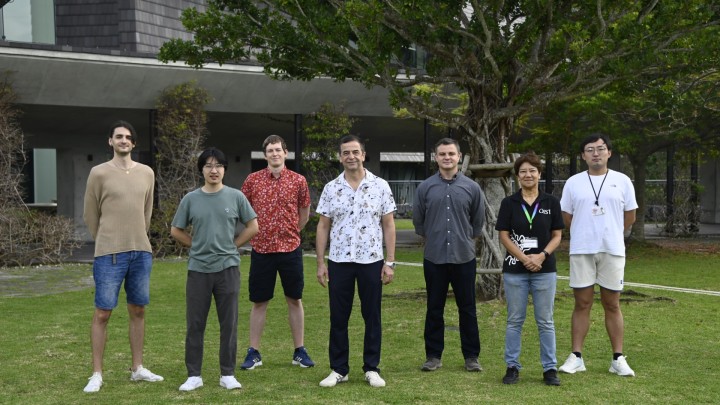
- Prof. Dr. Ugur Abdulla, Group Leader
- Dr. Daniel Tietz, Researcher
- Dr. Jose Rodrigues, Researcher
- Dr. Denis Brazke, Researcher
- Dr. Zetao Cheng, Researcher
- Mr. Chenming Zhen, PhD Student
- Ms. Miwako Tokuda, Administrative Assistant
2. Activities and Findings
2.1 Potential Theory and PDEs
One of the major problems in the Analysis of PDEs is understanding the nature of singularities of solutions of PDEs reflecting the natural phenomena. Solution of the Kolmogorov Problem and new Wiener-type criterion for the regularity of \(\infty\) opened a great new perspective for the breakthrough in understanding non-isolated singularities performed by solutions of the elliptic and parabolic PDEs at the finite boundary points and the point at \(\infty\).
We solved an outstanding open problem and proved Kolmogorov-Petrovsky-type necessary and sufficient condition for the removability of the fundamental singularity, and equivalently for the unique solvability of the singular Dirichlet problem for the heat equation. In the measure-theoretical context the criterion determines whether the parabolic measure of the singularity point is null or positive. From a topological point of view, the result presents the parabolic minimal thinness criterion of sets in parabolic minimal fine topology. From the probabilistic point of view, the test presents asymptotic law for the conditional Brownian motion near the singularity point. The results are published in a paper:
U. G. Abdulla, Removability of the Fundamental Singularity for the Heat equation and its Consequences, Journal of Mathematical Physics, 65, 12 (2024). https://doi.org/10.1063/5.0233490
In a recent paper a new Wiener-type criterion has been introduced to address the removability of fundamental singularities and, equivalently, the unique solvability of the singular Dirichlet problem for the heat equation. This work fully characterizes the removability of non-isolated boundary singularities through the fine-topological thinness of the exterior set near the singularity point. A significant tool in this characterization is the new concept of h-capacity of Borel sets, which measures thinness and establishes singularity behavior via the divergence of weighted sums of h-capacities within nested shells. In the probabilistic context, this criterion reveals an asymptotic law for conditional Brownian motion. The results are posted in a preprint
U. G. Abdulla, Wiener-type Criterion for the Removability of the Fundamental Singularity for the Heat Equation and its Consequences, Math Arxiv:2501.00920, 2025.
2.2 Mathematical Biosciences: Cancer Detection via Electrical Impedance Tomography (EIT) and Optimal Control Theory
The goal of this project is to develop a new mathematical framework utilizing the theory of PDEs, inverse problems, and optimal control of systems with distributed parameters for a better understanding of the development of cancer in the human body, as well as the development of effective methods for the detection and control of tumor growth.
In a recent paper we pursue a computational analysis of the biomedical problem on the identification of the cancerous tumor at an early stage of development based on the Electrical Impedance Tomography (EIT) and optimal control of elliptic partial differential equations. Relying on the fact that the electrical conductivity of the cancerous tumor is significantly higher than the conductivity of the healthy tissue, we consider an inverse EIT problem on the identification of the conductivity map in the complete electrode model based on the $m$ current-to-voltage measurements on the boundary electrodes. A variational formulation as a PDE-constrained optimal control problem is introduced based on the novel idea of increasing the size of the input data by adding "voltage-to-current" measurements through various permutations of the single "current-to-voltage" measurement. The idea of permutation preserves the size of the unknown parameters on the expense of increase of the number of PDE constraints. We apply a gradient projection (GPM) method based on the Fréchet differentiability in Besov-Hilbert spaces. Numerical simulations of 2D and 3D model examples demonstrate the sharp increase of the resolution of the cancerous tumor by increasing the number of measurements from $m$ to $m^2$.
The results are posted in a recent preprint
U.G. Abdulla and J.H. Rodrigues, Cancer Detection via Electrical Impedance Tomography and Optimal Control of Elliptic PDEs, 2025; Math ArXiv: 2509:02050;
2.3 Quantum Optimal Control in Biochemical Processes
The overarching goal of this project is to unveil the groundbreaking role of quantum coherence in biochemical processes. Optimal control of the external electromagnetic field input for the maximization of the quantum triplet-singlet yield of the radical pairs in biochemical reactions modeled by Schrodinger system with spin Hamiltonians given by the sum of Zeeman interaction and hyperfine coupling interaction terms are analyzed. Frechet differentiability and Pontryagin Maximum Principle in Hilbert space is proved and the bang-bang structure of the optimal control is established. A closed optimality system of nonlinear differential equations for the identification of the bang-bang optimal control is revealed. Numerical methods for the identification of the bang-bang optimal control based on the Pontryagin maximum principle are developed. Numerical simulations are pursued, and the convergence and stability of the numerical methods are demonstrated. The results contribute towards understanding the structure-function relationship of the putative magnetoreceptor to manipulate and enhance quantum coherences at room temperature and leveraging biofidelic function to inspire novel quantum devices.
It is remarkable that the optimal magnetic pulse driving the complex quantum system to coherent state has a simple bang-bang structure. Pontryagin Maximum Principle - fundamental mathematical principle for the optimality of the complex dynamical systems turned out to be a fundamental principle for the quantum coherence. Pontryagin Maximum Principle implies that along the optimal state and adjoined trajectories almost at every time instance the Hamilton-Pontryagin function achieves the maximum value with respect to finite-dimensional control parameter precisely at the value of the optimal control parameter. Due to the structure of the Hamilton-Pontryagin function, which inherited the structure of the Hamiltonian, its maximum with respect to each component of the control parameter is always achieved at the extreme values. Hence, the complex quantum system is driven to coherent state through banging of the components of the external magnetic pulse between its extreme values in specific time intervals.
The results are published in the following paper:
U.G. Abdulla, J. Rodrigues, P. Jimenez, Ch. Zhen, C. Martino, Bang-bang Optimal Control in Coherent Spin Dynamics of Radical Pairs in Quantum Biology, Quantum Science and Technology, 2024, Volume 9, Number 4, 045022. https://iopscience.iop.org/article/10.1088/2058-9565/ad68a1
In a recent paper we introduce a one-parameter family of optimal control problems by coupling the Schrodinger system to a control field through filtering equations for the electromagnetic field. Fréchet differentiability and Pontryagin Maximum Principle in Hilbert space is proved and the bang-bang structure of the optimal control is established. A new iterative Pontryagin Maximum Principle (IPMP) method for the identification of the bang-bang optimal control is developed. Numerical simulations based on IPMP and the gradient projection method (GPM) in Hilbert spaces are pursued, and the convergence, stability and the regularization effect are demonstrated. Comparative analysis of filtering with regular optimal electromagnetic field versus non-filtering with bang-bang optimal field (Abdulla et al, Quantum Sci. Technol., 9, 4, 2024) demonstrates the change of the maxima of the singlet yield is less than 1%. The results open a venue for a potential experimental work for the magnetoreception as a manifestation of quantum biological phenomena.
The results are posted in the following preprint:
U.G. Abdulla, J.H. Rodrigues, J.-J. Slotine, Quantum Optimal Control for Coherent Spin Dynamics of Radical Pairs via Pontryagin Maximum Principle, Math ArXiv: 2508.01806, 2025.
2.4. Dynamical Systems and Ergodic Theory
We prove a conjecture on the second minimal odd periodic orbits with respect to Sharkovsky ordering for the continuous endomorphisms on the real line. The conjecture was posed in U.G. Abdulla et al., International Journal of Bifurcation and Chaos, 27(5), 2017, 1-24. A $(2k+1)$-periodic orbit $\{\beta_{1}<\beta_{2}<\cdots <\beta_{2k+1} \}$, ($k\geq 3$) is called second minimal for the map $f$, if $2k-1$ is a minimal period of $f|_{[\beta_1,\beta_{2k+1}]}$ in the Sharkovski ordering. The full classification of second minimal orbits is presented in terms of cyclic permutations and a directed graph of transitions. It is proved that second minimal odd orbits either have a Stefan structure like minimal odd orbits or have one of the $4k-3$ types, each characterized by unique cyclic permutation and directed graph of transitions with accuracy up to inverses. The new concept of second minimal orbits and its classification has an important application toward the understanding of the universal structure of the distribution of the periodic windows in the bifurcation diagram generated by the chaotic dynamics of nonlinear maps on the interval.
The result is published in the following paper:
U.G. Abdulla, N.H. Iqbal, M.U. Abdulla, R.U. Abdulla, Classification of the Second Minimal Orbits in the Sharkovski Ordering, Axioms, 2025, 14(3), 222; https://doi.org/10.3390/axioms14030222
3. Publications
3.1 Journals
- U. G. Abdulla, Removability of the Fundamental Singularity for the Heat equation and its Consequences, Journal of Mathematical Physics, 65, 12 (2024). https://doi.org/10.1063/5.0233490
- U.G. Abdulla, J. Rodrigues, P. Jimenez, Ch. Zhen, C. Martino, Bang-bang Optimal Control in Coherent Spin Dynamics of Radical Pairs in Quantum Biology, Quantum Science and Technology, 2024, Volume 9, Number 4, 045022. https://iopscience.iop.org/article/10.1088/2058-9565/ad68a1
- U. G. Abdulla, N. H. Iqbal, M. U. Abdulla, R. U. Abdulla, Classification of Second Minimal Orbits in the Sharkovski Ordering, Axioms, 2025, 14(3), 222; https://doi.org/10.3390/axioms14030222
3.2 Preprints
- U. G. Abdulla, Wiener-type Criterion for the Removability of the Fundamental Singularity for the Heat Equation and its Consequences, Math Arxiv:2501.00920, 2025.
- U.G. Abdulla, J.H. Rodrigues, J.-J. Slotine, Quantum Optimal Control for Coherent Spin Dynamics of Radical Pairs via Pontryagin Maximum Principle, Math ArXiv: 2508.01806, 2025.
3.3 Books and other one-time publications
Nothing to report
4. Invited Lectures and Conference Presentations
4.1 Invited Colloquium Lectures
- Date: April 24, 2024
- Venue: Massachusetts Institute of Technology
- Speaker: Professor Ugur G. Abdulla (OIST)
- Title: Bang bang optimal control in coherent spin dynamics of radical pairs in quantum biology, MIT, Mechanical Engineering Department Seminar
- Date: November 20, 2024
- Venue: University of Miami
- Speaker: Professor Ugur G. Abdulla (OIST)
- Title: Removability of the fundamental singularity for the heat equation and its measure-theoretica, topological and probabilistic consequences, Colloquium
- Date: February 11, 2025
- Venue: University of Florida
- Speaker: Professor Ugur G. Abdulla (OIST)
- Title: Cancer Detection via Electrical Impedance Tomography and Optimal Control of Elliptic PDEs, Mathematical Biology Seminar
- Date: February 19, 2025
- Venue: University of Pittsburgh
- Speaker: Professor Ugur G. Abdulla (OIST)
- Title: Kolmogorov problem and Wiener-type critera for the removability of the fundamental singularity for the elliptic and parabolic PDEs, PDE and Analysis Seminar
- Date: April 22, 2025
- Venue: Texas A&M University
- Speaker: Professor Ugur G. Abdulla (OIST)
- Title: Kolmogorov Problem and Wiener-type Criteria for the Removability of the Fundamental Singularity for the Elliptic and Parabolic PDEs
4.2 Invited Conference Presentations
- Date: October 19, 2024
- Venue: American Mathematical Society 2024 Fall Eastern Sectional Meeting
- Speaker: Professor Ugur G. Abdulla (OIST)
- Title: Kolmogorov Problem and Wiener-type Criteria for the Removability of the Fundamental Singularity for the Parabolic PDEs
- Date: January 10, 2025
- Venue: Joint Mathematics Meetings 2025
- Speaker: Professor Ugur G. Abdulla (OIST)
- Title: Kolmogorov Problem and Wiener-type Criteria for the Removability of the Fundamental Singularity for the Elliptic and Parabolic PDEs
- Date: March 30, 2025
- Venue: American Mathematical Society Spring Central Meeting 2025
- Speaker: Professor Ugur G. Abdulla (OIST)
- Title: Wiener-type Criteria for the Removability of the Fundamental Singularity for the Elliptic and Parabolc PDEs
5. Intellectual Property Rights and Other Specific Achievements
Nothing to report.
6. Meetings and Events
6.1 Analysis and Partial Differential Equations Seminar Series
- Date: May 16, 2024
- Venue: OIST Campus L4E48
- Speaker: Professor Ugur G. Abdulla (OIST)
- Title: Kolmogorov Problem and Wiener-type Criteria for the Removability of the Fundamental Singularity for the Parabolic PDEs
- Date: October 11, 2024
- Venue: OIST Campus L4E48
- Speaker: Professor Raphael Winter (Cardiff University)
- Title: Recent progress on collisional kinetic PDEs
- Date: October 15, 2024
- Venue: OIST Campus L4E48
- Speaker: Dr. Cintia Pacchiano (Calgary University)
- Title: Regularity Results for Double Phase Problems on Metric Measure Spaces
- Date: November 12, 2024
- Venue: OIST Campus L4F01
- Speaker: Professor Yoldas Havva (Delft Institute of Applied Mathematics, TU Delft)
- Title: A cross-diffusion system obtained via (convex) relaxation in the JKO scheme
6.2 Mathematics in the Sciences (MiS) Seminar Series
- Date: April 10, 2024
- Venue: OIST Campus L4E48
- Speaker: Professor Ugur G. Abdulla (OIST)
- Title: Cancer Detection via Electrical Impedance Tomography and Optimal Control Theory: Invitation to Interdisciplinary Research
- Date: October 16, 2024
- Venue: OIST Campus L4F01
- Speaker: Professor Ugur G. Abdulla (OIST)
- Title: Cancer detection via Electrical Impedance Tomography and Optimal Control of Elliptic PDEs
- Date: January 24, 2025
- Venue: OIST Campus L4E48
- Speaker: Professor Jean-Jacques Slotine (Massachusetts Institute of Technology)
- Title: Contraction analysis of nonlinear dynamical systems -- a tutorial survey
6.3 Summer Graduate School
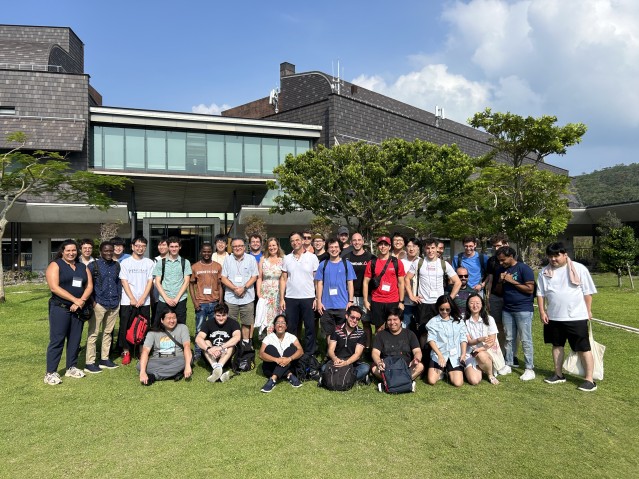
- 1st OIST-Oxford-SLMath Summer Graduate School on Analysis and Partial Differential Equations was held in Okinawa, Japan on July 29-August 9, 2024. Summer school offered two mini-courses: Mini-course “Measure-theoretical analysis, divergence-measure fields, and nonlinear PDEs of divergence form” was presented by Professors Gui-Qiang Chen (University Oxford) and Monica Torres (University of Purdue). Mini-course “Perron’s method and Wiener-type criteria in the potential theory of elliptic and parabolic PDEs” was presented by Professor Ugur G. Abdulla (OIST).
- Summer school presented four plenary lectures. Plenary speakers were Professor L. Craig Evans (UC Berkeley), Professor Juan Manfredi (U Pittsburgh), Professor Gui-Qiang Chen (Oxford) and Professor Ugur G. Abdulla (OIST).
- Mini-course Perron's method and Wiener-type criteria in the potential theory of elliptic and parabolic PDEs by Professor Ugur G. Abdulla
- Lecture 1 Harmonic functions - the mathematical representation of physical quantities in equilibrium; fundamental harmonic function; representation formula for the gravitational potential via Poisson's PDE by Professor Ugur G. Abdulla
- Lecture 2 (Active Learning Session) Mean value formulas, maximum/minimum principle for smooth sub-/superharmonic functions; uniqueness of the solution to the Dirichlet problem in bounded open sets by Professor Ugur G. Abdulla
- Lecture 3 Green's function, Green representation formula; Green's function for a ball; Poisson integral by Professor Ugur G. Abdulla
- Lecture 4 (Active Learning Session) Properties of the Poisson integral with Lebesgue integrable boundary function; solvability of the classical Dirichlet problem in a ball for any continuous boundary function by Professor Ugur G. Abdulla
- Lecture 5 Harnack inequality, interior estimates of derivatives and convergence theorems by Professor Ugur G. Abdulla
- Lecture 6 (Active Learning Session) Superharmonic functions by Professor Ugur G. Abdulla
- Lecture 7 Superharmonic function minimum principle. Perron's method by Professor Ugur G. Abdulla
- Lecture 8 (Active Learning Session) Boundary regularity of harmonic functions. The criterion for uniqueness. by Professor Ugur G. Abdulla
- Lecture 9 Boundary regularity and barrier, Bouligand's theorem. by Professor Ugur G. Abdulla
- Lecture 10 (Active Learning Session) Exterior cone condition for the boundary regularity. Example of boundary irregularity - Lebesgue's cusp. by Professor Ugur G. Abdulla
- Lecture 11 Newtonian potential and Capacity. by Professor Ugur G. Abdulla
- Lecture 12 (Active Learning Session) Existence and uniqueness of the capacitary measure for the compact sets. Properties of equilibrium measures and their potentials. Wiener's criterion for the boundary regularity. by Professor Ugur G. Abdulla
- Lecture 13 Wiener crieterion at \(\infty\) for the unique solvability of the Dirichlet problem in arbitrary open sets (Abdulla, 2007). Proof of the irregularity of \(\infty\) and non-uniqueness under the convergence of Wiener series at \(\infty\). by Professor Ugur G. Abdulla
- Lecture 14 (Active Learning Session) Wiener crieterion at \(\infty\) for the unique solvability of the Dirichlet problem in arbitrary open sets (Abdulla, 2007). Proof of the regularity of \(\infty\) and uniqueness under the divergence of Wiener series at \(\infty\). by Professor Ugur G. Abdulla
- Lecture 15 Heat equation and parabolic Dirichlet problem. Perron's solution. Exterior hyperbolic paraboloid condition for the boundary regularity of the finite boundary point. by Professor Ugur G. Abdulla
- Plenary Lecture Kolmogorov Problem and Wiener-type criteria for the Removability of Fundamental Singularity for the Parabolic PDEs by Professor Ugur G. Abdulla
- Lecture 16 Parabolic measure. Regularity of \(\infty\). Equivalency lemma: regularity of \(\infty\) is equivalent to uniqueness and the regularity of solution at \(\infty\). Exterior hyperbolic paraboloid condition at \(\infty\). by Professor Ugur G. Abdulla
- Lecture 17 (Active Learning Session) Heat potentials, caloric capacity and their properties. Formulation of the Wiener criterion at \(\infty\) for the heat equation. by Professor Ugur G. Abdulla
- Lecture 18 Proof of the Wiener crieterion at \(\infty\) for the uniqueness of the bounded solutions of the parabolic Dirichlet problem (Abdulla, 2008) - Part I by Professor Ugur G. Abdulla
- Lecture 19 (Active Learning Session) Proof of the Wiener crieterion at \(\infty\) for the uniqueness of the bounded solutions of the parabolic Dirichlet problem (Abdulla, 2008) - Part II by Professor Ugur G. Abdulla