



20 October 2025
OIST Global Admin Training Program Strengthens Inter-University Collaboration

Now in its tenth year, the OIST Global Admin Training Program has welcomed 27 administrators from eight universities, offering hands-on experience at OIST and fostering strong ties with institutions across Japan.
The program recently received additional funding through the J-PEAKS award, which supports initiatives that enhance Japan’s research capabilities through inter-university collaboration. This funding has enabled the program to expand, with more interns accepted in the past two years than ever before.
“The program was created to share what we’re learning about internationalization at OIST with other Japanese academic institutions, while at the same time benefiting from the fresh perspectives and new skills brought by program participants,” says Kohei Saito, who leads the program. “By learning from participating Japanese universities and research institutes, OIST staff are able to enhance our own efficiency and enrich the quality of our work.”
Interns are selected based on the needs of both OIST departments and their home institutions. While applicants must have a TOEIC score of at least 700, many are drawn to the opportunity to further strengthen their English skills. Most stay for one to two years, working in a single department, though some receive cross-departmental training.
During their time at OIST, interns contribute to projects and programs, offering valuable external insights and professional expertise. Host departments span a wide range of functions, including legal affairs, student services, public relations, workshops, academic HR, intellectual property, external funding, academic contracts, regional collaboration, graduate admissions, and faculty affairs.
Hiroshi Kimura, an administrator from Hitotsubashi University, worked in the Faculty Affairs Office, supporting faculty recruitment.
“The most valuable part was experiencing OIST from the inside — not just through websites or reports, but by working on-site,” says Kimura, who will become Deputy Head of the Educational Affairs Division upon returning to Hitotsubashi University. “This immersive experience helped me understand OIST’s culture and values, and how its strengths and challenges are shaped by that context.”
Interns are also encouraged to join social activities — such as club events and tea gatherings — to build communication skills in a multicultural environment and form connections with OIST colleagues and fellow interns.
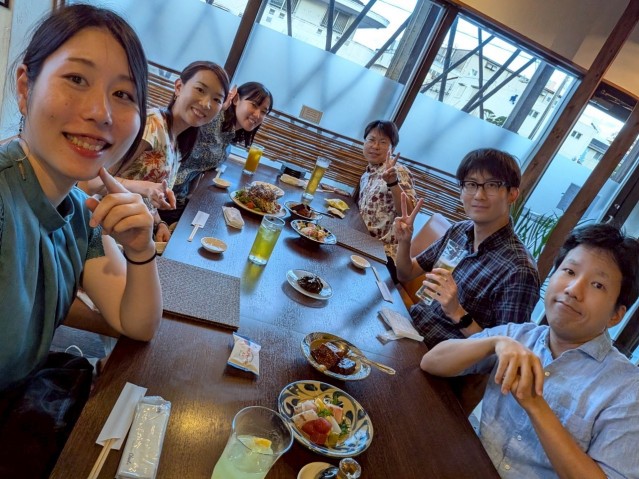
“What I enjoyed most was interacting not only with OIST staff, but also with interns from partner institutions like the University of Tokyo, Tohoku University, The University of Osaka, Kyushu University, NAIST, and RIKEN,” Kimura adds. “These exchanges gave me new perspectives on my own institution.”
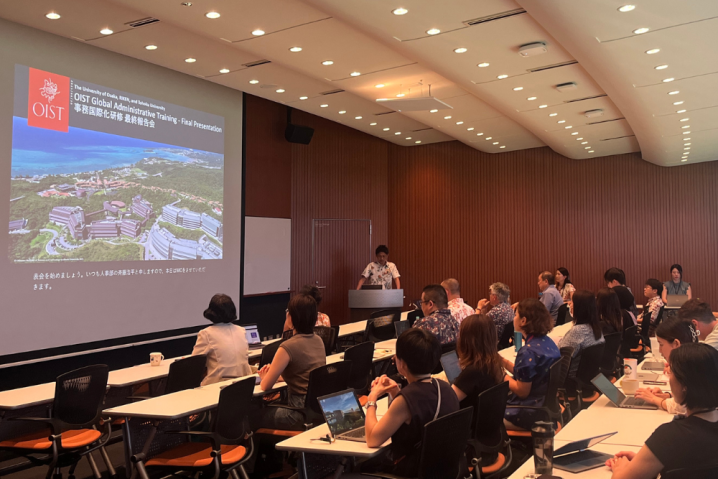
A mid-term review is conducted six months into the program to assess progress and address challenges. At the end, participants give a final presentation in English and submit a comprehensive training report with a self-evaluation.
“Through my time at OIST, my ability to communicate in English, as well as my understanding of others’ opinions and how plans are proposed and promoted, has been enhanced,” says Yukei Oshima an administrator from Kyushu University who is an intern with the Graduate School. “I believe these are essential skills for administrators in my home university.”
Since its launch in 2015 with Tohoku University, the program has hosted participants from institutions including The University of Osaka, Hitotsubashi University, the University of Tokyo, RIKEN, Kyushu University, NAIST and Nagasaki University.


