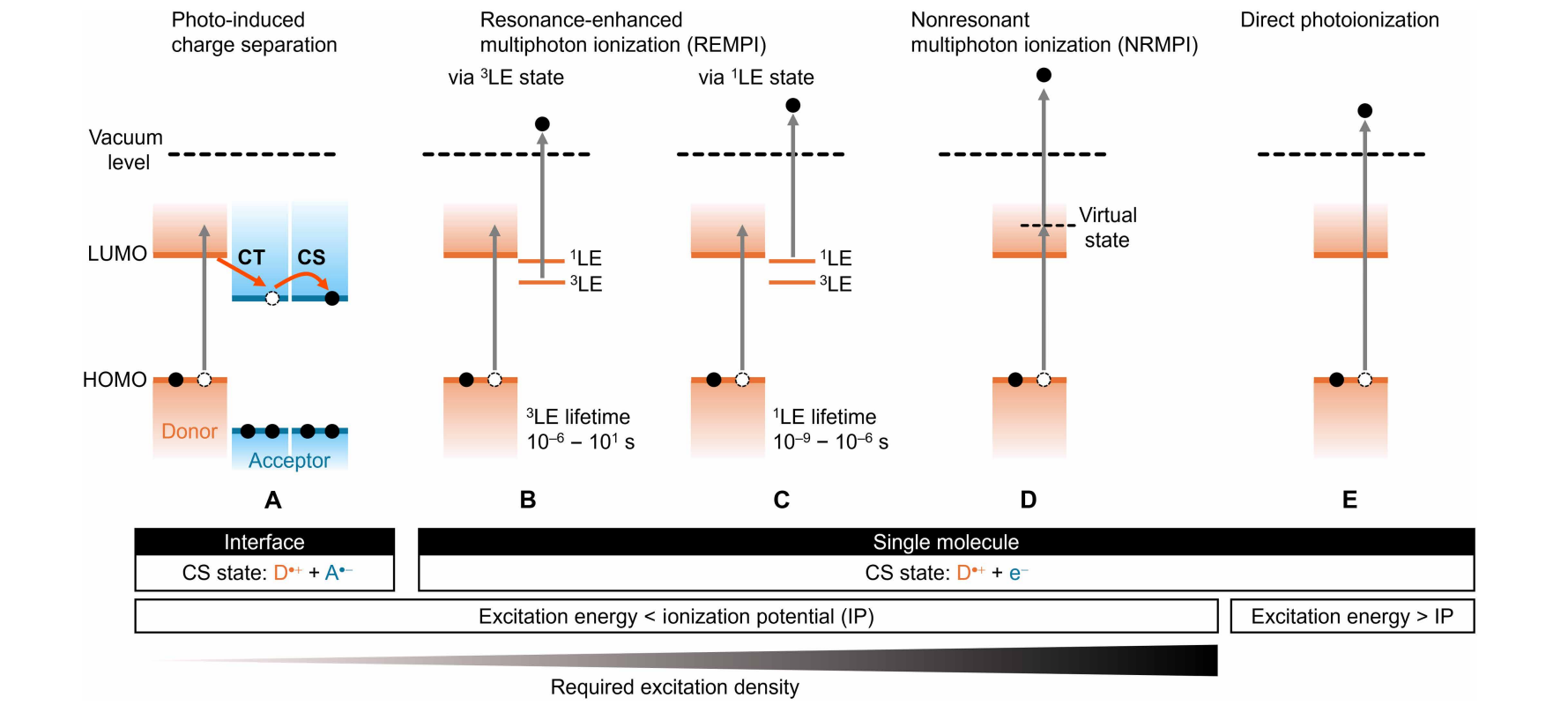



Charge generation pathways of organic materials

The researchers mapped the various pathways by which electrons can be excited from the highest occupied molecular orbital (HOMO) an organic material to the lowest unoccupied molecular orbital (LUMO) and beyond to ionization.
While photo-induced charge separation (CS) between donor and acceptor materials (A), direct photoionization in single-component molecules (E) and non-resonant multiphoton ionization (NRMPI, D) are well-studied, the resonant multiphoton excitation pathways (B–C) had received little attention.
In these states, electrons absorb multiple photons in succession, with each photon bumping the electron onto a higher but short-lived excited state before the next photon pushes it further. In NRMPI, the electron never lands on an excited state but is instead collectively pushed by multiple photons through ‘virtual’ states on the way to ionization.
Copyright OIST (Okinawa Institute of Science and Technology Graduate University, 沖縄科学技術大学院大学). Creative Commons Attribution 4.0 International License (CC BY 4.0).