研究の目的
脳の注目すべき機能の一つとして、時々刻々と変化する動的な環境でも経験を通して適応する学習能力があげられます。動的システムグループでは、数理的合理性というキーワードのもとで、脳はどのようにしてこのような学習機能を実現しているのか、また、脳と同じような学習機能を機械で実現するためにはどのようなアルゴリズムが必要となるのかを探求しています。
脳の注目すべき機能の一つとして、時々刻々と変化する動的な環境でも経験を通して適応する学習能力があげられます。動的システムグループでは、数理的合理性というキーワードのもとで、脳はどのようにしてこのような学習機能を実現しているのか、また、脳と同じような学習機能を機械で実現するためにはどのようなアルゴリズムが必要となるのかを探求しています。
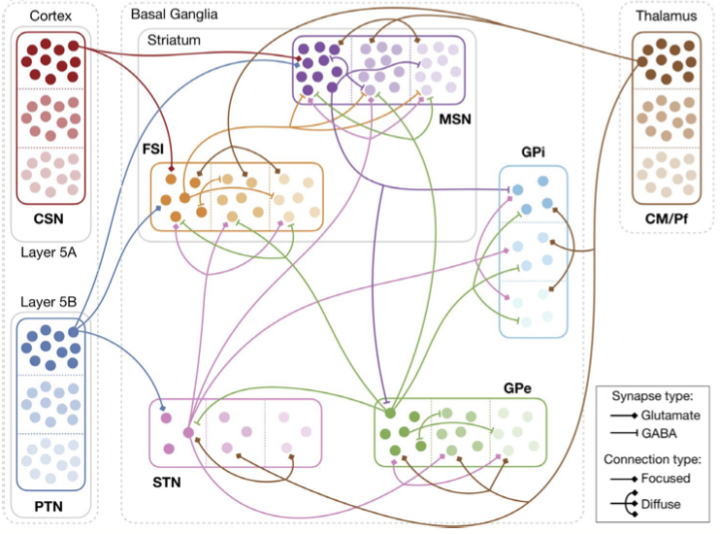
In the projects for utilizing and planning Japan’s flagship supercomputer “Fugaku,” we developed neurobiological data constrained spiking neuron models of the basal ganglia. We converted the mean-field (firing rate) model of the basal ganglia optimized to reproduce multiple experimental conditions (Lienard & Girard 2014) into a spiking neural network model (Girard et al., 2021). The model reproduced not only the average firing rates and oscillatory rhythms, but also realized action selection by competition and populations encoding different actions.
Girard B, Lienard J, Gutierrez CE, Delord B, Doya K (2021). A biologically constrained spiking neural network model of the primate basal ganglia with overlapping pathways exhibits action selection. Eur J Neurosci, 53, 2254-2277. https://doi.org/10.1111/ejn.14869
We participated in Japan’s national neuroscience project, Brain/MINDS (https://brainminds.jp/en/) for large-scale data analysis. We analyzed wide-field calcium imaging data from the premotor to parietal cortex of marmoset monkeys acquired in Matsuzaki lab in University of Tokyo (Ebina et al., 2024). In order to characterize the calcium responses of wide cortical fields, we applied non-negative matrix factorization (NMF) to the fluorescence signal and detected tens of components from the premotor cortex (PM), primary motor cortex (M1), primary somatosensory cortex (S1), and the parietal cortex (PPC). Then to analyze dynamic interactions across these neural populations, we applied the embedding entropy (EE) method (Shi et al., 2022) and found that the causal interactions across populations strengthened through lever push/pull task training (Yamane et al., in preparation).
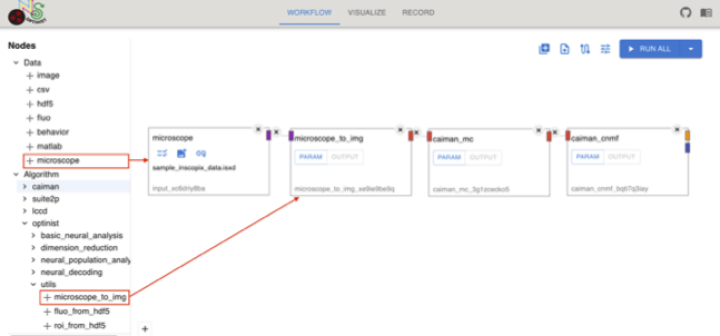
As calcium imaging becomes popular, there is increased demands for applying advanced data analysis methods, comparing their results, and building data analysis pipeline in efficient and reproducible way. We developed a software tool Optical Neuroimage Studio (OptiNiSt) that allow intuitive design of data analysis pipeline through graphic user interface and producing data processing script to be deployed in computing clusters (Yamane et al., 2025).
OptiNiSt is pre-loaded with popular data analysis tools like CaImAn, Suite2p, and LCCD, and extensible by registering user-defined analysis modules in Python. The source code is available from GitHub and users can simply install by `pip` command or downloading a Docker image (see https://optinist.readthedocs.io).
In building complex models, keeping track of how different parameters were chosen, from experimental data, literature, previous models, or tuning by simulation, is an important issue. We developed a spiking neural network modeling tool SNNbuilder, which is based on an entity-relation database to represent a complex models (Gutierrez et al., 2022). User can register and select data through graphical user interface and generate spiking neural network simulation codes in NEST language. This will be a basis for future development of data-driven model building and simulation systems.