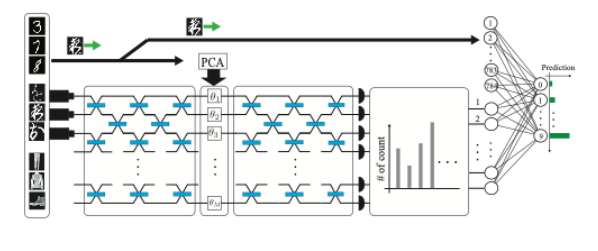



Inside the quantum image recognition engine

In their simulated system, image data is first simplified using a process called principal component analysis (PCA), which reduces the amount of information while preserving key features. A complex photonic state is generated, onto which this data is encoded, before being processed in the quantum reservoir —where interference between photons produces rich, complex patterns used for image recognition.
This system requires training only at the final stage—a simple linear classifier—making the overall approach both efficient and effective for accurate image recognition.
Date:
28 May 2025
Credit:
Sakurai et al., 2025
Copyright OIST (Okinawa Institute of Science and Technology Graduate University, 沖縄科学技術大学院大学). Creative Commons Attribution 4.0 International License (CC BY 4.0).
Share on: