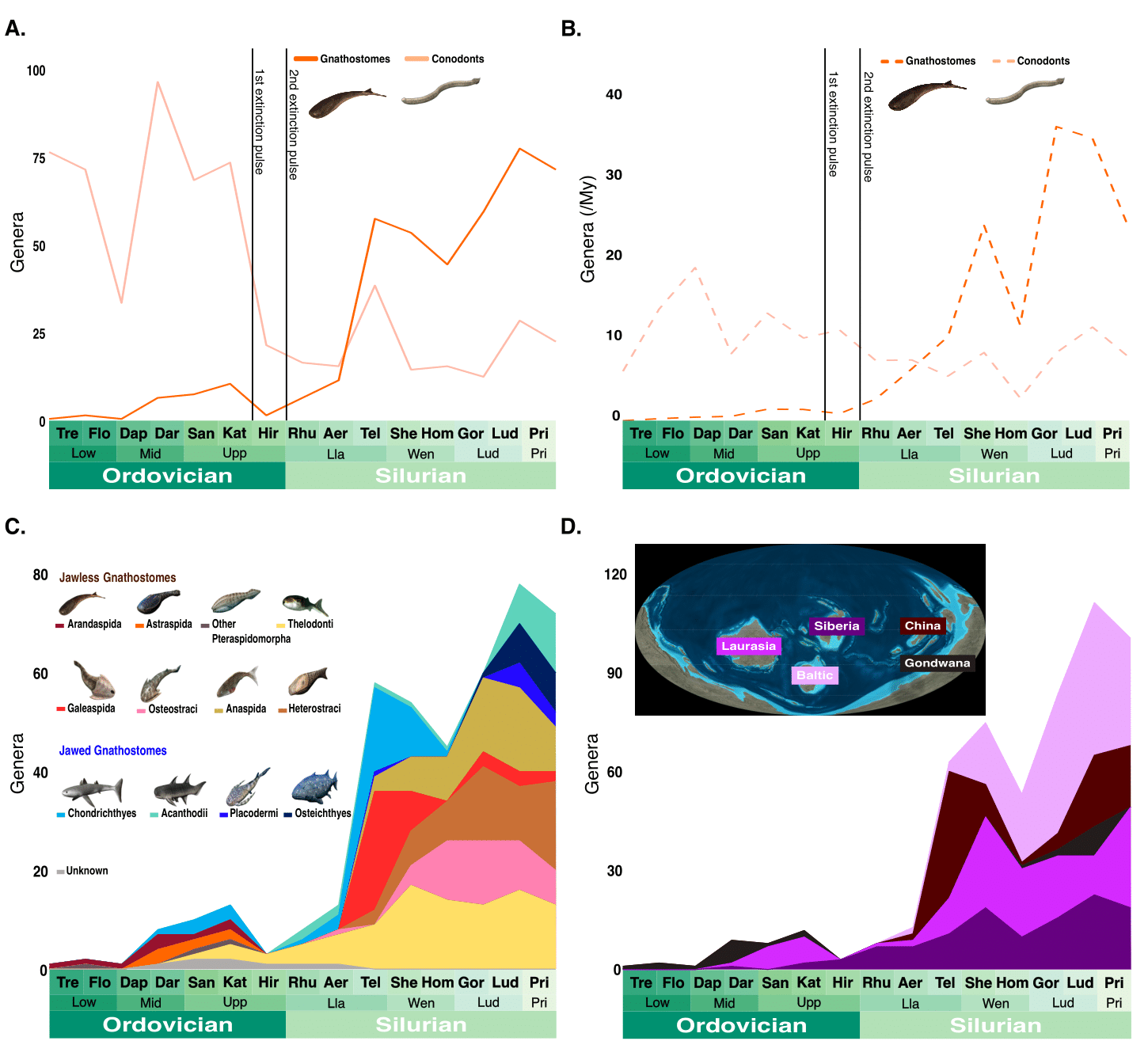



Genus-level diversity curves for gnathostomes from the Ordovician to the Silurian periods

The fall in jawless vertebrates coincides with the rise of jawed vertebrates following the two pulses of the Late Ordovician Mass Extinction (LOME). Top genus-level diversity curves follow global, taxonomic richness in genera – i.e. the number of identified genera - per geological stage (A.) and per million years in each stage (B.). Notice the sharp change during the final stage of the Ordovician period, the Hirnantian (Hir).
C. shows genus-level richness per stage for 13 different gnathostomes groups. Note that while gnathostomes denote jawed vertebrates today, many jawless forms lived in the Ordovician and Silurian periods, as these split off from our ancestors before the origin of jaws. D. shows diversity curves across 5 major regions at the time, highlighting the impact of isolation to specific refugia.
Copyright OIST (Okinawa Institute of Science and Technology Graduate University, 沖縄科学技術大学院大学). Creative Commons Attribution 4.0 International License (CC BY 4.0).