



The Okinawa Institute of Science and Technology (OIST) will hold its eighth graduation ceremony on February 27, 2026.
OIST Graduation Ceremony 2026
Program
FRIDAY, FEBRUARY 27, 2026, 2:00 p.m.
OIST AUDITORIUM
| 13:30 | Doors open |
|---|---|
| 14:00 |
Musical Introduction and Academic Procession |
| 14:45 | Intermission |
| 14:55 |
Conferment of PhD Degrees, |
| 16:00 | Reception |
President Message

Karin Markides
Congratulations, graduates. You have reached the pinnacle of academic achievement during an era defined by global uncertainty. In such times, the pursuit of scientific truth and bold innovation are not merely academic exercises. They are the essential tools we must use to build a resilient future. Your research and personal skills prove that human ingenuity can provide clarity amidst complexity.
As you transition from students to colleagues, I urge you to carry the spirit of Ichariba Choodee, the Okinawan belief that once we meet, we are family. No matter where your research takes you, never forget that this university will always be your academic and inspirational home. May the unique ties you have formed here in Okinawa remain a lifelong source of inspiration and a reminder of the community that supported your growth. We look forward to the lasting impact you will make on the world.
Congratulations, Doctors. The OIST community is immensely proud of you.
Commencement Speaker
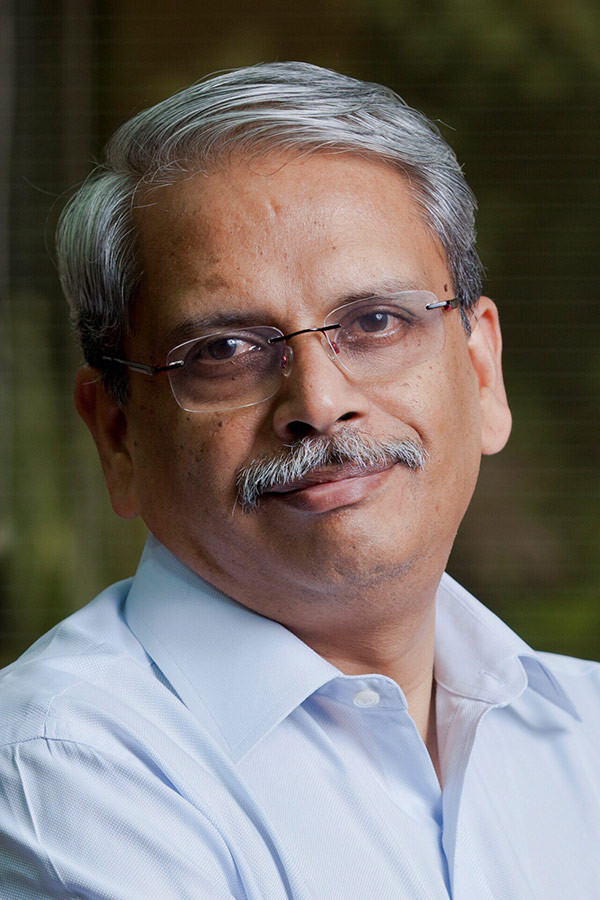
Senapathy “Kris” Gopalakrishnan
Recognized globally as a business and technology thought leader, Mr. Senapathy “Kris” Gopalakrishnan served as Vice Chairman of Infosys, a leading multinational technology company, from 2011 to 2014, and as Chief Executive Officer and Managing Director from 2007 to 2011. He is currently Chairman of Axilor Ventures, an accelerator supporting early-stage start-ups.
Mr. Gopalakrishnan chairs The Council at the Indian Institute of Science Bangalore and the Board of Governors at the International Institute of Information Technology Bangalore. He also leads several key initiatives, including the Vision Group on Information Technology for the Government of Karnataka, the Reserve Bank of India Innovation Hub, and the Confederation of Indian Industry Centre of Excellence in Innovation, Entrepreneurship, and Start-ups.
His leadership has earned numerous accolades: he was named Top CEO (IT Services) in Institutional Investor’s inaugural ranking of Asia’s Top Executives and honored with the Asian Corporate Director Recognition Award by Corporate Governance Asia in 2011. He served as President of the Confederation of Indian Industry in 2013–14 and was a Co-Chair at the World Economic Forum in Davos in 2014. In 2011, the Government of India awarded him the Padma Bhushan, the nation’s third-highest civilian honor.
Mr. Gopalakrishnan is deeply committed to advancing research in brain sciences and aging-related disorders, while actively investing in start-ups and the broader entrepreneurial ecosystem. He holds master’s degrees in physics and computer science from the Indian Institute of Technology, Madras, and is a Fellow of the Indian National Academy of Engineers and an Honorary Fellow of the Institution of Electronics and Telecommunication Engineers. A longtime supporter of OIST, he served on the OIST Board of Governors from 2017–2025.
Graduating Student Speaker

Yuki Tara
Yuki, originally from Okinawa, earned his Bachelor’s degree in Pharmaceutical Sciences and obtained a pharmacist license at the University of Shizuoka. During his undergraduate training, he developed a strong interest in fundamental life science research, and his participation in the OIST Science Challenge 2018 motivated him to pursue a PhD at OIST.
In his doctoral studies, Yuki investigated the pathophysiology of diabetes, focusing on mRNA turnover in pancreatic β-cells to advance understanding of disease mechanisms and explore potential therapeutic targets. His research was carried out under the supervision of Prof. Vincent Laudet and Prof. Tadashi Yamamoto.
His achievements include receiving the JSPS DC2 Research Fellowship, as well as the JSPS Research Fellowship Incentive Allowance for outstanding research performance. In parallel with his research, he has been actively involved in STEM outreach activities, engaging with more than 900 students.
He is currently a JSPS Postdoctoral Research Fellow at OIST and plans to continue contributing to research and education in Okinawa.
Tradition

Academic Dress
“Academic dress” is part of a tradition spanning a thousand years of history, connecting us to the first universities in Europe. Originally the dress was worn daily by students and professors alike; however, its use now is restricted to formal occasions at universities.
OIST’s academic dress was designed entirely by the students, and follows the red, white, and black of the OIST colors. The hood, worn only by OIST PhD graduates, features a local textile called Yuntanza Minsa, woven with the Guushi-Bana method of forming the pattern with a pointed bamboo stick. The design of the hood combines local patterns for good fortune, with stylized sine waves representing the sciences.
The hoods are generously hand-woven from locally hand-dyed cotton from Yuntanza Hanaui, a craft-weavers guild from nearby Yomitan Village, and we thank them for their wonderful contribution.

© OIST/Jeff Prine
Traditional Okinawan Dance
Every year, our graduation ceremony starts with a performance of traditional Okinawan dance (琉球舞踊) and music by OIST community members.
In 2026, we will enjoy "Kajadifu," the most famous of the congratulatory dances, performed on occasions of joy, such as celebrations and inaugurations. Rich in the primary forms and techniques of Ryukyuan dance, such as the use of decorative fans, it is a celebration of the joy of life and one of the most important dances in the canon.
Graduates

Mohamed Mostafa Kamal Eltabbal
Graduation Date: 31 May 2025

James Miloslav Colin Osborne
Graduation Date: 31 May 2025

Akyl Shakir
Graduation Date: 30 June 2025

Alexey Vylegzhanin
Graduation Date: 30 June 2025

Ivan Shpurov
Graduation Date: 30 June 2025

Tatiana Gridneva
Graduation Date: 31 July 2025

Mao-Ting Hsu
Graduation Date: 31 July 2025

Xiaochen Fu
Graduation Date: 31 July 2025

Yuki Tara
Graduation Date: 31 August 2025

Akira Kawano
Graduation Date: 31 August 2025

Tanomi Yamamura
Graduation Date: 31 August 2025

Munissa Sadykova
Graduation Date: 31 August 2025

Yi-Shan Cheng
Graduation Date: 31 August 2025

Ilhem Nadia Rabehi
Graduation Date: 30 September 2025

Jiahao Zhang
Graduation Date: 30 September 2025

Nonno Hasegawa
Graduation Date: 30 September 2025

Dan Kozome
Graduation Date: 30 September 2025

Yoshiki Ochiai
Graduation Date: 30 September 2025

Lazzat Aibekova
Graduation Date: 30 September 2025

Hend Samniya
Graduation Date: 31 October 2025

Soon Teh
Graduation Date: 31 October 2025

Margarita Dronova
Graduation Date: 30 November 2025

Samuel Cyrus Cure
Graduation Date: 30 November 2025

Jan Grasic
Graduation Date: 30 November 2025

Cedric Galetzka
Graduation Date: 30 November 2025

Shagufta Qamar
Graduation Date: 30 November 2025

Graduation Date: 30 November 2025

Tatsuki Hamamoto
Graduation Date: 31 December 2025

Sarika Sasidharan Nair
Graduation Date: 31 December 2025

Oscar Eduardo Juez Neira
Graduation Date: 31 December 2025

Lorena Andreoli
Graduation Date: 31 January 2026

Yung-Chieh Liu
Graduation Date: 31 January 2026

Natalya Weber
Graduation Date: 31 January 2026

Graduation Date: 31 January 2026

Shannon Reiko Duke Hayashi
Graduation Date: 31 January 2026

Ayse Haruka Oshima Acikbas
Graduation Date: 31 January 2026

Josefine Reuschenbach
Graduation Date: 31 January 2026