



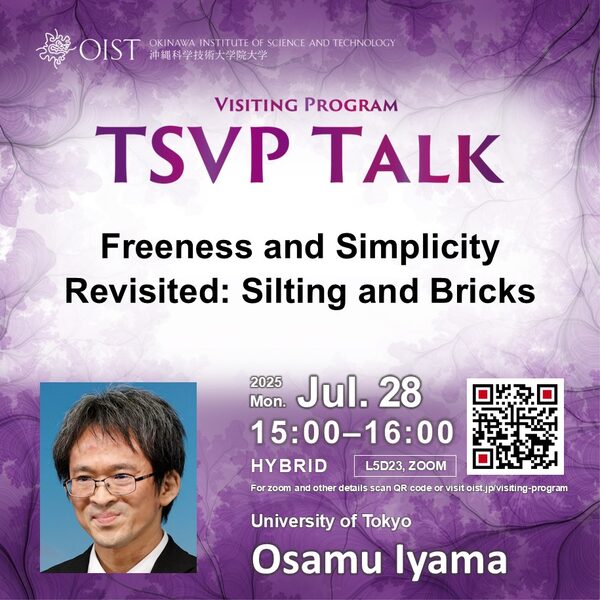
TSVP Talk: "Freeness and Simplicity Revisited: Silting and Bricks" by Osamu Iyama
Description
Speaker: Prof. Osamu Iyama (The University of Tokyo, Japan)
Title: Freeness and Simplicity revisited: Silting and Bricks
Abstract: A central subject in the representation theory of rings is to understand modules over a given ring. Among them, two classes of modules over a ring A are particularly fundamental. One is the class of free modules (i.e., direct sums of A), and the other is the class of simple modules (i.e., modules without proper submodules). When A is a field, all modules are both free and semisimple (i.e., direct sums of simple modules). However, for general rings, these two types of modules are rather exceptional and have been extensively generalized.
In this talk, I will introduce silting complexes and bricks, which can be viewed as broad generalizations of free modules and simple modules, respectively. A brick is a module whose endomorphisms are either isomorphisms or zero. A semibrick is a set of bricks with no nonzero homomorphisms between distinct elements. For instance, the set of simple modules forms a semibrick by Schur’s Lemma. From a categorical perspective, semibricks are exactly the sets of simple objects in abelian full subcategories, as observed by Ringel.
On the other hand, the class of free modules is generalized to that of tilting complexes in the derived categories (i.e., the categories of chain complexes) via Rickard's Morita theory. Further generalization leads to the class of silting complexes, motivated by mutation — a categorical operation to construct new silting complexes from existing ones. Among these, 2-term silting complexes enjoy particularly nice properties; for example, they play a central role in the categorification of cluster algebras.
I will present some recent developments in the study of semibricks and 2-term silting complexes, focusing on their interplay with the complete lattice of torsion classes and with non-singular fan in the real Grothendieck group.
Profile: Osamu Iyama is a Professor at the Graduate School of Mathematical Sciences, The University of Tokyo, Japan. His research investigates central notions in algebra—including rings, categories, quivers, and representations—with wide-ranging applications to geometry, combinatorics, and related areas. He has developed several foundational concepts and theories in these areas, such as cluster tilting, τ-tilting, silting, mutation, higher Auslander algebras, and Geigle-Lenzing complete intersections, which have become essential frameworks in mathematics and have inspired extensive subsequent research by many other researchers.
Iyama was an invited speaker at the International Congress of Mathematicians (ICM) in 2018 and has received several prestigious awards, including the Frontiers of Science Award, the Inoue Prize for Science, the JSPS Prize, the Spring Prize, and the inaugural ICRA Award.
He received his Ph.D. in mathematics from Kyoto University in 1998, and served as a Professor at Nagoya University until 2020. Over the course of his career, he has supervised sixteen Ph.D. students to completion and mentored around twenty postdoctoral researchers, many of whom have gone on to pursue successful academic careers. He has organized numerous international conferences and serves on the editorial boards of five international mathematics journals.
Time: 15:00-16:00, July 28, 2025
Location: OIST, Lab 5, Floor D, Room L5D23
Zoom Link:
Join Zoom
Meeting ID: 947 8296 0593
Passcode: 584111
This talk is part of the Thematic Program TDA PARTI: Topological Data Analysis, Persistence And Representation Theory Intertwined.
※ Please note that this event may be recorded and the videos uploaded. In addition, photos may be taken during the event. These are intended for publication online (the OIST website, social media, etc.)※
Add Event to My Calendar
Subscribe to the OIST Calendar
See OIST events in your calendar app