


Poster Session Theme
Others (related to the theme of symposium)
Others (related to the theme of symposium)
Evolutionary Neurobiology Unit
Watanabe Unit
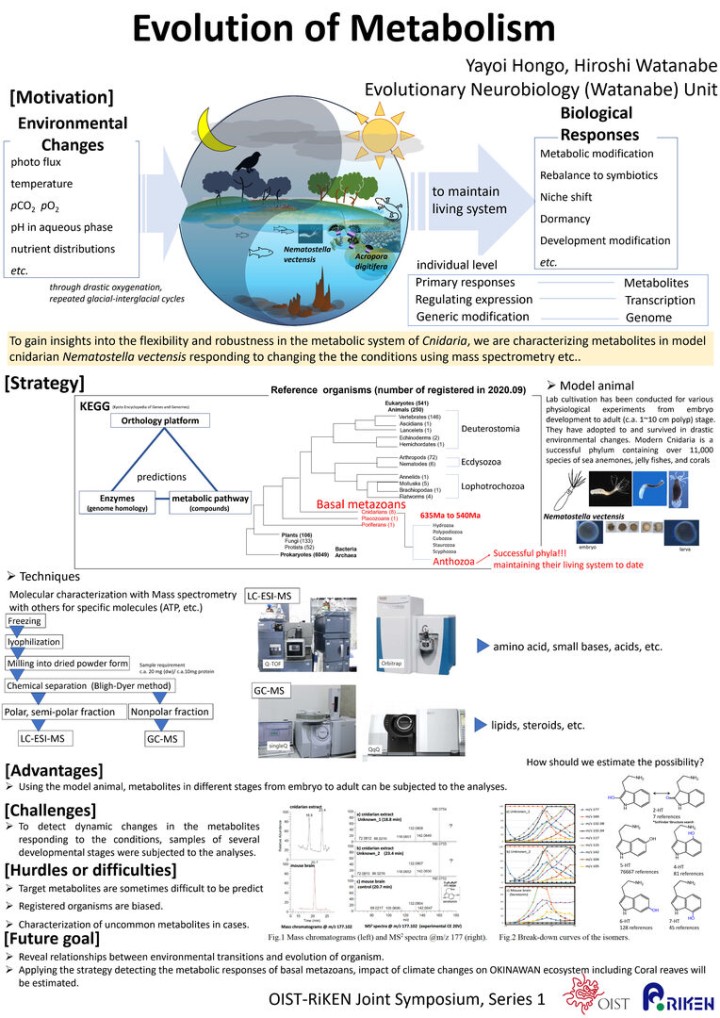
To maintain the living system, metabolisms play primary roles on homeostasis, responding to changes in environmental parameters such as temperature, photo flux, availability of chemical substrates. In animal evolution, it is thought that the ancestral lineages of early metazoans like Cnidaria emerged during 635Ma to 540Ma. They have adopted to and survived in drastic environmental changes including oxygenation and repeated glacial-interglacial cycles in geological time. Modern Cnidaria is a successful phylum containing over 11,000 species of sea anemones, jelly fishes, and corals. In order to gain insights into the flexibility and robustness in the metabolic system of Cnidaria, we are characterizing metabolites of model cnidarian Nematostella vectensis responding to changing the the conditions using mass spectrometry. The procedure involves de-novo identification of unexpected signals. I will present the analytical strategies going back to the basics in analytical chemistry.
RIKEN Nishina Center for Accelerator-Based Science
Ion beam breading team
In larviculture facilities, rotifers are generally used as an initial food source, while proper size of live feeds to connect rotifer and Artemia are needed associated with fish larval growth. The improper management of feed size and density induces mass mortality and abnormal development of fish larvae. To improve the survival and growth of target larvae, this study applied carbon and argon heavy-ion-beam irradiation in mutation breeding to select rotifer mutants with larger lorica sizes.
The optimal irradiation conditions of heavy-ion beam were determined with lethality, reproductivity, mutant frequency, and morphometric characteristics. Among 56 large mutants, TYC78, TYC176, and TYA41 showed active population growth also. In conclusion, (1) heavy-ion-beam irradiation was defined as an efficient tool for mutagenesis of rotifers and (2) the aforementioned three lines which have larger lorica length and active population growth may be used as a countermeasure of live feed size gap during fish larviculcure.

RIKEN Cluster for Pioneering Research,RIKEN Center for Advanced Photonics
Quantum Optodevice Laboratory,Terahertz Quantum Device Research Team
Light-emitting diodes (LEDs) are solid light sources with small size, high durability, and high efficiency. The use of energy efficient LED technology could save a large amount of energy consumption and CO2 in the world. LEDs which emit UV light have wide applications in curing, water/air purification, and a bio-medical field. Here, we would like to introduce AlGaN UV LEDs that we have developed and to discuss possible applications.

RIKEN Center for Computational Science, RIKEN Cluster for Pioneering Research
Data Assimilation Research Team, Prediction Science Laboratory
Recent satellites such as Himawari-8 have observed sea surface temperatures, salinity, and height at high spatiotemporal resolution. However, the data is not available in the cloudy regions because clouds block infrared radiations. Data assimilation plays a role in combining models and observations with statistical methods and dynamical systems theory and can provide complete state estimates without missing values. Although frequent data assimilation is required for the effective use of high-frequency observations, the typical frequency of ocean data assimilation systems is only a week. Frequent data assimilation may cause initial shocks with high-frequency gravity waves. Therefore, this study explores an optimal setting for frequent data assimilation and demonstrates that the relaxation-to-prior method (Zhang et al. 2004; Whitaker and Hamill 2012) and the incremental analysis update method (Bloom et al. 1996) are effective for frequent data assimilation.
Shun Ohishi1, Tsutomu Hihara2, Hidenori Aiki3, Joji Ishizaka3, Yasumasa Miyazawa4, Misako Kachi5, and Takemasa Miyoshi1
1: R-CCS/Data Assimilation Research Team, 2: JAFIC, 3: Nagoya University/ISEE, 4: JAMSTEC/APL, 5: JAXA/EORC
RIKEN Nishina Center for Accelerator-Based Science
Ion beam breading team
Accelerated heavy-ions have been widely used for mutation breeding and molecular biology. We have studied the types of mutations induced by heavy-ion irradiation in rice. We showed that LET affects mutation rates. The highest mutation rate was obtained in C-ion irradiation at 30 keV/µm. We also indicated that Ar-ion (LET: 290 keV/µm) irradiation tended to disrupt genes by large deletions. We have been inducing and isolating novel mutants and their responsible genes. For example, we isolated the long grain 1 (lin1) mutant, which exhibited long grains and increased grain weight. Whole-genome sequencing and genetic linkage analysis indicated that a 1 bp deletion within the coding sequence of Os06g0675200, which showed no homology to previously characterized genes, is responsible for the long-grain phenotype. Our findings indicate that the lin1 mutation may be useful to further improve grain length and presumably grain yield in rice cultivars that harbor the Nipponbare-type LIN1 allele.
Ryouhei Morita, Hiroyuki Ichida, Yoriko Hayashi, Yuki Shirakawa, Katsunori Ichinose, Tomoko Abe
Ion Beam Breeding Team, Nishina Center for Accelerator-Based Science, RIKEN
RIKEN Nishina Center for Accelerator-Based Science
Astro-Glaciology Research Group
Our Group promotes both experimental and theoretical studies to open up a new interdisciplinary research field called astro-glaciology, which combines astrophysics, analytical chemistry, glaciology, and climate science. In this poster, we will present and discuss three topics ongoing, using ice cores drilled at “Dome Fuji station” in Antarctica: (1) Volcanic eruptions as time-markers: A key plan to identify micro-tephra from a huge historic eruption of Asama-yama (VEI=5, Nagano, Japan, 1108AD) in our Antarctic ice core. (2) Relationships between climate change and solar activity (and oceanic oscillations) in order to contribute to a better prediction of climate change in the future. (3) Traces of past supernovae in our galaxy and solar cycles: The former will be a counterpart of the Super-Kamiokande at Univ. of Tokyo, and the latter itself is crucial in Astro-science, but also serves as a new yardstick to estimate timescales on the ice core. We are open for collaboration and can provide with our precise and detailed data of 10 anions and 5 cations for environmental studies, and water-isotopic ratios (18O, D, 17O) as proxies of air temperature, sea surface temperature, and humidity, basically for the past 2,000 years. We will also mention a newly developed automated ice-core sampler that employs laser melting for the first time. This new sampler enables the analysis of 2,000-year record embodied in the Dome Fuji ice core, which took us several years, in about 30 working days.
RIKEN Cluster for Pioneering Research
Microfluidics RIKEN Hakubi Research Team
Mechanical properties of cell membrane are important factors that reflect physicochemical states in various biological contexts including stemness, cancer, and aging. Dysregulation of mechanical properties along aging increases the risk of arteriosclerosis, heart failure, and other various diseases. However, the detailed molecular cascade of such mechanical properties has not completely appreciated yet, because the phenomenon involves the complex and multiphased physiological processes. In this project, we develop a novel method by the combination of 3D modeling technology and nanoelectroporation method, named NanoELP-seq (Nano Electrophoresis Leveraged Phenotyping and RNA-sequencing). NanoELP-seq can comprehensively analyze both omics information and cellular mechanical phenotype, dubbed “membrane-state phenotype”, in single-cell. Moreover, to elucidate the molecular mechanism against aging, we will analyze immortal fish cells which have more deformable cell membrane than mammalian cells and do not show signs of replicative senescence. This project will contribute to the treatment of age-related diseases.
RIKEN Cluster for Pioneering Research
Microfluidics RIKEN Hakubi Research Team
We have developed an on-chip approach that electrophoretically fractionates cytoplasmic components versus nuclei of single cells. The approach uniquely enables stringent and length-bias-free fractionation of cytoplasmic versus nuclear RNA exploiting the homogeneous electrophoretic property of RNA molecules1. We demonstrated the integration of our approach with high-throughput RNA-sequencing2 and the nanopore-based RNA-sequencing to dissect the hidden diversity of the transcript usage across the nuclear compartment. Our approach has uncovered the landscape of the transcriptional noise that is regulated across the nuclear membrane in eukaryotic cells to amplify or attenuate the noise for the specific biological functions. 1. Abdelmoez et al. Anal Chem 2020, 92(1), 1485. 2. Abdelmoez et al. Genome Biol 2018, 19(1),66.