


Poster Session Theme: Marine Genomics
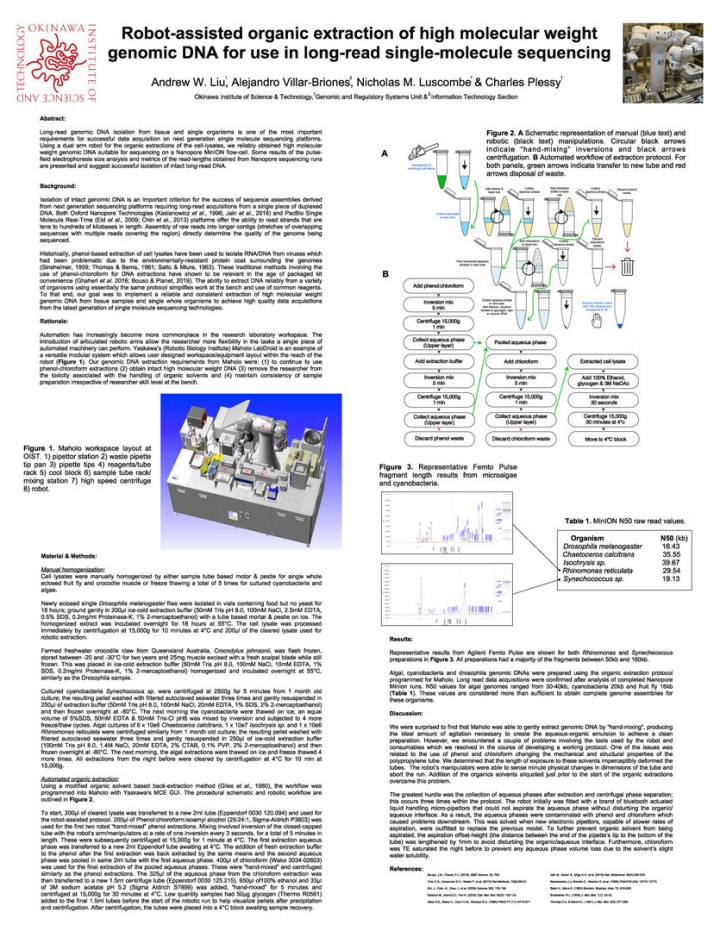
Robot-assisted organic extraction of high molecular weight genomic DNA for use in long-read sequencing.
Andrew W. Liu, OIST
Genomics & Regulatory Systems Unit
Luscombe Unit
We have developed a reliable genomic DNA isolation protocol using Yaskawa’s (RBI) LabDroid platform to perform phenol/chloroform extraction and ethanol precipitation for long-read sequencing. Although not entirely automated, the protocol requires a small amount of work on the part of the researcher: mechanical homogenization by hand and a cell debris centrifugation to create a cell lysate in user extraction buffer of choice. The user cleared lysate can be frozen at -80°C or immediately handled by the robot for the organic extraction. The final product is ethanol precipitated DNA which is suitable for long term storage at -80°C. Further processing by hand includes a 70% ethanol wash & resuspension in TE before integrity analysis, adaptor ligation and sequencing. Successful extractions for long-read sequencing (Nanopore) have been performed with single fruit flies, individual larvaceans, cyanobacteria and algal culture. Evidence of fragment sizes and long-read sequencing metrics from some of our extractions are presented.
A.W. Liu, A.Villar-Briones, C. Plessy & N.M. Luscombe
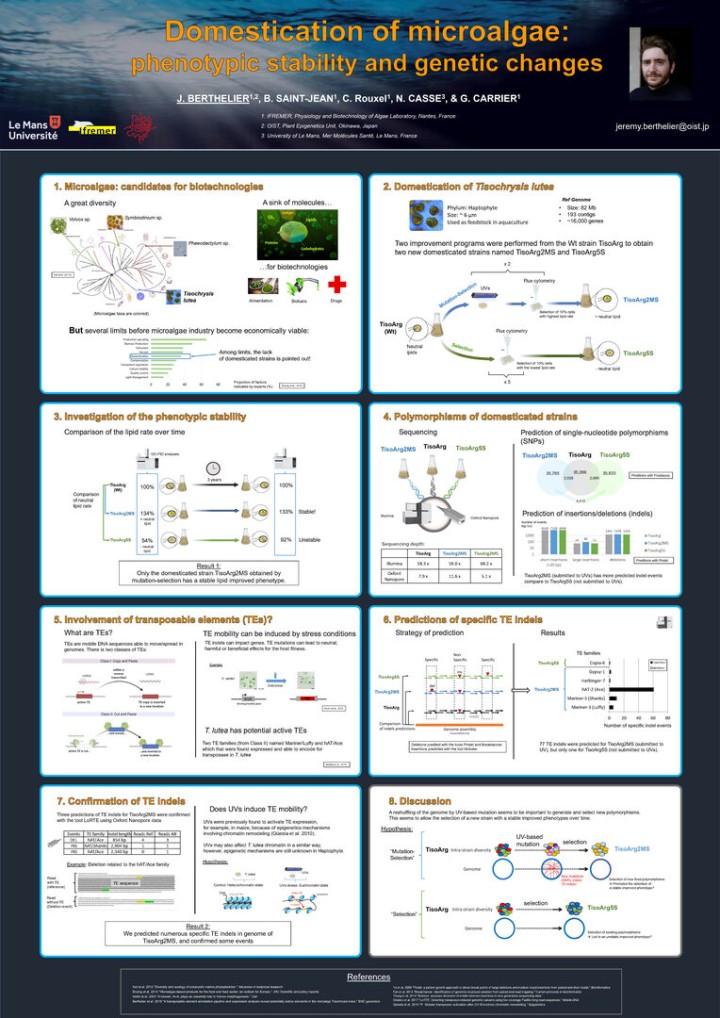
Domestication of microalgae: phenotype stability and genetic changes
Jeremy Berthelier, OIST
Plant Epigenetics Unit
Saze Unit
Microalgae are increasingly studied for biotechnological applications such as alimentation or biofuel to face the depletion of natural resources. Nevertheless, several factors must be unlocked before microalgae industry become economically viable, and one of them is the lack of domesticated strains. Microalgae domestication is performed using improvement programs such as genetic engineering, selection or mutation-selection. However, the phenotypic stability over time of domesticated strains and their genetic changes have been little investigated. We examined those two points with the microalgae Tisochrysis lutea. Two improvement programs were applied from a Wt strain to obtain two new domesticated strains featuring improved lipid traits. Their lipid content was measured after the improvement programs and three years later to evaluate the phenotypic stability of domesticated strains. To investigate genetic changes, genome of Wt and domesticated strains were sequenced with Illumina and Oxford Nanopore technologies, and we searched for insertions/deletions of transposable elements specific to domesticated strains.
Jeremy Berthelier1,2, Bruno Saint-Jean2, Nathalie Casse3, Catherine Rouxel2, Gregory Carrier2
1: Plant Epigenetics Unit, Okinawa Institute of Science and Technology Graduate University, Japan; 2: PBA laboratory, Ifremer, France; 3: MMS laboratory, Le Mans University, France
Application of heavy-ion-beam irradiation to breeding large rotife
Kazuhide Tsuneizumi, RIKEN
RIKEN Nishina Center for Accelerator-Based Science
Ion beam breading team
In larviculture facilities, rotifers are generally used as an initial food source, while proper size of live feeds to connect rotifer and Artemia are needed associated with fish larval growth. The improper management of feed size and density induces mass mortality and abnormal development of fish larvae. To improve the survival and growth of target larvae, this study applied carbon and argon heavy-ion-beam irradiation in mutation breeding to select rotifer mutants with larger lorica sizes.
The optimal irradiation conditions of heavy-ion beam were determined with lethality, reproductivity, mutant frequency, and morphometric characteristics. Among 56 large mutants, TYC78, TYC176, and TYA41 showed active population growth also. In conclusion, (1) heavy-ion-beam irradiation was defined as an efficient tool for mutagenesis of rotifers and (2) the aforementioned three lines which have larger lorica length and active population growth may be used as a countermeasure of live feed size gap during fish larviculcure.

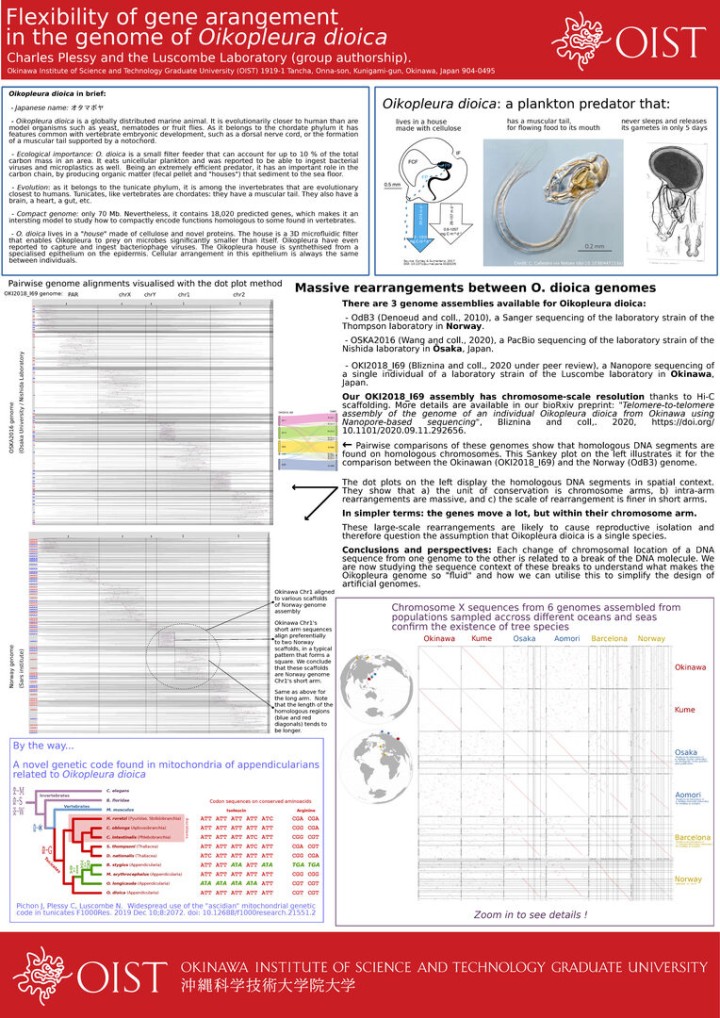
Flexibility of gene arrangement in the genome of Oikopleura dioica.
Charles Plessy, OIST
Genomics and Regulatory Systems Unit
Luscombe Unit
Changes of synteny, the arrangement of genes on chromosomes, can impair genomic mechanisms relying on proximity and also reduce reproductive fitness, as meiosis relies on cross-overs between homologous regions. The animal plankton Oikopleura dioica is one of the fastest-evolving marine organisms, due to its fast life cycle and the loss of DNA repair enzymes. its genome is one of the smallest in the animal reign (65 Mbp). We analysed single individual sequences from North Atlantic, Mediterranean sea and North Pacific, and observed an unexpected extent of rearrangements of synteny given expectations from taxonomy and phylogeny, suggesting that the regulatory circuits in Oikopleura are less dependent on long-range interactions compared with other chordate animals. We propose that the Oikopleura genome can be used as a model for better decipher the principles constraining gene order, with the perspective of applying these rules to the synthesis of artificial genomes.
Identification of a novel chimeric photoreceptor from marine metagenome data
Yuko Makita, RIKEN
Center for Sustainable Resource Science
Synthetic Genomics Research Group
Blue light penetrate deeper into the ocean and blue light sensing is a key to know their environment for organisms. We focused on a blue light photoreceptor of cryptochrome (cry), which is widely distributed in bacteria, fungi, animals and plants, and searched novel cry genes in marine metagenome data. Interestingly, we found a novel chimeric photoreceptor of red-light sensing phytochrome (phy) and cry. To estimate the host organism, we used the Marine Microbial Eukaryote Transcriptome Sequencing Project (MMETSP) dataset and luckily found 100% identity fragment with a marine picoplankton, Pycnococcus provasolii. The photosensing activity was confirmed with UV and visible absorption spectra of phy and cry parts of the chimeric protein. This fused photoreceptor detects light within the orange/far-red and blue spectra and act as a dual photoreceptor and it named as dualchrome (duc). Based on its genome sequence, we predicted five crys, one duc but there is no phy. Transcriptome analysis under monochromatic light condition was also performed.
Yuko Makita1, Shigekatu Suzuki2, Keiji Fushimi3, Setsuko Shimada1, Tomoko Kuriyama1, Yukio Kurihara1, Hidefumi Hamasaki1, Rei Narikawa3, Haruyo Yamaguchi2, Masanobu Kawachi2, Minami Matsui1.
1Synthetic Genomics Research Group, RIKEN Center for Sustainable Resource Science. 2Center for Environmental Biology and Ecosystem Studies, National Institute for Environmental Studies. 3Graduate School of Integrated Science and Technology, Shizuoka University